
Windproof Travel Umbrellas: 2026 Ultimate Buyer’s Guide to Compact, Auto‑Open, and Carry‑On‑Ready Picks
Windproof Travel Umbrellas: 2026 Ultimate Buyer’s Guide to Compact, Auto‑Open, and Carry‑On‑Ready Picks
A sudden gust that flips an umbrella inside out can cost commuters a missed train and a soaked laptop. Windproof travel umbrellas are compact, reinforced umbrellas that resist strong gusts while folding small enough for carry-on luggage. Better Canes Umbrellas (Better Canes & Umbrellas Inc.), founded in 2000 and based in Chatham, NJ, offers commuter-ready and fashion-forward umbrellas alongside walking sticks (hiking and novelty) and collectible shoe horns. Our beginner's guide compares compact, auto-open, and carry-on-ready options so commuters and travelers can pick the right balance of size, wind resistance, and ease of use. If the choices feel overwhelming, we start from zero and explain testing criteria, packing tips, and purchase trade-offs. Which compact model proved most reliable in real-world gusts?
What is a windproof travel umbrella and how does it differ from a regular travel umbrella?
A windproof travel umbrella is a compact umbrella built with reinforced frames and vented canopies that resist inversion and survive stronger gusts. Our website recommends these for commuters who need reliable coverage without carrying a full-length golf umbrella. Key components are the ribs, shaft, and canopy fabric; a rib is a frame member that supports the canopy, a shaft is the central pole that bears the load, and canopy fabric is the outer material that sheds water and resists tearing.
What materials and frame designs resist wind best? 🌬️
Reinforced fiberglass ribs with flexible hub joints resist permanent bending while allowing controlled flex during gusts. Fiberglass bends under pressure and springs back instead of snapping, which reduces one-off failures during a busy commute. The table below compares common rib materials by weight, fatigue resistance, and repairability.
| Material | Strengths | Weaknesses |
|---|---|---|
| Fiberglass | Light, flexible, bends and returns to shape under gusts | Can splinter under extreme impact; harder to splice for DIY repair |
| Steel | Very strong under steady loads; inexpensive | Heavier, corrodes without coating, can bend permanently under high torque |
| Aluminum | Lighter than steel, resists corrosion | Stiffer than fiberglass; may deform permanently after a hard bend |
Canopy fabric choices matter: coated polyester is durable, sheds water quickly, and holds color well; nylon packs slightly smaller but can show water spots. Water-shedding treatments (a durable water repellent finish) reduce drying time and stop seams from wicking. Better Canes Umbrellas lists models with reinforced hubs and coated-polyester canopies aimed at commuters who want a mix of durability and style.
How does canopy venting prevent inversion? 🌬️
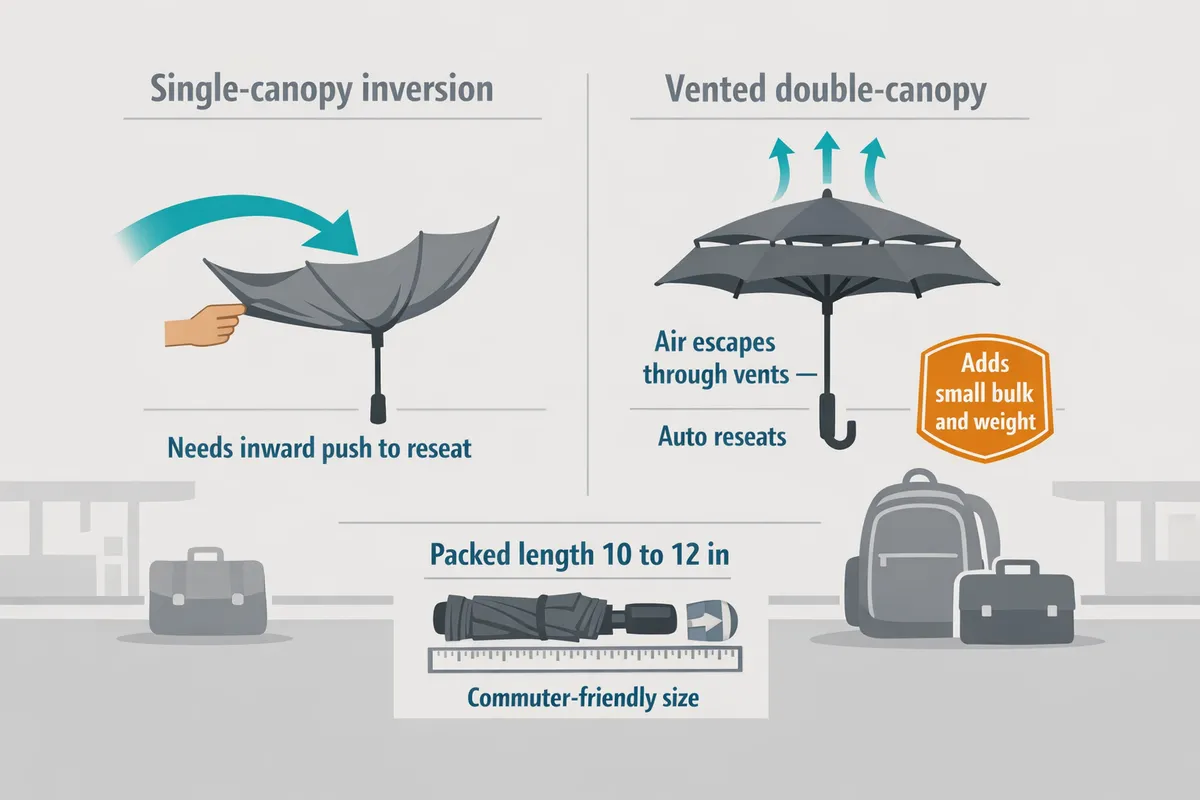
A vented double-canopy is a canopy design that redirects gusts through a top layer so pressure equalizes instead of flipping the umbrella. The vent creates a controlled pathway for wind to pass, which lets the canopy flex and reseat rather than staying inverted. Single-canopy umbrellas trap wind beneath the fabric, so a strong gust often forces the canopy inside out and keeps it there until manually pushed back.
Visual behavior difference: a vented umbrella will often pop back into normal shape after the gust passes; a single canopy usually needs an inward push at the outer edge to re-seat. Vented designs add a small amount of bulk and weight but reduce the time you spend wrestling with an inverted umbrella between trains.
How compact should a travel umbrella be for daily commuting? 🧳
For daily commuting, a packed length of 10 to 12 inches balances pocketable size with a canopy large enough to cover a backpack or briefcase. A canopy diameter in the 38 to 44 inch range typically covers a briefcase plus a commuter without forcing them to hunch. Packing examples: a 10.5-inch umbrella fits upright inside most backpacks and larger tote bags; a 12-inch model stows neatly in a briefcase's outer pocket but takes slightly more space.
If you want an umbrella to sit in an overhead bin or under a seat during flights, a packed length under 22 inches fits easily into most carry-on bags and personal items. Our Better Canes Umbrellas commuter lineup highlights compact travel umbrella for daily commuting options and several stylish umbrellas for commuters that prioritize a low packed length and ample canopy coverage.
What common failure modes affect windproof umbrellas? ⚠️
Broken ribs, jammed opening mechanisms, and seam leakage at rib joints are the most common failure modes for windproof umbrellas. Broken ribs usually happen when a hard sideways shock bends a weaker material past its elastic limit; temporary fixes include splinting the rib with a strip of tape or a small zip tie until you can replace the frame. Jammed openers often clear by applying a little soapy water to the slider and gently working it; repeated force risks tearing the release collar.
Seam leakage where water pools at rib joints indicates worn seam tape or stitching; a temporary field fix is clear packing tape over the leaking spot, but professional resealing gives a longer-term result. Warranty considerations: if a structural rib or hub fails within the seller's warranty period, choose repair or replacement through warranty channels; if multiple ribs fail or the shaft buckles, replacement is usually more cost-effective than repair.
💡 Tip: After heavy rain or wind, open the umbrella fully in a dry space and let it air-dry before folding; this prevents seam and joint deterioration and reduces odor.
How should commuters and travelers prioritize features when choosing a windproof travel umbrella?
Prioritize wind resistance, packed length, weight, and opening mechanism based on how you carry gear and where you travel most. Our website recommends choosing features by matching them to real scenarios such as rush-hour subway rides, short flights, or business travel.
Which features matter most for daily commuters? 🚇
Daily commuters should rank packed length, weight, opening speed, canopy coverage, and handle grip ahead of secondary extras. Packed length is a measurement that reports an umbrella's collapsed length and determines whether it fits inside your bag. Weight is how heavy the umbrella is when carried; aim for under 14 ounces if you shoulder a laptop and commuter bag. Opening speed refers to one-handed deployability; auto-open models let you board trains without juggling bags. Canopy coverage is the diameter when open; choose enough to cover a briefcase or backpack. Handle grip should be slip-resistant for wet platforms.
Use this quick scoring method to compare models before you shop:
- Assign weights to priorities (for example: packed length 30%, weight 25%, opening 20%, wind resistance 15%, grip 10%).
- Rate each umbrella 1 to 5 on those metrics.
- Multiply ratings by weights and sum to get a comparative score.
Our website's commuter picks from Better Canes Umbrellas include models scored for compact travel umbrella for daily commuting to shorten decision time.
💡 Tip: Measure your bag's interior (height and width) before you buy. A packed length that's 1 inch shorter than your bag fits more reliably than a model that matches the bag's exact height.
Auto-open versus manual operation: which fits transit life? 🚌
Choose auto-open if you need one-handed deployment while boarding; choose manual if you need the lightest, simplest option. Auto-open is a mechanism that opens the canopy with a single button press and keeps one hand free for a pass or bag. This fits subway, bus, or taxi use when you frequently juggle items. Manual models cut moving parts and usually shave ounces from the total weight, which helps ultralight packers and short domestic travelers who prioritize carry-on packing. Better Canes Umbrellas lists both auto-open and manual commuter options; pick auto-open when you expect crowded platforms and manual when minimizing weight matters more.
How to find stylish umbrellas for commuters 🕴️
Look for matte finishes, subtle patterns, and durable fabrics that resist water marks to keep office attire neat. Stylish umbrellas for commuters pair low-reflective hardware and neutral colorways so a coat and briefcase remain the visual focus. Specific cues to watch for:
- Matte or satin canopy fabrics that hide spotting.
- Minimal hinge and rib exposure for a cleaner silhouette.
- Slim, ergonomic handles in leatherette or rubber for professional grip.
- Lighter neutral palette options (navy, charcoal, forest green) rather than loud logos.
Our website showcases Better Canes Umbrellas commuter styles that balance understated looks with reinforced frames so you do not sacrifice durability for appearance.
How to interpret wind-performance claims and test methods?
Trust claims that state specific gust speeds or inversion counts and that reference independent testing over generic 'windproof' labels. Wind-performance claims vary widely; look for tests that state a gust speed (for example, 30 to 45 mph ranges) or list how many inversion cycles the canopy survived. Independent lab or third-party field tests carry more credibility than vendor-only photos. Be wary of terms like "wind-resistant" without numbers; they tell you less than a stated pass/fail at a given gust speed. Better Canes Umbrellas highlights models that reference third-party checks in product notes so you can compare apples-to-apples when evaluating windproof travel umbrellas.
What are the practical first steps to compare, test, and buy a windproof travel umbrella?
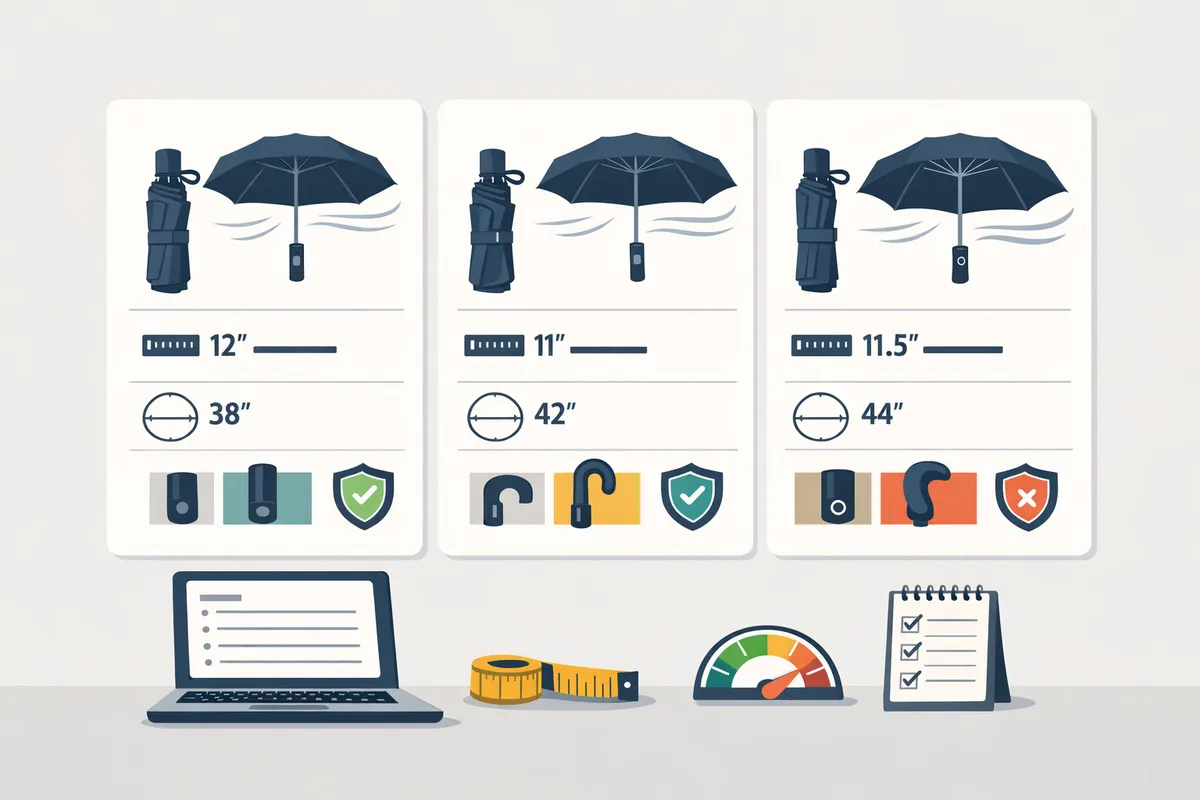
Start by narrowing options with a standardized spec comparison, then verify a shortlist with a simple hands-on wind test and confirm packed dimensions against your luggage and airline limits. This sequence saves time, prevents surprise fit issues at the gate, and reduces the chance of buying a fragile model that fails in real winds.
🔎 Which models perform best: use a standardized comparison table.
Create a shortlist using identical metrics so you compare apples to apples. Wind speed tolerance is the rated gust speed that a canopy resists before inverting. Use those numbers alongside packed length, weight, canopy fabric, vent design, auto open, and warranty to filter models quickly.
| Model | Wind speed tolerance (claimed) | Packed length | Weight | Canopy fabric | Vent design | Auto open | Warranty |
|---|---|---|---|---|---|---|---|
| Better Canes Traveler Compact | Claims up to 45 mph | 11.5 in | 10 oz | 210T pongee | Single vent | Yes | 1 year limited |
| Better Canes Metro Auto | Claims up to 40 mph | 12.5 in | 12 oz | 190T pongee | Dual vent | Yes | 1 year limited |
| Repel WindPro Compact | Claims up to 50 mph | 11 in | 9.8 oz | 210T pongee | Reinforced ribs + vent | Yes | Lifetime limited |
| Blunt Metro Travel | Claims up to 48 mph | 12 in | 13 oz | Microfiber-poly blend | Patented radial vents | No (manual) | 2 years |
| Totes Titan Compact | Claims up to 42 mph | 10.5 in | 11 oz | Polyester | Single vent | Yes | 1 year |
| Senz Original Mini | Claims up to 55 mph | 13 in | 14 oz | Ripstop polyester | Asymmetrical vented canopy | No | 2 years |
Use the table to remove any umbrella that fails your size or weight limit. Our website recommends comparing packed length against the actual bag or suitcase you normally use rather than a general carry-on spec.
🌬️ How to run a simple at-home wind test and what passes.
You can approximate real-world wind performance with a strong fan or a brisk outdoor walk to validate inversion resistance, canopy re-seating, handle comfort, and drainage. Test sequence: 1) Open the umbrella and aim a fan at the canopy from 10–15 feet at maximum setting, 2) mimic crosswinds by angling the canopy, 3) close and shake gently to watch how water drains and whether ribs lock properly.
Pass/fail checklist you can use in-store or at home:
- Pass: canopy snaps back to shape after a gust within three seconds.
- Fail: ribs bend permanently or canopy flips and does not reseat.
- Pass: handle feels secure in one-handed grips for at least two minutes of walking with simulated gusts.
- Fail: water pools in folds or the umbrella traps water against your bag when closed.
⚠️ Warning: Avoid testing outdoors during unsafe weather. Use a fan indoors for controlled results.
Our website recommends trying the Better Canes Metro Auto and Traveler Compact in this test when possible; we stock units in store so you can perform the same checks before you buy.
🧳 How to pack and carry an umbrella for air and commuter travel.
Positioning and protection prevent crushed ribs and jammed zippers, and knowing airline carry-on rules prevents gate hassles. For daily commuting, put a compact travel umbrella for daily commuting in an external sleeve or a designated side pocket to avoid compressing other gear.
Packing steps for carry-on and checked bags:
- Keep the umbrella in its protective sleeve and slide it into an external pocket or vertical sleeve next to the bag frame.
- If you must stow it inside a suitcase, place the umbrella along the suitcase spine with soft items (clothes) cushioning both ends.
- For checked baggage, wrap the umbrella in a soft item and avoid putting heavy items directly on top of it.
- At security, remove any umbrella with exposed metal points if requested and follow gate rules—compact models usually meet carry-on size limits but confirm your airline’s policy before travel.
💡 Tip: Choose a compact umbrella with a packed length at least 1–2 inches shorter than the narrowest pocket or sleeve you plan to use.
Our product pages highlight which Better Canes umbrellas are explicitly labeled carry-on-ready and include packed dimensions so you can confirm fit before purchase.
✅ Why choose Better Canes Umbrellas to save time and reduce purchase risk.
Better Canes Umbrellas curates commuter-focused models to reduce hours of cross-brand comparison and inconsistent specs. We group compact, auto-open, and carry-on-ready umbrellas into clear categories and label packed length, weight, and vent design so you can make fast shortlist decisions.
Practical buyer protections we highlight:
- In-store testing options for hands-on wind and comfort checks.
- Clear return policies that let you test an umbrella in everyday use without penalty.
- Product pages showing the exact packed dimensions so a compact travel umbrella for daily commuting fits your bag.
If you value quick, confidence-based decisions, our website organizes options for stylish umbrellas for commuters and practical commuter workhorses side by side so you can pick by fit and performance, not by scrolling through inconsistent specs.
What advanced care, testing resources, and alternatives should frequent travelers consider?
Frequent travelers should adopt simple maintenance routines, consult independent wind-test data, and weigh hybrid alternatives before upgrading an umbrella. These steps extend service life, reduce repair costs, and help you pick a compact travel umbrella for daily commuting that matches real-world wind exposure. The following subsections give step-by-step care, where to find credible test metrics, when a cane-hybrid helps, and a quick replacement checklist.
How to maintain and dry a travel umbrella to extend its life 🛠️
Proper care prevents fabric breakdown and joint corrosion. Better Canes Umbrellas recommends rinsing away salt and road spray, air-drying fully, and storing the umbrella in a sleeve to prevent mildew and stuck ribs. Follow these steps after every wet use:
- Rinse salt, grit, and road spray under cool water to stop fabric abrasion and metal corrosion.
- Open the umbrella fully and hang it in a ventilated spot for 2–12 hours until the canopy feels dry to the touch.
- Close loosely only when the canopy is completely dry; tuck into the sleeve to protect fabric while packed.
- Every 3–6 months, inspect ribs and joints for looseness; tighten external screws and replace worn tips.
💡 Tip: Air-dry the canopy fully before folding to avoid mildew and stuck ribs.
These steps keep a compact travel umbrella for daily commuting ready on short-notice trips and reduce the chance of rusted joints or fabric staining.
How to interpret independent wind-test data and endorsements 🌬️
Independent wind tests that report gust speeds and inversion cycles give the clearest signal of field performance. Better Canes Umbrellas points shoppers toward outlets that publish repeatable metrics rather than vague praise. Use this quick guide to read test results:
| Reviewer | Key metrics reported | Why it matters for commuters |
|---|---|---|
| Wirecutter | Gust speed, inversion cycles, real-world photos | Shows whether an umbrella survives typical city gusts and how it looks after use |
| OutdoorGearLab | Frame stress tests, canopy material, wind tunnel notes | Reveals structural weak points and fabric porosity under sustained wind |
| Consumer Reports | Durability ratings, rust resistance, user reports | Adds long-term reliability context from larger sample sizes |
| Independent YouTube tests | Live gust demo, inversion counts, repairability | Video proves how the umbrella behaves when you must run between transit and shelter |
Focus on gust speed (reported in mph or kph) and the number of inversion cycles before a permanent bend. For travel shoppers, prioritize umbrellas that survive repeated inversion tests and show quick rib recovery in videos. Better Canes Umbrellas lists test summaries on product pages to help compare models without combing multiple sites.
What are umbrella-cane hybrids and when do they help? 🚶♂️
Umbrella-cane hybrids combine a weather canopy with a walking support shaft to protect users who need balance or carry luggage. Better Canes Umbrellas stocks hybrid options that suit travelers who want both rain coverage and mobility support. Typical use cases:
- Older travelers or those with mobility needs who prefer a single item for balance and weather protection.
- Airport transfer days when one hand holds luggage and the other needs grip support.
- Urban commuters who value a stable shaft during crowded boarding or wet sidewalks.
Choose hybrids with non-slip handles, a firm ferrule for pavement contact, and a collapsible canopy if carry-on size matters. Expect added weight compared with a compact travel umbrella for daily commuting; weigh the mobility gain against packed-length limits on flights.
When should you replace a travel umbrella? 🔁
Replace a travel umbrella when ribs show permanent bends, the canopy leaks after cleaning, or repair costs exceed buying a new compact model. Frequent users should run this quick checklist every 6–12 months:
- Ribs: permanent bends or cracked joints that do not return to shape.
- Canopy: persistent pinholes, seam failure, or leaking after a full cleaning.
- Mechanism: auto-open or auto-close that sticks, or repeated failures to latch.
- Cost analysis: repair parts plus labor exceed 50% of a new compact umbrella price.
If two or more boxes check true, replace the umbrella. Better Canes Umbrellas offers a wide range of commuter-friendly and stylish umbrellas for commuters, so swapping to a new model risks little downtime while restoring reliable protection.
Frequently Asked Questions
This FAQ answers the practical buyer concerns most people have about windproof travel umbrellas so you buy the right compact, auto-open, or carry-on-ready model. Each question includes examples, packing or maintenance steps, and how Better Canes Umbrellas fits that need.
Are windproof travel umbrellas worth the extra cost? 💸
Yes — for frequent commuters and travelers, a windproof model reduces downtime, repair costs, and the risk of sudden failure during a commute. A reinforced, vented umbrella typically survives repeated gusts that would break cheaper frames; for example, a commuter who replaces low-cost umbrellas two or three times a year often ends up spending as much as they would on a single reinforced model. Better Canes Umbrellas lists commuter-focused models with reinforced ribs and vented canopies designed to cut inversion frequency and lower the need for replacements. Factor in the time saved (fewer stops for emergency shelter, less drying/repair time) when comparing upfront price to the total seasonal cost.
How compact should a travel umbrella be for daily commuting? 🎒
Aim for a packed length of roughly 10–12 inches for a compact travel umbrella for daily commuting so it fits most backpacks and briefcases while still offering usable canopy coverage. Ultracompact models under 10 inches exist, but they usually reduce canopy diameter and sometimes use lighter ribs, which can affect wind performance during heavy gusts. Measure the interior pockets or briefcase compartment you use and compare packed length before buying; Better Canes Umbrellas identifies packed length on product pages so you can match size to your carry method. If you routinely carry a laptop sleeve or tight briefcase, choose a model at the shorter end of the 10–12 inch range or an ultracompact design with the understanding of the coverage trade-off.
Will a windproof umbrella still flip inside out in strong gusts? 🌬️
A windproof umbrella can still invert under extreme gusts, but vented canopies and flexible ribs greatly reduce permanent inversion and usually allow the canopy to re-seat after a gust. In practice, a vented umbrella channels pressure through the canopy vents instead of forcing a single large sheet of fabric, and flexible ribs bend and return rather than snapping. Simple field fixes work: close the canopy partway, push the ribs back into place from the inside, then reopen; this often reseats a partially inverted canopy without damage. Better Canes Umbrellas highlights vented designs and flexible rib materials on model pages so you can pick a design built to re-seat rather than require repair.
💡 Tip: To re-seat a partially inverted canopy, close the umbrella halfway, press the bent ribs back toward the shaft from inside the canopy, then open fully. That sequence usually restores shape without forcing the frame.
Do airline carry-on rules allow compact umbrellas? ✈️
Most airlines allow small umbrellas in carry-on bags and personal items, but airline and security rules vary by carrier and country, so check your carrier’s current policy before travel. Pack the umbrella in a sleeve, place the tip away from soft fabrics, and avoid leaving metal tips exposed inside checked luggage to prevent punctures. Better Canes Umbrellas offers compact, carry-on-ready models with protective sleeves intended for transit and city travel. If flying internationally, verify both the airline and the departure airport security guidance to avoid surprises at screening.
⚠️ Warning: Pack umbrellas so they do not puncture soft-sided luggage or press against fragile items; use a sleeve or place them between rigid items in your bag.
How should I clean and dry a travel umbrella after heavy use? 💧
Rinse off salt, road grime, or dirt with fresh water, open the umbrella fully, and air-dry completely before folding and storing to prevent mildew and corrosion. For salt exposure, rinse more thoroughly and let metal joints dry; avoid machine washing or high-heat drying. Store in a breathable sleeve and perform occasional joint lubrication with a light oil if you notice stiffness in the mechanism. Better Canes Umbrellas’ care notes recommend these same steps and include model-specific guidance on fabric type and recommended cleaners for coated canopies.
Are stylish umbrellas for commuters less durable than plain ones? 👔
No — stylish umbrellas for commuters are not automatically less durable; many fashionable designs use the same reinforced ribs and high-density canopy fabrics as performance models. Instead of judging durability by appearance, check the construction details: rib material (fiberglass or steel), canopy fabric weight and coating, venting, and manufacturer warranty. Better Canes Umbrellas offers both fashion-forward and plain designs where the product pages list construction specs so you can compare build features side-by-side. Look for independent reviews or wind-test summaries when durability under gusts matters most.
Choose the umbrella by matching features to your travel and commuting needs.
The core takeaway is simple: match durability, pack size, and opening style to how you travel so you avoid damaged gear and wasted time. Windproof travel umbrellas that pair reinforced ribs with a compact fold and reliable opening keep you moving between trains, flights, and sidewalks without extra hassle.
If your routine calls for a compact travel umbrella for daily commuting, prioritize reinforced frames and easy one-handed operation. Testing a few models in person or reading focused reviews will help you compare real-world durability and fit for your bag or carry-on.
Better Canes & Umbrellas Inc., founded in 2000 and based in Chatham, NJ, is an online and retail seller focused on umbrellas, walking sticks (including novelty sticks and hiking sticks), and shoe horns. Their assortment spans commuter-friendly umbrellas to novelty and gift items, combining style and practical use across ages.
Contact Better Canes & Umbrellas Inc.'s customer team to get personalized recommendations and help choosing the right model for your commute or travel plans.