
Walking Poles for Seniors: Correct Height
Walking Poles for Seniors: Correct Height
A single inch too short or too tall on walking poles for seniors can worsen balance and increase joint pain during routine walks. Walking poles for seniors are mobility aids that improve stability and reduce pressure on hips, knees, and wrists. This how-to guide shows caregivers and older adults how to measure pole height, set locking systems, and use poles safely with arthritis-friendly grips. Better Canes Umbrellas offers a broad selection of walking sticks and poles designed for different grip styles, weight limits, and folding mechanisms, so caregivers can choose a ready-fit option without hours of trial and costly mistakes. We compare shaft materials, grip shapes, and tip types, and provide step-by-step fitting tips. Which pole design eases arthritis pain best for your gait?
How do I choose the right walking poles for a senior?
Match a senior's balance, hand strength, and typical walking surfaces to pole type, grip, and adjustability for safe daily use. Start by noting walking goals and medical concerns, then compare fixed, telescoping, and ergonomic options against objective specs like weight and length range. Better Canes Umbrellas offers adjustable and ergonomic models that address common senior needs during this evaluation.
Assess mobility, balance, and medical needs 🩺
Assess mobility by listing the senior's walking goals, gait changes, hand strength, fall history, and any medical conditions that affect balance. 1) Ask what the senior wants to do with poles (short walks, uneven trails, shopping trips). 2) Record medical issues: arthritis, peripheral neuropathy, recent stroke, or cane dependence. 3) Observe gait: slow step length, shuffling, or unsteady turns suggest a need for maximum stability. 4) Test hand grip strength and pain—if hand pain limits gripping, prioritize contoured or larger-diameter grips.
Expected outcome: a 2–3 bullet profile (goals, balance risk, hand limitations) that guides pole selection. What can go wrong: choosing an ultralight or packable pole for someone with poor balance, which can increase wobble and fall risk. Ask a physical therapist these specific questions: "Does the senior need a fixed-length pole for stability or an adjustable pole for home-use and outings?" and "Which grip shape reduces pain in my specific arthritis pattern?" Better Canes Umbrellas models span fixed and adjustable options to match profiles identified here.
💡 Tip: Measure and test height while the senior wears their usual walking shoes; footwear changes effective pole length by about 0.5–1 inch.
Compare pole types and key features 📏
Choose pole type by matching the senior's stability needs, storage needs, and hand comfort to fixed-length, telescoping, or ergonomic-handle designs. Fixed-length poles remove locking failure as a risk and suit users who need the most consistent support. Telescoping poles add packability and micro-adjustments but require a reliable lock; choose models with simple twist or lever locks rated for frequent tightening. Ergonomic or larger-diameter grips reduce joint compression and help walking poles for seniors with arthritis by widening contact area and using softer materials like cork or anatomical foam.
Trade-offs to weigh:
- Stability vs. packability. Fixed-length and single-piece poles score higher for stability. Telescoping helps with storage but adds moving parts.
- Weight vs. sturdiness. Carbon poles are lighter but cost more; aluminum balances weight and durability.
- Grip shape and size. T-shaped and pistol grips suit wrist weakness; contoured cork or foam helps arthritis.
- Anti-vibration. Vibration-dampening inserts reduce impact for neuropathy or joint pain but add slight weight.
Better Canes Umbrellas lists ergonomic grips and adjustable locking systems across several models, which helps caregivers match features to diagnosed needs without juggling multiple brands.
Specs comparison table 📊
Use a side-by-side specs matrix to compare weight, length range, material, grip type, anti-vibration, and recommended user profile before buying. The table below helps you map a senior's profile from the assessment to concrete models.
| Model | Weight | Length range | Material | Grip type | Anti-vibration | Recommended user profile |
|---|---|---|---|---|---|---|
| Better Canes Umbrellas Adjustable Support Pole | 14 oz | 26–36 in | Aluminum | Ergonomic foam | Yes | Everyday walkers needing adjustable height and cushioned grip |
| Better Canes Umbrellas Ergonomic Folding Pole | 12 oz | 24–33 in | Aluminum alloy | Contoured cork | Partial | Commuters and travelers who need packable pole with arthritis-friendly grip |
| TrailMate Fixed-Length Classic | 16 oz | Fixed 32 in | Steel | T-handle plastic | No | Users who prefer maximum stability with no moving parts |
| StabilityPro Telescoping Carbon | 10 oz | 24–34 in | Carbon fiber | Soft rubber | Yes | Active seniors on uneven terrain wanting low weight and shock absorption |
| SeniorAid Ultra-Light Aluminum | 9 oz | 25–35 in | 6061 Aluminum | Foam straight | Minimal | Seniors prioritizing minimal weight and easy swing for short walks |
| GripSure AntiVibe Hiking Pole | 13 oz | 26–36 in | Aluminum | Anatomical cork | Yes | Trail users who want vibration dampening and secure grip |
How to use this table in three steps:
- Match recommended user profile to the assessment profile from the first subsection. Expected outcome: shortlist of 2–3 models.
- Test grip feel in-store or compare photos and reviews; prefer larger-diameter or contoured grips for arthritis. Expected outcome: one comfortable grip selected.
- Verify lock type and weight against daily use needs; choose anti-vibration if neuropathy or joint pain is present. Expected outcome: final purchase decision that reduces strain and simplifies daily walking.
Better Canes Umbrellas models appear across the matrix as adjustable and ergonomic options that fit common senior profiles.
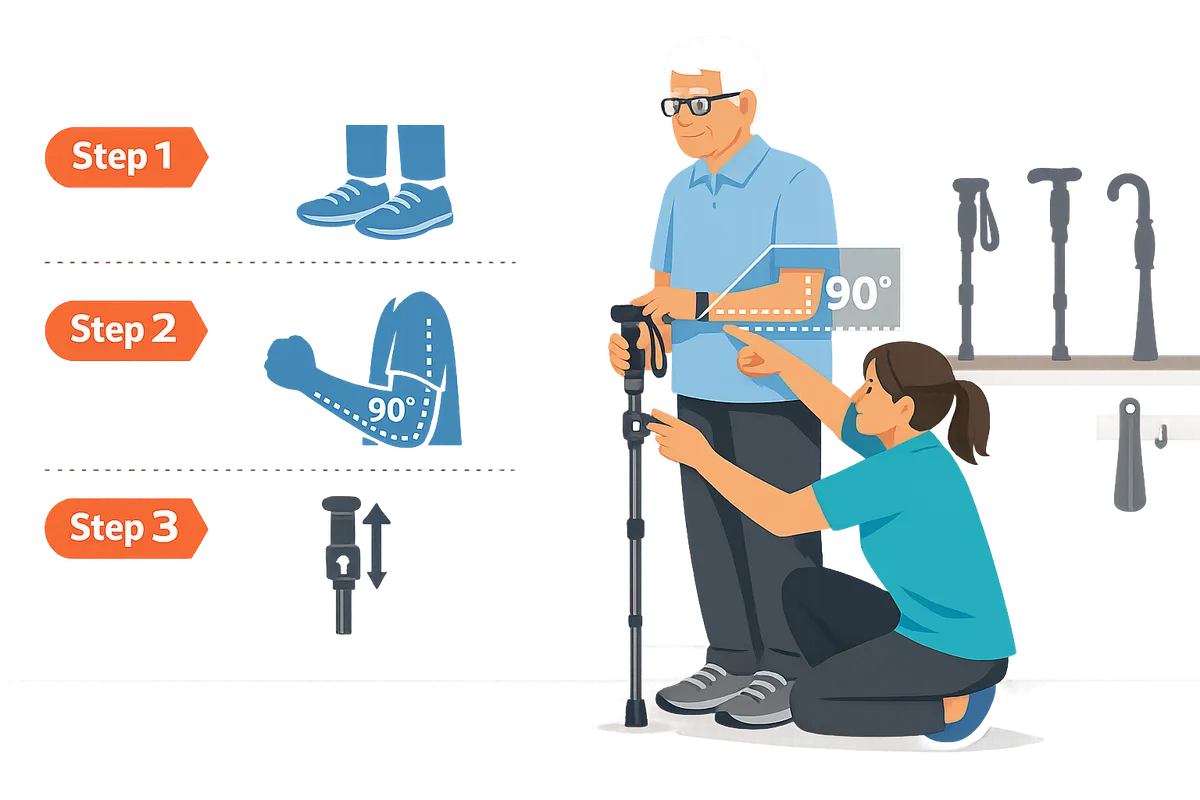
How do I measure and set the correct height for walking sticks for seniors?
Set the pole height so the senior's elbow forms about a 90-degree angle while standing in their usual shoes with the pole tip on the floor. That elbow angle gives stable support and prevents shoulder or back strain during normal walking. Follow the four practical steps below to measure, lock, test, and adjust for arthritis or short stature.
📏 1. Measure standing height and elbow angle
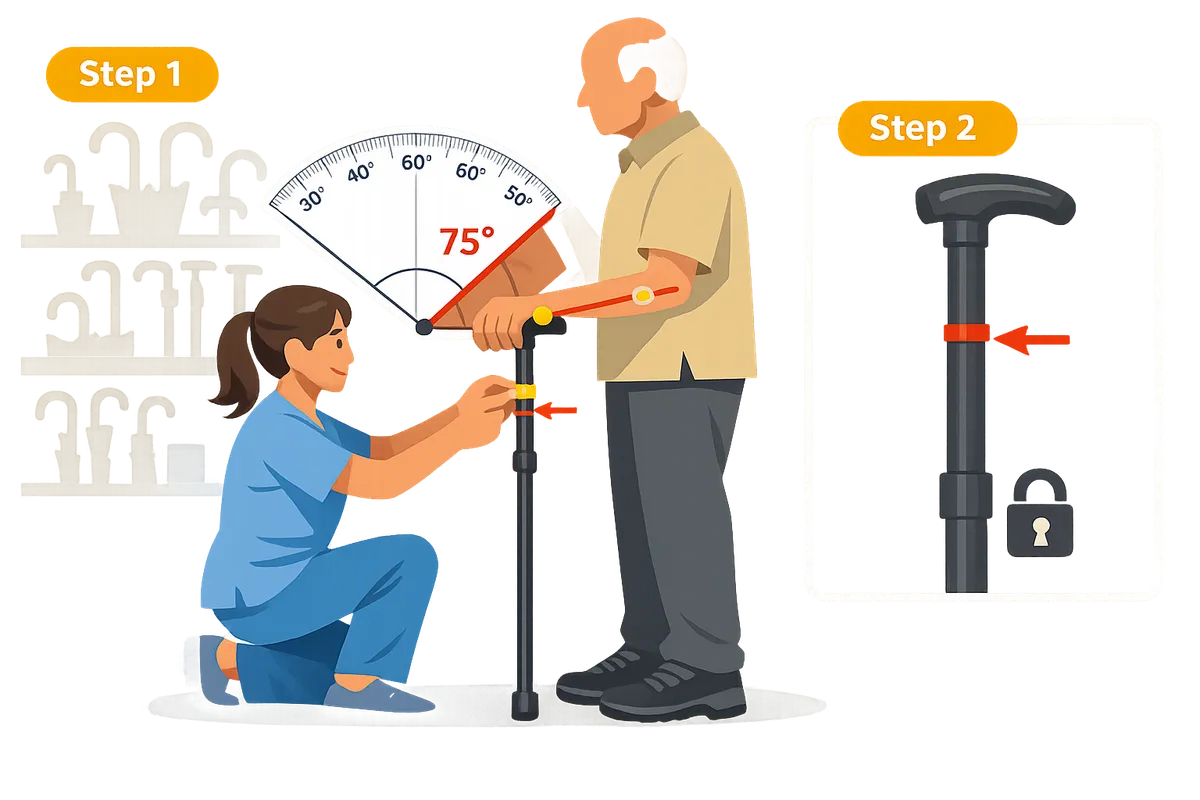
Measure standing with the senior wearing the shoes they will walk in and place the pole tip on the floor beside the foot. 1) Have the senior stand upright, relax the arm at their side, and bend the elbow until the forearm is roughly parallel to the ground. 2) With the hand in the normal grip position, measure from the floor to the wrist crease or to where the hand naturally rests on the grip. 3) Mark that spot on the pole with a removable tape or pencil line before adjusting.
Common mistakes: measuring barefoot, gripping the pole higher than the normal hand position, or ignoring the shoe sole height. For compact or novelty sticks from Better Canes Umbrellas, note that tip-to-handle height can differ from telescoping ranges; mark the exact point you measured so you can replicate it later.
🔧 2. Adjust telescoping poles and secure locks
Extend the pole to the marked height and secure each locking mechanism before putting any weight on the stick. Open or twist the lock per the manufacturer instructions, extend to the mark, then tighten until the mechanism clicks or feels rigid. Test by pressing downward and twisting the pole; there should be no visible slip or audible creak when you apply firm downward pressure.
If the pole slips during the downward test, re-tighten and retest; repeated slippage means the lock is wearing or a fixed-length pole is safer. Better Canes Umbrellas walking sticks often use twist locks or lever clamps; follow the product label and retest locks after the first week of use.
⚠️ Warning: Never rely on a partially engaged lock. Slippage while weight-bearing can cause falls. Check locks before each walk and replace a pole that continues to slip.
👣 3. Test length with a short walk and fine-tune
Walk 5 to 10 paces and watch for neutral shoulders, even arm swing, and comfortable heel-strike timing. Observe these cues while the senior walks at a normal pace: 1) If the torso leans forward or the user reaches down, the pole is too short. 2) If shoulders rise or the elbow over-extends behind the body, the pole is too long. 3) If hand pain or tight grip persists, try small adjustments of 0.5 to 2 cm.
Adjust in small increments and retest immediately. For example, lower the pole 1 cm if the senior feels pulled forward; raise 1 cm if their wrist bends backward at each step. Our Better Canes Umbrellas team recommends repeating the 10-pace test until gait symmetry and comfort are consistent over three short walks.
🦴 4. Modify height and grip for arthritis
For arthritis, raise or lower the pole by 1 to 2 cm and fit a larger, cushioned grip to reduce pressure on the wrist and fingers. Try thicker grips (25–35 mm diameter) made from foam, gel, or cork to spread contact forces across the palm. Add a softer strap and set it so the hand rests in the strap with minimal squeeze; the strap should support the pole between steps so the user does not have to grip tightly all the time.
If hand pain continues after a 1–2 cm height change and a cushioned grip, test a hand-angled or ergonomic grip style. Better Canes Umbrellas offers replacement grips and soft straps that you can trial in pairs to compare immediate comfort differences.
💡 Tip: If a senior reports wrist pain after 10 minutes of walking, try increasing the pole height by 1 cm and switching to a larger-diameter foam grip before changing the walking routine.
How should seniors use, maintain, and troubleshoot walking poles safely?
Seniors should use walking poles with a consistent reciprocal gait, correct grip and strap technique, and a regular inspection routine to stay safe and stable. Following simple walking cues and a monthly maintenance checklist prevents slips, reduces joint strain, and extends pole life.
🖐️ Proper grip and wrist strap technique
Hold the pole so the palm carries weight and the strap supports the wrist without cutting off circulation. This keeps the hand relaxed while letting the strap bear occasional loads.
- Thread the hand up through the bottom of the strap, then place the wrist into the loop and close the fingers around the grip. Expected outcome: the strap catches weight when you relax your grip.
- Keep the grip light; let the strap take force during planting. Expected outcome: less hand and forearm fatigue.
- Use a loose hold (no strap) if the strap causes pain, swelling, or numbness from arthritis. Expected outcome: reduced local pressure but more grip effort.
- If the strap rides too tight, pad it or switch to a padded strap model. Recovery: remove the pole and gently massage the wrist for a few minutes if circulation feels restricted.
Better Canes Umbrellas offers models with padded grips and wrist straps designed for repetitive daily use, which helps seniors keep wrist pressure low while walking.
🚶♂️ Walking technique and gait cues for balance
Use poles opposite the stepping foot, planted at heel strike, to widen your base and stabilize each step. Timing the pole with your heel reduces lateral sway and improves balance during transfers.
- Start slow: take a comfortable step and plant the opposite pole slightly ahead of your heel. Expected outcome: a controlled, wider support base.
- Maintain an upright trunk and look 3–4 meters ahead to keep posture steady. Expected outcome: fewer forward or backward trips.
- Shorten stride when unstable: reduce step length by about 10–20% or by one palm-width. Expected outcome: quicker recovery if balance falters.
- Use two poles if you feel unsteady; use one pole only for mild instability or when instructed by a clinician. Example: a senior with occasional wobble should pair poles for errand walks and switch to a single pole for short indoor moves.
Better Canes Umbrellas' walking sticks work as single or paired supports so you can match pole use to daily balance needs.
🧼 Maintenance checklist and replacement parts
Inspect pole tips, locks, grips, and straps at least once a month and replace worn parts promptly to avoid slips or sudden failures. Regular checks stop small issues from becoming fall risks.
- Clean: wipe shafts and grips after muddy or salty walks with mild soap and dry thoroughly.
- Check tips: replace rubber tips when tread is worn down to 2 mm or when metal shows. Replacement interval: heavy outdoor use every 4–6 months; mostly indoor use every 12–18 months.
- Test locks and adjustments: tighten twist or lever locks monthly. If a lock slips under weight, stop using the pole until repaired or replaced.
- Inspect straps and grips: replace frayed straps or grips that crush or split; consider new grips every 12–24 months for daily users.
💡 Tip: Keep a spare set of rubber tips and a small multi-tool in your bag so you can swap parts before a walk if the tip is worn or a screw loosens.
Better Canes Umbrellas sells poles with replaceable tips and durable grips, making routine upkeep straightforward for caregivers and seniors.
⚠️ Common mistakes to avoid and when to seek help
Do not use poles that are too short, have damaged tips, or encourage you to lean your full body weight onto a single pole without professional guidance. Those mistakes raise fall and injury risk.
- Mistake: Using a pole that sits too low. Problem: increases shoulder and back strain. Fix: remeasure height so elbow forms about a 90-degree angle in usual shoes.
- Mistake: Ignoring a worn rubber tip. Problem: slips on wet or tiled floors. Fix: replace tip immediately before walking.
- Mistake: Forcing one pole to bear full body weight. Problem: can overload the wrist and cause falls. Fix: use two poles or consult a physical therapist for transfer training.
Seek clinician advice if you notice increasing trips or near-falls, new or worsening joint pain after using poles, numbness in hands or fingers, or if you cannot maintain a consistent gait despite adjustments. Replace the entire pole if the shaft is bent, the lock fails repeatedly, or the pole wobbles even after tightening.
⚠️ Warning: Avoid walking on wet or icy surfaces with visibly worn tips; worn rubber can fail suddenly and cause a slip.
Better Canes Umbrellas customer support can help match models to grip needs and advise which poles are best for paired use versus a single support.
Frequently Asked Questions
This FAQ answers the most common sizing, arthritis, safety, and replacement questions about walking poles for seniors. Each answer gives a clear, actionable step and points to product choices at Better Canes Umbrellas when relevant.
What is the correct height for walking sticks for seniors? 📏
Set walking pole height so the senior's elbow forms about a 90-degree angle while standing in their usual shoes with the pole tip on the floor. Measure while wearing the shoes they normally walk in, then test by walking 5 to 10 paces and make 1 to 2 cm micro-adjustments until arm swing and shoulder comfort feel natural. Expected outcome: a stable push-off without shoulder or back strain. Better Canes Umbrellas carries both fixed-length and adjustable sticks so caregivers can try a sample and pick the length that produces the correct elbow angle.
💡 Tip: Always measure and test height with the same shoes the senior will walk in to avoid a sizing error between indoor and outdoor footwear.
Can walking poles help seniors with arthritis? 🦴
Yes. Walking poles reduce joint load and improve balance for seniors with arthritis when paired with ergonomic, cushioned grips and the correct pole height. Choose larger-diameter grips (for example, 38–42 mm as a starting range) and softer materials like gel or foam to reduce local pressure on painful thumbs or wrists. Expected outcome: lower wrist and knee strain and longer comfortable walking sessions. Better Canes Umbrellas lists models with larger grips and cushioned handle options so buyers can test what relieves their specific hand pain.
How do I know if a telescoping pole is safe for an older user? 🔒
A telescoping pole is safe if its locking mechanism holds under bodyweight and shows no slippage or visible wear at the joints. Test safety by setting the pole to the intended height, applying downward pressure equal to bodyweight while standing beside a chair for support, and checking for any movement; repeat monthly and after heavy use. Prefer poles with robust lever locks or twist locks that close firmly; if a lock slips during the test, stop using the pole. Better Canes Umbrellas offers fixed-length walking sticks for users who want to avoid adjustable parts and adjustable models that pass a simple hold-and-lean check.
⚠️ Warning: Do not use a telescoping pole that slips or creaks at the joint—lock failure can cause a sudden collapse and a fall.
How often should I replace pole tips or other parts? 🛠️
Replace rubber tips when tread is visibly worn, traction declines, or the tip no longer seats tightly on the shaft; for frequent pavement use this is commonly every 6 to 12 months. Carry one set of spare rubber tips and inspect tips, straps, and grips after any heavy outdoor session; replace frayed straps or compressed grips that no longer secure the hand comfortably. Expected outcome: consistent traction, quieter walking on hard surfaces, and reduced risk of slips. Better Canes Umbrellas sells spare rubber tips and replacement wrist straps compatible with most of their walking sticks.
Can I use hiking poles on pavements and in town? 🚧
Yes, if you swap to rubber pavement tips and shorten the pole for a controlled city stride. Reduce length by about 2 to 4 cm from a trail setting so the senior maintains a compact, steady step and less forward reach; use rubber ferrules or pavement tips to lower vibration and noise on concrete. Expected outcome: better grip on asphalt and concrete, quieter steps, and a safer, more comfortable urban walk. Better Canes Umbrellas stocks pavement-friendly tips and commuter-style sticks suited to sidewalks and transit use.
When should I consult a physical therapist about pole use? 🤝
See a physical therapist if the senior remains unsteady after correct sizing, has frequent near-falls, or develops increased pain when using poles. A clinician can assess gait mechanics, recommend cadence or step-width changes, and decide if a different support device will reduce fall risk or pain. Example triggers for referral: more than one fall or two near-falls in six months, or escalating joint pain within a week of starting pole use. Better Canes Umbrellas staff can help with product fitting but cannot replace clinical assessment.
Next steps to set the right pole height
Set pole height so your elbow forms a 90-degree angle when you hold the grip; that alignment gives predictable support and balance. Follow the measuring steps from this guide, test while wearing the shoes you walk in, and use small adjustments until your stride feels natural. For seniors with joint pain, a slightly shorter setting can reduce shoulder extension and make each step less strenuous. This article is part of our Cane Fit & Stability series and focuses on practical fit, not theory.
💡 Tip: Measure with the shoes you wear for walks and tighten quick-release clamps before testing outdoors.
If you want to try a ready solution, order an adjustable model from Better Canes Umbrellas and test the fit at home using the elbow-angle method above. Trying one lets you confirm comfort and stability without guesswork. Subscribe to our newsletter for fitting tips, model comparisons, and alerts when new supportive designs arrive.