
Walking Canes: The Complete Beginner’s Guide to Choosing Size, Style, and Support
Walking Canes: The Complete Beginner’s Guide to Choosing Size, Style, and Support
A mismatched cane height can turn a short walk into hours of pain and extra medical appointments for daily users. Walking canes are mobility aids that provide balance and redistribute weight, helping people stay stable while preserving comfort. This practical beginner's guide teaches how to choose the right size, pick a style that fits daily needs or gifting occasions, and care for canes to extend their life, with product-aware recommendations from our website. Better Canes & Umbrellas Inc., founded in 2000 in Chatham, NJ, offers a wide assortment—from commuter compact sticks and supportive hiking canes to novelty collectible walking sticks and shoe horns—so readers can match function with personal style. Which cane will suit your stride and wardrobe?
Walking canes are mobility aids that provide balance and partial weight support to people who need steadiness while walking. What core types, materials, and parts should beginners understand?
A walking cane is a mobility aid that provides balance, minor off-loading of weight, and a stable contact point for standing or stepping. This matters because the right type, material, and handle directly affect comfort, safety, and how often you must replace or maintain the cane. Use the guidance below to narrow choices quickly and then compare specific models from Better Canes Umbrellas.
What is a walking cane and who uses one? 🪑
A walking cane is a mobility aid that provides balance, partial weight support, and a single-point contact for users with mild balance issues or short-term recovery. Typical use cases include mild vestibular or gait instability, recovery after orthopedic procedures, and everyday balance help for errands or commuting. For many buyers, canes also serve as style statements or memorable gifts; Better Canes Umbrellas carries both practical commuter options and collectible novelty sticks that match those needs. If you expect more than minor weight-bearing support, a cane may not be sufficient and a clinician-recommended alternative should be considered.
What are the core cane types and when to choose each? 🧭
Standard, quad, folding, hiking, and novelty sticks each match distinct stability, portability, or style needs.
- Standard cane: Best walking canes for stability in everyday settings; single shaft with a variety of handles. Use for short walks, shops, and commuting.
- Quad cane: Four-prong base provides a broader footprint and extra steadiness when standing or taking short steps. Choose for slower gait or intermittent standing needs. Better Canes Umbrellas stocks quad options for increased base support.
- Folding cane: Collapses into sections for travel or storage. Pick folding models if you need a compact backup cane for public transport or flights.
- Hiking stick: Built for uneven ground with aggressive tips and shock absorption. Better Canes Umbrellas offers hiking sticks with replaceable tips for trail use.
- Novelty stick: Designed for fashion, costumes, or collection; not always optimized for daily stability. Use novelty sticks for events or display rather than continuous mobility support.
Match the type to how and where you walk most often. If in doubt, pick a cane designed for the dominant use case (commuting, indoor balance, or trail stability).
How do materials affect weight, durability, and feel? 🌳
Material choice determines a cane's weight, resilience, required care, and perceived quality. The right material reduces fatigue, fits your style, and sets maintenance expectations. Better Canes Umbrellas lists material details for each model so you can compare feel and upkeep before purchasing.
| Material | Typical weight | Durability | Care | Best for |
|---|---|---|---|---|
| Wood | Medium to heavy | High with proper care | Avoid prolonged moisture; occasional polish | Classic style, collectors, formal use (see wooden walking canes) |
| Aluminum | Light | Good, resists corrosion | Wipe clean; check adjustability pins | Everyday commuting, lightweight portability |
| Carbon fiber | Very light | High, impact-resistant | Wipe clean; avoid hard impacts | Long walks, low fatigue, premium feel |
| Composite | Varies | Good | Follow manufacturer care | Cost-conscious buyers wanting varied finishes |
Wooden walking canes appeal when warmth of feel and traditional aesthetics matter. For long distances, pick aluminum or carbon fiber to reduce arm fatigue.
Which handle shapes suit arthritis or wrist issues? ✋
Handle shape determines pressure distribution across the palm and wrist and can reduce pain for long-term users. Different shapes suit different hand and wrist conditions, so testing in person is valuable. Better Canes Umbrellas offers multiple handle styles so you can compare grip contours and materials before buying.
- Crook (J-handle): Classic look and easy hook-over-arm storage. Best for brief rests, not ideal for chronic wrist pain.
- Derby: Slightly angled with a rounded top; distributes weight across the palm and reduces wrist deviation. Often recommended for mild arthritis.
- Offset: The shaft sits behind the handle, keeping the wrist straighter under load. Good for users with wrist extension limits.
- T-handle: Wide flat top spreads pressure across the palm; useful for neutral wrist position during standing.
- Molded ergonomic grips: Contoured to hand anatomy and often include memory-foam or gel. Best for long-term daily use or severe arthritis.
💡 Tip: Try the grip by walking 20 steps and mimicking typical tasks (carrying a bag, opening a door) to check for wrist strain.
What are the main parts of a cane and why they matter?
A cane's key parts—shaft, handle, ferrule, collar, and tip—each affect comfort, stability, and service life. Knowing these parts helps you spot weak points and plan maintenance; Better Canes Umbrellas lists replacement tips and adjustable shafts for many models.
- Shaft: Carries load and defines feel; thicker diameters may feel sturdier while lighter materials reduce fatigue.
- Handle: Controls ergonomics; swapping to an ergonomic grip can cut wrist pain.
- Ferrule (tip): The rubber or carbide end that contacts the ground; a worn ferrule reduces traction and should be replaced promptly.
- Collar: Decorative or structural band at the handle junction; indicates build quality and can cover adjustment mechanisms.
- Adjustable mechanism: Allows height tuning; test the lock for wobble before relying on it for daily use.
Choose canes with replaceable tips and easy-to-check adjustment locks to minimize downtime and repair costs.
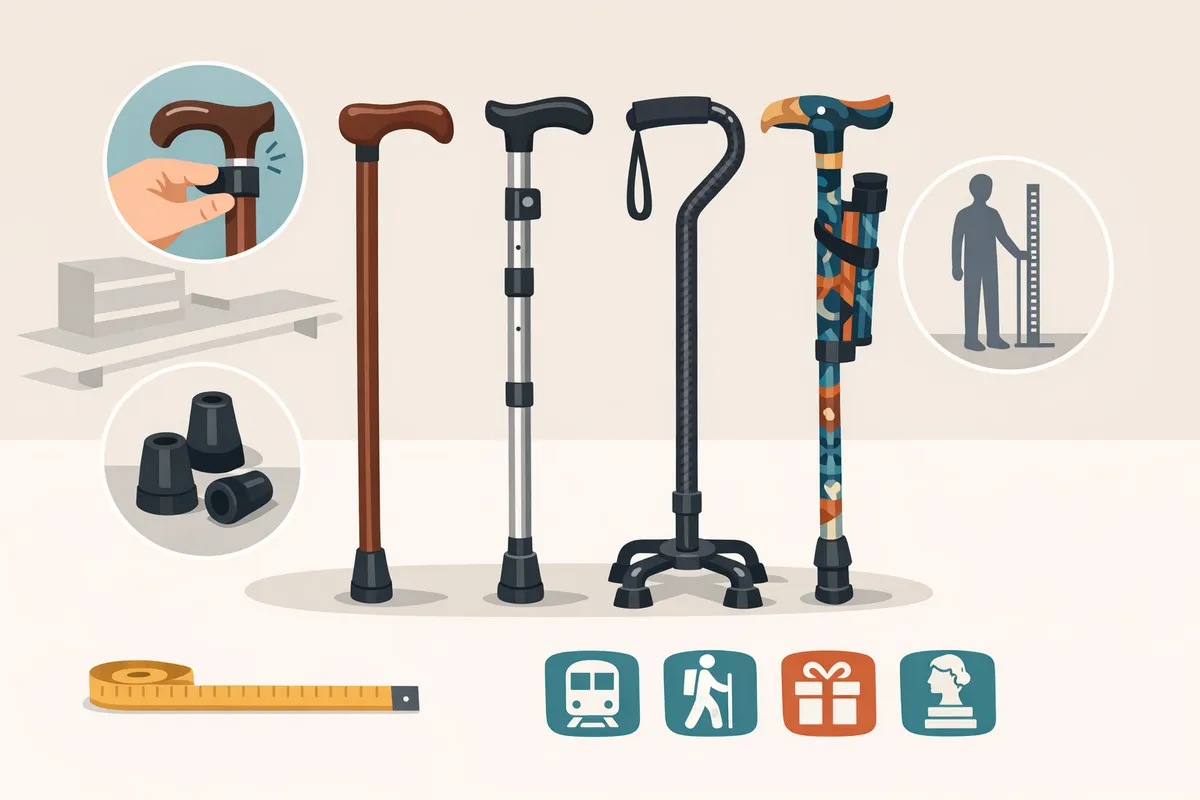
Measure and match a cane to your body and needs so the cane gives proper support and reduces fall risk. How do you choose the right size and the best walking canes for stability?
Measure wrist-to-floor and prioritize a wide base, stiff shaft, and a non-slip ferrule to get a cane that supports weight safely and reduces fall risk. Proper fit keeps your elbow slightly bent so you can push down on the cane without locking the arm. Use these steps and feature checks to convert a measurement into the right model and to compare stability-focused options on Better Canes Umbrellas' curated picks.
Correct cane length and a simple measuring method 📏
The correct cane length keeps your elbow bent roughly 15–20 degrees when standing upright. Follow these steps to measure and match a cane.
- Stand upright with shoes you normally wear while walking. Keep posture natural and arms relaxed at your sides.
- Have someone measure from the wrist crease (the line where your hand meets the wrist) straight down to the floor, or measure yourself by placing a cane at the wrist and marking the floor.
- Choose a cane labeled to match that measurement (for example, a 34-inch wrist-to-floor measurement should map to a cane listed around 34 inches).
- Pick an adjustable cane when your measurement falls between standard sizes, when multiple household members will share one cane, or during short-term rehab that requires height changes.
Example: a person whose wrist-to-floor is 33.5 inches should select a cane that adjusts to include 33–34 inches or buy a fixed cane rated at 34 inches. Better Canes Umbrellas carries adjustable walking sticks and fixed-length options so you can match the measurement without custom ordering.
💡 Tip: Measure while wearing the shoes you actually walk in and recheck after a short walk; posture and shoe soles change effective height.
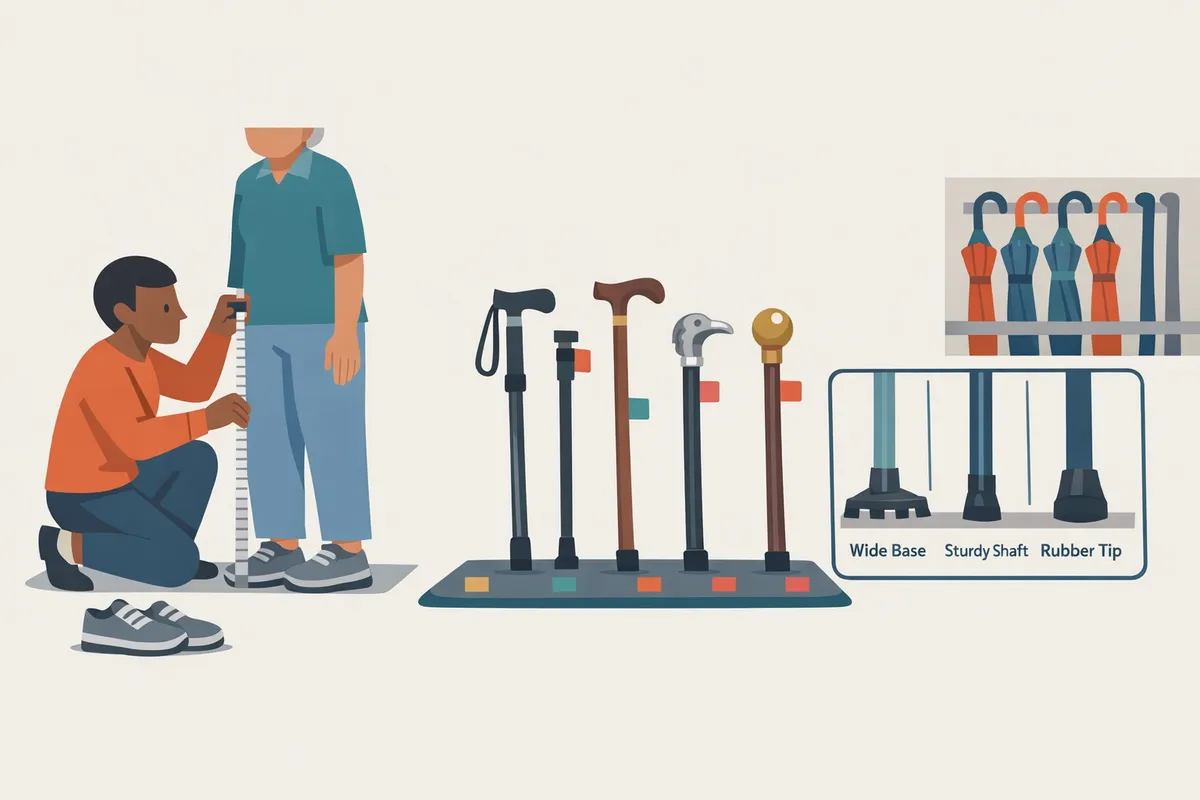
Key stability features to prioritize ⚖️
Prioritize a wide base, a stiff shaft, and a high-quality non-slip ferrule when choosing the best walking canes for stability. Ferrule is the rubber or plastic tip that contacts the floor and provides traction, and a worn ferrule greatly reduces safety. Shaft stiffness is the shaft's resistance to bending that keeps the cane from flexing under weight; stiffer shafts give steadier support for users who need partial weight offloading.
Features to prioritize for stability:
- Wide base or quad foot for larger footprint.
- Thick, stiff shaft material (solid wood or reinforced metals).
- Replaceable, non-slip ferrule with deep tread.
- Comfortable, ergonomic handle that distributes pressure across the palm.
Comparison: quad cane vs single-point cane vs tripod cane
| Cane type | Primary stability benefit | When to choose |
|---|---|---|
| Quad cane | Four-foot footprint increases lateral stability | For significant balance loss or uneven terrain |
| Single-point cane | Lightweight and easier to maneuver | For mild balance issues and indoor use |
| Tripod cane | Middling footprint with easier pivot than quad | For moderate instability where turning matters |
A quad cane is a cane with four small feet that offers a larger footprint and more lateral stability than a single-point cane; choose a quad when you need standing support or have pronounced side-to-side wobble. Better Canes Umbrellas lists wide-base and quad options in the stability picks section for shoppers who prioritize footprint over portability.
⚠️ Warning: Replace ferrules as soon as you see flattening or hard spots; driving on worn ferrules increases slip and fall risk.
Match cane choice to common medical needs 🩺
Choose the cane type that addresses the specific support problem (pain, numbness, short-term weakness) and consult a clinician for prescribed gait changes.
Condition-based recommendations:
- Arthritis (hand or wrist pain): prefer ergonomic or palm-rest handles that spread pressure; consider a slightly thicker shaft for secure grip.
- Peripheral neuropathy or poor footing: choose a wide-base or quad cane and a soft, high-traction ferrule to increase contact area.
- Short-term post-op weakness or progressive rehab: use adjustable-height canes so clinicians can raise or lower the cane as strength returns.
Example: a patient recovering from ankle surgery who needs partial weight-bearing should use an adjustable cane set by a clinician and switch to a single-point cane once gait normalizes. Better Canes Umbrellas highlights clinician-recommended walking sticks in a dedicated collection to simplify selection for specific conditions.
How wooden walking canes compare to lighter modern materials 🌲
Wooden walking canes often feel solid and offer a substantial shaft that some users find reassuring, while aluminum and carbon fiber reduce weight and shoulder strain.
Trade-offs to consider:
- Wooden walking canes: heavier, often handcrafted, and preferred for formal style or gifting; wood provides a confident, rigid feel but can fatigue the shoulder on long walks.
- Aluminum canes: lightweight, corrosion-resistant, commonly adjustable, and budget-friendly; good for travel and variable-height needs.
- Carbon fiber canes: lightest and strong, minimize energy cost for long-distance walking; usually pricier.
Scenarios: choose wooden walking canes for everyday home use, formal occasions, or when a solid feel matters. Choose aluminum or carbon fiber for travel, long daily walks, or when reducing shoulder and wrist strain matters. Better Canes Umbrellas stocks both wooden and lightweight models so buyers can match material to use case and personal style.
Start with a small checklist and simple tests so you buy a cane that fits, feels safe, and matches your daily routine. How should a beginner shop, test, and buy a cane?
Begin with a short checklist, three quick in-store tests, and clear online-order rules so you minimize returns and find a cane you actually use. Our Better Canes Umbrellas collections group stable, adjustable, and travel-friendly options to save time when you want proven choices. Follow the steps below whether you buy in person or online to reduce risk and get the right fit for daily life.
Shopping checklist 🧾
A six-item checklist prevents common buying mistakes and shortens return hassles. Keep this printed or on your phone when you shop.
- Correct length: Measure wrist-to-floor while standing. If you need a definition: wrist-to-floor measurement is the distance from your wrist (with arm relaxed at your side) to the floor; that measure tells you the cane length that promotes a 20-30 degree elbow bend.
- Handle comfort: Try the handle for 30 seconds to check for pressure points or slipping. Padded grips reduce hand fatigue for arthritis or weak grip.
- Base type: Single-point, quad, or tripod bases change stability and maneuverability. Quad bases give the most static stability; single-point is lighter for stairs.
- Weight capacity: Match the cane’s rated load to the user’s body weight plus carry items. Exceeding capacity shortens life and increases failure risk.
- Ferrule quality: A ferrule is the rubber tip that contacts the ground and provides traction. Check tread pattern, thickness, and how easily it clips onto the shaft.
- Return and warranty policy: Confirm the return window, condition rules, and any warranty on shafts or handles.
Better Canes Umbrellas organizes product pages so you can jump to “stability picks” or “wooden walking canes” to compare options quickly.
In-store tests 🩼
Three simple tests reveal fit and real-world comfort before you pay. Always try these with the shoes you will wear most often.
- Walk 10 natural steps. Observe wrist angle, handle slip, and whether the cane feels to one side. A cane that forces you to lean or twist indicates wrong length or handle shape.
- Transfer weight briefly onto the cane while standing. Feel for shaft wobble or handle rotation. Any audible creak, visible shaft bend, or movement at the collar signals lower build quality.
- Sit and stand using the cane for support. Test the cane while pushing off a chair to check handle ergonomics and hand pain. If your wrist tenses or you shift weight awkwardly, try a different grip style.
Better Canes Umbrellas sells models you can try in our retail location and flags customer photos and fit notes for online shoppers who will later confirm fit.
Order online with confidence 📦
Clear return rules, adjustable designs, and good size guides reduce the risk of a poor fit when you cannot try a cane in person. Use these four practical steps before you order.
- Choose an adjustable cane. An adjustable cane is a cane that allows length changes with simple push-button or twist-lock mechanisms; it reduces the chance of sizing errors for first-time buyers.
- Read size charts and customer photos. Compare the listed wrist-to-floor range with your measured number and view photos of users with similar height or body type.
- Preserve packaging and test within the return window. Keeping original packaging and tags simplifies exchanges and protects you if you need to return.
- Confirm warranty and shipping costs. Factor return shipping into the total cost if the return window is tight.
Better Canes Umbrellas lists detailed size charts and customer Q&A on product pages so you can match measurements and see real-world fit notes.
Maintenance and care 🧰
Regular maintenance extends cane life and protects investments like wooden walking canes. Follow these quick checks every month and after any heavy use.
- Inspect the ferrule. Replace the ferrule at the first sign of flat spots, cracks, or reduced traction to avoid slips.
- Tighten collars and grips. Give adjustable collars, decorative collars, and handle fasteners a quick twist to remove play that causes wobble.
- Protect wood finishes. For wooden walking canes, wipe dry after rain, use a wood polish every few months, and avoid long exposure to direct heat.
- Carry a spare tip and basic tools. Keep a replacement ferrule and a small wrench or screwdriver with your cane for field fixes.
💡 Tip: Keep one spare ferrule per cane in your bag; replacing a worn tip immediately prevents falls and uneven wear.
Better Canes Umbrellas stocks replacement tips and care accessories so you can buy maintenance items alongside a new cane.
Use targeted resources and comparison tools to refine choices and find specialty canes that match lifestyle or gifting goals. What are the next steps for users who need advanced guidance or specific styles?
Use a focused toolkit of comparison tables, clinician input, and seller warranties to narrow options and pick a cane that fits daily needs or gifting goals. Better Canes Umbrellas offers curated assortments across commuter, mobility, hiking, and novelty use cases and can speed selection. The company has operated since 2000 and maintains category pages that group durable wooden walking canes, hiking sticks, and novelty items for easier comparison.
Quick comparison table for fast decisions 📊
A side-by-side table speeds decisions by comparing adjustability, weight, stability, portability, and typical buyer use. Below are six common cane types with concise specs so you can scan for fit and move to product pages quickly.
Definitions first. Standard Cane is a single-point shaft that offers basic balance support for everyday surfaces. Quad Cane is a multi-foot base that provides extra standing stability for users with higher fall risk. Folding Cane is a collapsible aid that prioritizes portability for travel and transit. Hiking Stick is an outdoor-oriented support that focuses on traction and shock absorption on trails. Wooden Walking Canes are crafted-shaft canes that mix style and function, often heavier but durable. Novelty Cane is a decorative or collectible stick designed primarily for appearance rather than long-term support.
| Cane type | Ideal use | Typical weight | Adjustability | Stability rating | Best buyer profile | Suggested product on our website |
|---|---|---|---|---|---|---|
| Standard Cane | Everyday balance on flat surfaces | 0.9–1.5 lb | Telescoping or fixed | Moderate | Commuters, short walks | Better Canes Umbrellas — Classic Aluminum Standard Cane |
| Quad Cane | Increased standing and gait support | 2.0–3.5 lb | Usually telescoping | High | Users with balance issues or recent falls | Better Canes Umbrellas — Four-Base Stability Quad Cane |
| Folding Cane | Travel, public transit, storage | 0.8–1.2 lb | Often telescoping + foldable | Low-Moderate | Frequent travelers, commuters | Better Canes Umbrellas — Compact Foldaway Cane |
| Hiking Stick | Trails, uneven terrain, long walks | 1.0–2.0 lb | Fixed or adjustable | Moderate-High (trail dependent) | Hikers, trail walkers | Better Canes Umbrellas — Trail-Pro Hiking Stick |
| Wooden Walking Cane | Fashion, gifting, moderate use | 1.2–2.8 lb | Often fixed; some adjustable | Moderate | Gift buyers, collectors, style-focused users | Better Canes Umbrellas — Handcrafted Wooden Walking Cane |
| Novelty Cane | Costume, display, occasional use | 0.7–2.0 lb | Usually fixed | Low (unless reinforced) | Gift givers, collectors | Better Canes Umbrellas — Curated Novelty Sticks & Gift Bundles |
Get clinician and therapist input 🩺
Seek occupational therapy or physical therapy input when chronic pain, recent surgery, repeated trips, or uneven-terrain use affect cane choice. Bring these items to your appointment: a short video of your typical walk, your exact height and weight, samples or photos of current footwear, and a list of daily surfaces (stairs, gravel, public transit). That information helps a clinician recommend a cane type, ferrule size, and whether a quad base or forearm support is appropriate.
Describe needs clearly by saying: "I need support for X minutes daily, I walk on Y surfaces, and I have Z joint pain." Our website groups clinician-approved product categories to make it faster to compare options the therapist recommends.
💡 Tip: Record a 20–30 second video of a usual walking route (indoors and outdoors) and show it to the clinician. Visuals speed accurate recommendations.
Choosing novelty and collectible canes for gifts 🎁
Select novelty canes when appearance or collectibility is the priority rather than full-time load bearing. If the recipient will use the cane for occasional support, choose styles with reinforced shafts and a replaceable ferrule to avoid slips and damage. For purely decorative gifts, focus on craftsmanship, provenance, and presentation in the listing.
If you want both style and occasional function, pick a wooden walking canes model with an internal reinforcement or an aluminum-core shaft hidden inside a decorative exterior. Better Canes Umbrellas offers gift bundles and novelty sticks that note whether an item is suitable for walking versus display.
⚠️ Warning: Many novelty canes lack tested load ratings; avoid them for daily support unless the seller explicitly lists weight capacity and a reinforced shaft.
Check warranty, returns, and customer service 🔁
Confirm warranty length, what components are covered, and the return window before purchasing. Look for these policy details: length of warranty, coverage for ferrules and hardware, clear return shipping instructions, and a repair or replacement option for breakage. Ask whether the seller supplies spare ferrules and how to submit a warranty claim.
Buying from Better Canes Umbrellas simplifies follow-up because product pages include stated return procedures and service options, and the catalog separates commuter, hiking, and wooden walking canes to reduce guesswork.
- What to ask before buying:
- Does the warranty cover daily-use failure of the shaft or joint?
- Is there a trial or easy-return period for fit issues?
- Are replacement ferrules and tips available separately?
Frequently Asked Questions
This FAQ answers the most common beginner questions about sizing, stability, materials, buying, and care for walking canes. Each answer gives a direct sentence first, then practical steps, examples, and product suggestions from Better Canes Umbrellas.
How tall should my walking cane be? 🧭
Proper cane length lets your elbow rest at roughly a 15-degree bend when holding the handle. To measure quickly at home, stand with shoes on and have someone measure from your wrist crease to the floor; that number in inches is the cane length you want. A second quick check is to hold a cane at your side; your elbow should form about a 15-degree bend. If multiple household members will share one cane, choose an adjustable model and set the smallest and largest heights you need before ordering. Better Canes Umbrellas lists adjustable options with clear min/max settings so you can compare fit before purchase.
When should I use a quad cane instead of a standard cane? 🦯
Use a quad cane when you need a larger footprint for lateral stability, slower gait control, or extra support after lower-limb surgery. Common scenarios include marked unsteadiness during turns, a slow or shuffling gait, post-op recovery from knee or hip procedures, or caregiver-assisted transfers where extra base helps reduce falls. For example, a patient recovering from hip replacement who struggles with side-to-side balance will usually feel steadier with a small-footprint quad than with a single-point cane. Better Canes Umbrellas labels wide-base and quad-style sticks as stability-focused so you can find the right option quickly.
Are wooden walking canes practical for daily use? 🌳
Wooden walking canes provide classic looks and a solid feel but tend to weigh more than aluminum or carbon fiber options, which can matter for commuters. For daily commuters who take frequent walks or stairs, a lightweight aluminum or carbon shaft reduces fatigue across a day. For gifts, collectors, or occasional walkers, wooden walking canes make a durable, attractive choice that ages well with proper care. Care tips: keep wood dry, apply mineral oil or a dedicated wood finish annually, and fit a fresh rubber ferrule if the original shows wear. Better Canes Umbrellas carries both wooden walking canes and lighter commuter sticks so you can match purpose to style.
What features matter most for stability? ⚖️
Ferrule quality, base size, shaft rigidity, and handle comfort are the primary features that determine a cane's stability. Prioritize a non-slip rubber ferrule or a quad/wide base for wet or uneven surfaces. Choose a shaft that does not flex under your weight; rigid aluminum or hardwood shafts transmit support more reliably than thin, flexible tubing. Pick a handle that spreads pressure across the palm, such as an offset or ergonomically shaped grip, if you have arthritis or carpal tunnel. For example, a commuter who walks on wet sidewalks should use a wide-base ferrule and a stiff shaft. Better Canes Umbrellas tags models as stability-focused so you can filter by base style and handle shape.
💡 Tip: Replace a ferrule at the first sign of cracking or hardening to keep slip risk low.
Is it safe to buy a cane without trying it in person? 🛒
You can safely buy a cane online when the seller provides clear sizing guides, a reasonable return window, and responsive customer support. Best practices: favor adjustable canes so you can fine-tune length at home, confirm the return or exchange policy before purchase, and read customer photos and reviews on the product page to verify real-world fit. For a test at home, set the cane to your measured wrist-to-floor length and try a short walk on tile and carpet to check comfort and ferrule grip. Better Canes Umbrellas includes size charts, user photos, and a customer service team to answer fit questions prior to checkout.
How do I maintain and repair a walking cane? 🔧
Replacing a worn ferrule, tightening a loose collar, and checking the handle restores most functional cane issues without replacing the entire cane. Maintenance steps: inspect the ferrule monthly and swap to a replacement when tread grooves flatten; tighten threaded collars or set screws if the handle wobbles; wipe metal shafts with a damp cloth and oil wood canes lightly once a year. If you need parts, measure the ferrule inner diameter or the shaft outer diameter and order the matching replacement. Better Canes Umbrellas sells replacement ferrules, collars, and accessory parts in the accessories collection and offers guidance on matching sizes.
Take a practical next step to choose, size, and care for your cane.
You now know how fit, grip, tip, and style affect comfort and stability, and how simple checks prevent trips and wasted purchases. For a beginner, the clearest outcome is this: pick a cane that matches your height and daily routine, try it standing and walking, and keep a regular inspection schedule to avoid wear-related slips.
Better Canes & Umbrellas Inc., founded in 2000 and based in Chatham, NJ, is an online and retail seller focused on umbrellas, walking sticks (including novelty sticks and hiking sticks), and shoe horns. The company expanded its assortment in 2005 to include a wide range of walking and novelty sticks and later added shoe horns in unique styles and designs. The site positions itself as a source for reliable, fashionable, and collectible items that serve both practical daily needs and gift occasions.
💡 Tip: Measure from your wrist crease to the floor while wearing usual shoes to confirm cane height before buying.
Shop Better Canes Umbrellas to test styles that balance support and looks; start by trying a supportive commuter or hiking stick. Subscribe to our newsletter for sizing reminders and care tips.