
Walking Canes Guide 2026: Balance & Sizing
Walking Canes Guide 2026: Balance & Sizing
One misplaced inch in cane height can shift balance and turn a short walk into a painful chore. Our walking canes guide is a practical resource that explains which cane type, correct fit, and maintenance steps provide safe balance and how to size a cane using a practical calculator. Our Better Canes & Umbrellas catalog, founded in 2000 in Chatham, NJ, expanded in 2005 from umbrellas to walking and novelty sticks and later added shoe horns, so we cover commuter, hiking, and giftable options. This guide helps you pick between supportive commuter canes, hiking sticks, and collectible novelty canes, and highlights the sizing detail most shoppers miss.
Which walking cane is best for balance and daily support?
The best walking cane for balance and daily support combines a stable base, an ergonomic grip, and correct height. For shoppers searching for best walking canes for balance 2026, prioritizing those three factors shortens testing time and reduces fall risk. Our Better Canes & Umbrellas catalog groups models by those features so you can match a cane to a routine in minutes.
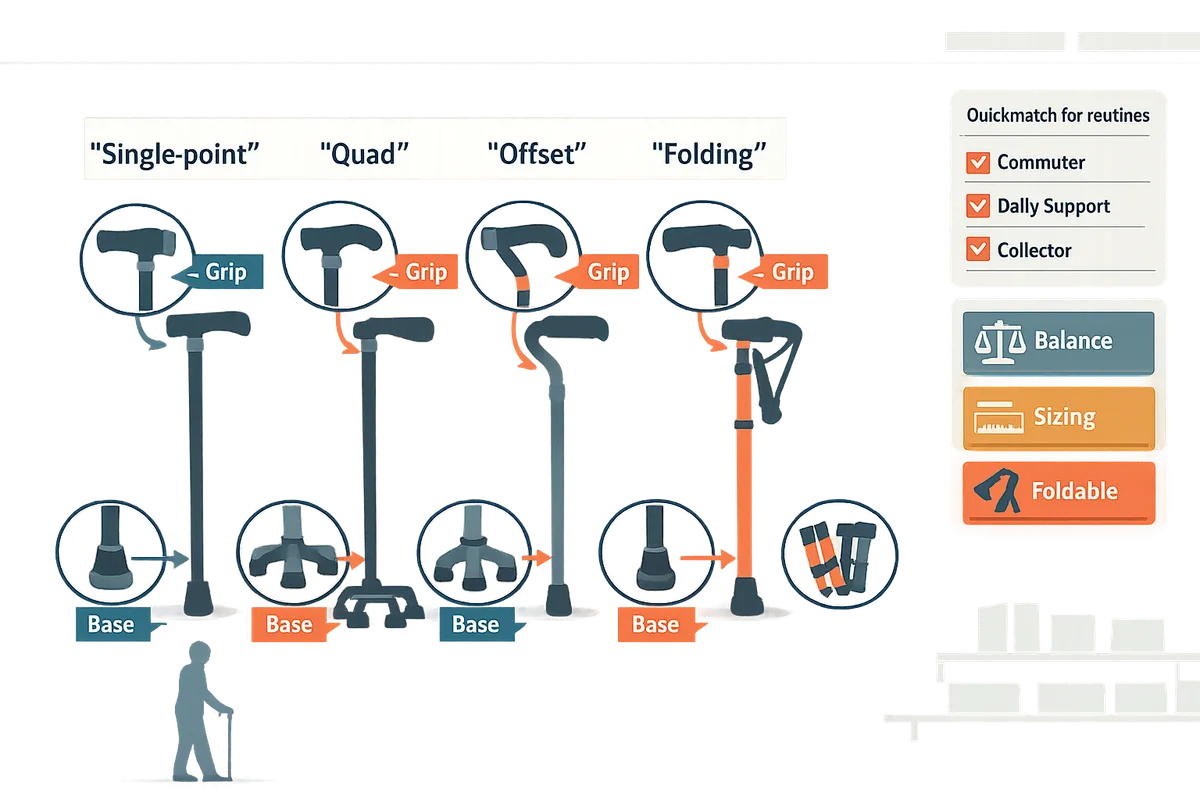
What cane types exist and which fit my needs? 🦯
Four common cane types meet most balance and daily-support needs: single-point, quad, offset, and folding. Single-point cane is a cane type that provides simple support with one contact point; it fits people who need occasional stabilization and want a lightweight option. Quad cane is a cane type that provides broad lateral stability with four contact feet; it suits users with pronounced balance issues or early post-op recovery. Offset cane is a cane type that shifts weight behind the shaft to reduce wrist angle and concentrate load on the forearm; it helps people with weak grips or shoulder pain. Folding cane is a cane type that collapses for storage and travel; it benefits commuters and travelers who need portability. Our Better Canes & Umbrellas collection includes commuter folders, sturdy quads, and fashion-forward single-point sticks to match these use cases.
Which handle suits arthritis or hand weakness? 🖐️
A palm-shaped ergonomic grip typically reduces hand pressure for arthritis while a derby handle supports balance and wrist alignment. Derby handle is a handle style that offers a curved shape to distribute force across the thumb and palm; clinicians often recommend it for mild hand weakness and users who need stable wrist alignment. Crook handle is a handle style that hooks over a forearm or chair; it is simple but concentrates pressure on a narrow area and suits short-term or occasional use. T-handle is a handle style that gives broad support across the top of the hand and helps users with tremor maintain a neutral wrist. Palm or anatomically molded grips are a handle style that increases contact area and lowers peak pressure on finger joints; our Better Canes & Umbrellas palm-grip models include cushioned options and larger grips for reduced strain.
💡 Tip: Try a cane with a removable gel sleeve or larger-diameter grip from our catalog for two weeks to judge pain reduction and hand fatigue.
How do top canes compare by weight, base, grip, and price? 📊
Compare canes by weight, shaft material, grip type, base type, price range, warranty, and recommended user to match balance needs and lifestyle. Below is a side-by-side snapshot of representative models that illustrate trade-offs between portability, stability, and style.
| Model (example) | Weight | Shaft material | Grip type | Base type | Price range | Warranty | Recommended user | Product (internal product link text) |
|---|---|---|---|---|---|---|---|---|
| Commuter folding cane | ~1.0 lb | Aluminum | Foam T-handle | Single-point rubber tip | $30–$60 | 1 year | Daily commuter, travel | Better Canes & Umbrellas — Commuter Folding Cane |
| Lightweight carbon cane | ~0.8 lb | Carbon fiber | Ergonomic palm grip | Single-point rubber tip | $80–$150 | 2 years | Active users, stairs/climbing | Better Canes & Umbrellas — Carbon Lightweight Cane |
| Quad base support cane | ~1.9 lb | Steel or reinforced aluminum | Derby handle | Four-foot quad base | $45–$120 | 1–2 years | Users needing lateral stability, rehab | Better Canes & Umbrellas — Quad Stability Cane |
| Novelty collectible cane | ~1.2 lb | Wood or resin | Crook or decorative knob | Single-point rubber tip | $40–$200 | Limited | Gift buyers, collectors, costume use | Better Canes & Umbrellas — Novelty/Collectible Cane |
For a quick decision: choose a commuter folder if you carry public transit or a bag; choose a quad if you need wide-contact stability; choose a palm-grip carbon model if hand pain and weight matter. Our product pages show photos, hand measurements, and replacement tip options so you can match the cane to daily tasks without guessing.
How long should my walking cane be? Use a walking cane sizing calculator.
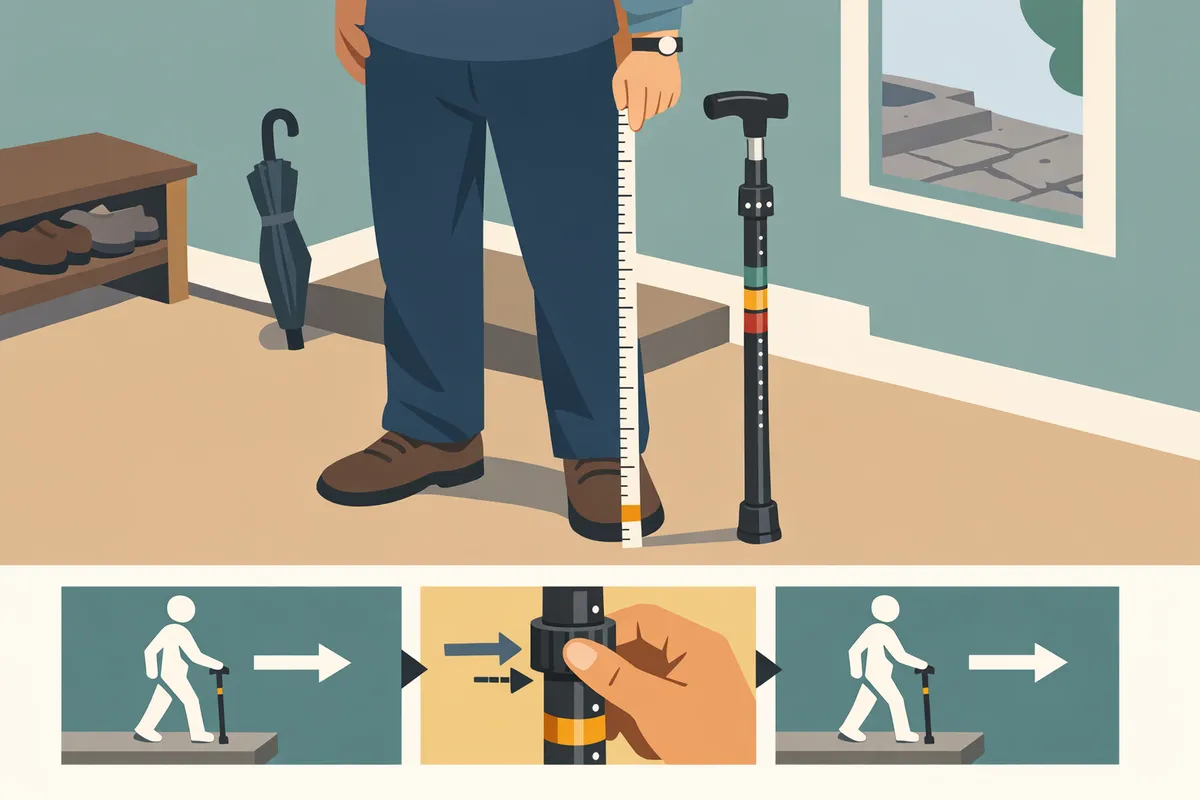
Your walking cane should place your wrist in a neutral position with the elbow bent roughly 20–30 degrees while standing in the shoes you normally wear. Measuring wrist-to-floor gives an accurate starting shaft length and the walking cane sizing calculator on our site converts that measurement into a recommended cane length and an adjustment range. Correct length reduces shoulder and back strain and makes each step safer.
How do I measure cane length at home? 📏
Measure from the crease of your wrist to the floor while standing straight in the shoes you usually wear. This wrist-to-floor method captures the real height your cane must accommodate. Follow this numbered checklist exactly to avoid errors:
- Stand upright with shoulders relaxed and weight evenly distributed.
- Wear the shoes you will walk in most often (dress shoes, sneakers, or boots).
- With your arm hanging naturally, have a helper measure from the wrist crease (where a watch sits) straight to the floor.
- Record the measurement to the nearest 1/4 inch or 0.5 cm.
- Compare that number to cane sizing ranges in product descriptions.
Our Better Canes Umbrellas product pages show sizing ranges for each model so you can match your wrist-to-floor number to available shafts. Measuring in different shoes can change the result by about 0.5–1 inch, so test the shoes you wear most.
💡 Tip: Mark the wrist crease with a washable pen or a small piece of tape before measuring to ensure repeatable results.
How does the walking cane sizing calculator work? 🧮
A walking cane sizing calculator is a tool that converts wrist-to-floor or height inputs into a recommended shaft length and an allowed adjustment range for adjustable canes. Our calculator asks for either wrist-to-floor measurement or overall height plus your usual shoe type and then returns a suggested shaft length and a safe adjustment window. The output typically includes a single recommended length and a few inches of adjustment range so you can set an adjustable model to your exact need.
Required inputs usually are:
- Wrist-to-floor measurement or height.
- Type of footwear you plan to use.
- Which hand you will hold the cane in (helps some clinical calculators).
What the calculator output means:
- Recommended shaft length.
- Allowed adjustment range for adjustable models.
- A note on fit checks to perform after initial setup.
Our Better Canes Umbrellas sizing tool also flags models that fall outside your recommended range so you can narrow options quickly.
When should I choose an adjustable cane and how do I verify fit? ✅
Choose an adjustable cane when your footwear varies, your recovery is changing, or a clinician expects progress so you can fine-tune length without buying a new cane. Adjustable models let you change shaft length in small increments to maintain correct wrist alignment as conditions change.
Quick verification steps after adjusting the cane:
- Wrist alignment check. Hold the cane at the recommended length while standing. Your wrist should rest near neutral, not tilted forward or back.
- Elbow angle check. With the cane tip about 6 inches lateral to your foot, your elbow should bend roughly 20–30 degrees. This range promotes a natural arm swing and reduces shoulder load.
After those checks, walk 20–30 steps on level ground and reassess comfort and posture. If you feel leaning, shoulder strain, or uneven gait, shorten or lengthen the cane by one quarter-inch and repeat the walk.
Our Better Canes Umbrellas adjustable models include clear adjustment markings and user instructions to make those fine adjustments simple and repeatable.
How do I use, maintain, and buy canes for specific scenarios and budgets?
Use a cane correctly on stairs, uneven ground, and when rising from a chair, inspect and replace worn parts regularly, and match cane type to the intended activity and budget. Following scenario-specific steps reduces fall risk and prevents returns. Below are clear stair and uneven-ground patterns, a short monthly maintenance checklist, readable cost ranges by category, and targeted product recommendations from Better Canes Umbrellas.
How should I use a cane on stairs and uneven surfaces? 🪜
Hold the cane on the side opposite your weaker leg and follow "up with the good, down with the bad." This grip and rhythm give the most stable pattern for stairs and uneven ground. For ascending stairs, step up with the stronger leg first, then bring the cane and the weaker leg up to the same step. For descending, place the cane on the lower step, move the weaker leg down next, then bring the stronger leg down. Keep the cane tip close to the step edge and a slightly bent elbow (about 20 to 30 degrees) so the cane supports weight instead of locking the arm.
- Ascending (up with the good): Step up with the stronger leg. Move the cane and weaker leg to the same step. Repeat.
- Descending (down with the bad): Place the cane on the lower step. Move the weaker leg down next, then bring the stronger leg down.
Scenario notes:
- Curbs: Treat a curb like a single step and turn so the tip contacts the curb edge for better stability.
- Gravel and loose surfaces: Use a larger-diameter ferrule for extra bite; plant the cane firmly before weight transfer. A ferrule is a small cap that fits on the cane tip to improve traction and protect the shaft.
- Slick surfaces: Keep the cane tip vertical and test the tip before committing weight; wear shoes with good tread.
💡 Tip: When you try canes at home, practice one full flight of stairs while holding a rail to confirm balance before going outdoors.
Better Canes Umbrellas stocks higher-traction replacement tips and heavy-duty ferrules that reduce slippage on uneven surfaces.
How often should I check and replace cane tips and parts? 🔧
Inspect rubber tips and ferrules at least once a month and replace them as soon as tread wears thin, rubber splits, or the cane wobbles. Regular checks prevent small wear issues from becoming fall hazards and extend usable life. For example, a flattened tip can hide until wet-weather use causes a slip; monthly inspection catches that before an accident.
Maintenance checklist:
- Inspect rubber tip tread and sidewalls for cracks, flattening, or embedded debris. Replace immediately if grip is compromised.
- Check ferrule fit and shaft alignment. If the cane wobbles, tighten collars or replace the ferrule.
- Wipe down the shaft with mild soap and dry immediately to prevent finish loss or corrosion.
- Test folding or telescoping locks for secure engagement; service or replace hardware that slips under light force.
- Keep a spare rubber tip on hand; replacing a tip typically takes under two minutes.
⚠️ Warning: Using a cracked or flattened tip on wet surfaces increases the risk of slipping. Replace tips promptly.
Our store, Better Canes Umbrellas, stocks replacement tips and common hardware so you can order parts without hunting specialty suppliers.
Which cane should I buy for commuting, hiking, or gifting? 💼
Choose a cane by primary use so features match the environment and avoid costly returns. A commuter folding cane prioritizes compact size for transit, a hiking stick prioritizes shock absorption and larger tips for trails, and a novelty cane balances decorative handles with reliable shafts for safe gifting.
Cost ranges by category (typical retail):
- Commuter folding canes: $30 to $80.
- Everyday support canes (ergonomic grips, reinforced shafts): $40 to $150.
- Hiking sticks and shock-absorbing poles: $50 to $200.
- Novelty and collectible canes: $25 to $120.
- Clinician-prescribed or custom-fit mobility canes: $150 to $500+ depending on customization.
Insurance note: A clinician prescription may be required for insurers to reimburse a cane as durable medical equipment; confirm your insurer's documentation rules before purchasing. A walking cane sizing calculator is a tool that helps you confirm shaft length by measuring elbow angle and standing height. Use the walking cane sizing calculator before buying to avoid fit-related returns.
Product recommendations from our catalog:
- For daily commuters, choose Better Canes Umbrellas commuter canes with folding shafts and compact carry cases to reduce transit hassle.
- For trails, pick Better Canes Umbrellas hiking sticks with shock-absorbing cores and larger trekking ferrules for uneven terrain.
- For gifts and special occasions, browse Better Canes Umbrellas novelty canes that pair decorative handles with reliable shafts so the item looks distinctive while remaining functional.
Buying checklist before checkout:
- Confirm intended use and primary environment.
- Verify height with the walking cane sizing calculator.
- Choose a grip that matches hand strength and arthritis needs.
- Add a spare rubber tip to the order.
- Save clinician documentation if you plan to seek insurance reimbursement.
Sitting-to-standing transfers: stand with feet hip-width apart, push from the arms of the chair or your strong leg, bring the cane into your stronger hand once upright, then switch the cane to the side opposite the weaker leg if needed. Practicing this sequence at home reduces hesitation and the risk of a misstep when you are out in public.
Frequently Asked Questions
This FAQ provides concise, actionable answers to common buyer, fit, safety, and purchasing questions about walking canes. Use these quick Q&As to confirm fit, weight limits, transport rules, and insurance steps before you shop. Consult our sizing guidance or product pages on the site for deeper, model-specific details.
How accurate is a walking cane sizing calculator? 🧭
A walking cane sizing calculator gives a reliable starting shaft length but requires validation with a wrist-to-floor measure and a short trial walk. A walking cane sizing calculator is a tool that estimates shaft length using wrist-to-floor or height inputs. For best fit, measure wrist-to-floor while standing in the shoes you normally wear, set the cane so your elbow bends about 20–30 degrees, and take a short 10–20 step walk to confirm balance. If you have recent surgery, balance concerns, or progressive mobility loss, ask a clinician to confirm the measurement before purchase and compare recommended lengths on Better Canes & Umbrellas product pages.
What are the best walking canes for balance 2026? ⚖️
The best walking canes for balance 2026 pair a wide, stable base with an ergonomic grip and a lightweight, durable shaft. Models that score highest combine a quad or tripod base or an oversized slip-resistant ferrule with handles shaped to reduce wrist torque, such as derby or orthopedic molded grips. Materials like carbon fiber or aircraft-grade aluminum reduce swing weight while keeping strength; foam or gel grips reduce pressure on arthritic hands. See our comparison matrix for side-by-side weight, grip type, base style, and price to match a model from Better Canes & Umbrellas to your balance needs.
Can I use a novelty cane for daily support? 🎩
Most novelty canes are decorative and are not safe for daily, full-weight support unless the product explicitly states a weight rating and reinforced construction. Decorative shafts, carved handles, and costume fittings often lack internal reinforcement or tested load ratings. If you want a novelty look plus daily support, choose a model that lists a safe load and uses reinforced materials; Better Canes & Umbrellas labels supportive models separately from pure novelty sticks.
⚠️ Warning: Do not rely on decorative canes for weight-bearing without a documented load rating and visible reinforcement.
Will my insurance cover a walking cane? 🧾
Insurance coverage for walking canes varies by plan; many insurers require a medical necessity statement or prescription and purchases from an enrolled supplier for reimbursement. Check your plan language for durable medical equipment rules, request a physician's note that specifies medical need, and confirm whether receipts must include specific supplier identifiers. Keep an itemized receipt and any supplier paperwork from Better Canes & Umbrellas to simplify claims and supply whatever codes your insurer requires.
💡 Tip: Save the itemized receipt and a provider note at purchase to speed insurer reimbursement.
How do I transport a folding cane on public transit? 🚌
Fold or collapse the cane, stow it upright or under your seat when not in use, and keep it accessible for quick retrieval when you need it. Choose a compact folding commuter cane if you ride frequently; these models fold into small bundles and include a fabric strap or case for secure storage. When boarding, collapse the cane, place it beside your bag or under the seat, and avoid blocking aisles. Better Canes & Umbrellas lists commuter features and folded dimensions to help you pick a transit-friendly model.
What weight rating should I look for in a cane? 🏋️
Choose a cane whose listed safe load equals or exceeds your body weight plus a 20–30% safety margin to account for dynamic forces during walking and transfers. Look for product specifications that list static and dynamic load ratings, reinforced shaft construction, and supportive ferrule designs. If you weigh near the upper limit of a standard cane, select bariatric-rated models and confirm the specification sheet on Better Canes & Umbrellas before ordering. If you have uncertain mobility needs, ask a clinician to recommend an appropriate safety margin.
Next steps: pick the right cane type, size it correctly, and keep it maintained for steady balance.
This walking canes guide shows that choosing the correct handle, shaft, and height delivers safer support and fewer aches. Test fit by standing upright and bending your elbow about 20 to 30 degrees while the cane tip sits roughly 6 inches from your foot. For outdoor stability choose a hiking stick or quad cane; for indoor use a single-point cane usually works. If you experience repeated slips or pain, consult a clinician before finalizing your choice.
Better Canes & Umbrellas Inc., founded in 2000 and based in Chatham, NJ, is an online and retail seller focused on umbrellas, walking sticks (including novelty sticks and hiking sticks), and shoe horns. Browse Better Canes & Umbrellas to compare cane styles and use the walking cane sizing calculator on product pages as your first action to confirm the right height and model. Subscribe to our newsletter for sizing tips, maintenance reminders, and style ideas.