
Walking Canes for Balance: 2026 Complete Fit & Safe-Use Guide (Height Calculator, Bases, Bariatric Options, Stairs)
Walking Canes for Balance: 2026 Complete Fit & Safe-Use Guide (Height Calculator, Bases, Bariatric Options, Stairs)
A single misstep on stairs causes 1 in 3 older adults to fall each year, so proper walking support matters. Walking canes for balance are mobility aids that provide lateral stability while standing and walking. This beginners-guide in our Support & Comfort Canes cluster covers choosing, sizing, fit checks, terrain tips, and product picks from our catalog at Better Canes Umbrellas. Better Canes & Umbrellas Inc., founded in 2000 in Chatham, NJ, sells commuter, hiking, novelty, and bariatric canes plus shoe horns to match daily needs and gifting goals. We start from zero with a height calculator and simple fit tests so you avoid wasted hours, costly returns, and unsafe choices. Which cane base prevents slips on wet subway platforms may surprise you.
Which cane types offer the best balance and stability for everyday use?
Quad, offset, and single-point canes each deliver different balance profiles: quad canes provide the most stable footprint, offset canes reduce wrist load while still supporting balance, and single-point canes prioritize portability and stair use. Choose by the support you need on your typical terrain and by any wrist or grip discomfort you already have. Better Canes Umbrellas stocks examples of each type so you can test which profile fits your daily routes and home layout.
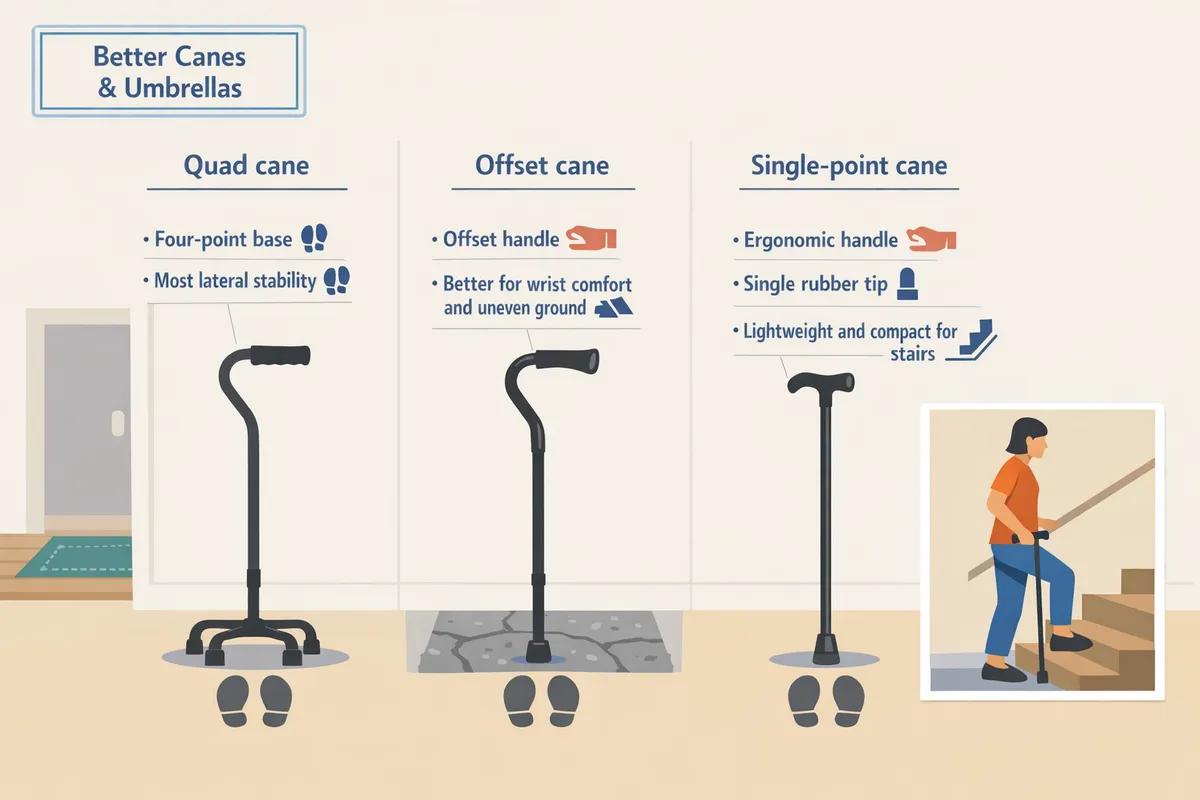
What is a quad cane and who benefits from it? 🦯
A quad cane is a walking cane type that provides a four-point base and offers the most lateral stability of common cane designs. A four-point base increases the support surface by roughly two to three times compared with a single-point cane. This larger footprint makes quad canes a common recommendation for seniors with marked balance impairment, people recovering from a stroke, or users with unilateral weakness who need a broad support area when standing or turning. For example, a person with left-side weakness who cannot trust a single tip during short transfers will often feel safer with a quad base on flat surfaces. Quad canes trade off compactness: they handle narrow doorways and stairs poorly because the base is bulkier. Better Canes Umbrellas offers several quad models that balance a slim profile with a stable four-point base to help buyers test fit in-store or at home.
⚠️ Warning: Quad cane bases can catch on stair edges. Use a rail when ascending or descending until you are practiced with the cane.
What is an offset cane and when should you choose it? 🧭
An offset cane is a walking cane type that places the shaft behind the handle to align load over the shaft and reduce wrist strain. The offset design moves the user's weight closer to the cane centerline so less wrist torque occurs while walking. That makes offset canes a good match for people with mild balance problems who also have wrist arthritis or pain, and for users who prefer a more natural arm position during longer walks. For instance, a commuter who walks 20 minutes each way and has occasional ankle wobble but persistent wrist soreness will often prefer an offset cane for comfort on pavement. Offset canes pair well with ergonomic grips like anatomical or palm grips. Better Canes Umbrellas lists offset options with cushioned grips that customers test for wrist comfort before purchase.
How does a single-point cane compare for balance? ⚖️
A single-point cane is a walking cane type with one contact point that prioritizes portability and maneuverability over maximum stability. Single-point canes weigh less and fit narrow spaces, so they work well for users who need occasional support rather than continuous lateral stability. People who usually have steady gait but need help with short distances, minor unevenness, or stairs often prefer single-point canes; physical therapists commonly recommend them during late-stage rehab. For example, a person who uses a cane mainly for curb negotiation and stairs will appreciate a single-point cane that fits through tight hallways and stores easily. Better Canes Umbrellas carries stylish single-point models and compact folding sticks for commuters and travelers.
Quick comparison table: choosing the best walking cane for balance and stability 📊
Use the table below to match base size, typical weight capacity, portability, terrain suitability, and recommended user profiles for the best walking cane for balance and stability.
| Cane type | Base size (footprint) | Typical weight capacity | Portability | Best terrain | Recommended user profile |
|---|---|---|---|---|---|
| Quad cane | Large (4-point) | 200–300 lb typical | Low (bulkier) | Flat indoor, short outdoor level walks | Users with marked balance loss, unilateral weakness, frequent standing transfers |
| Offset cane | Medium (single tip with offset shaft) | 200–300 lb typical | Medium (standard shaft) | Pavement, shopping centers, smooth outdoor paths | Users with mild balance issues plus wrist pain or long walking distances |
| Single-point cane | Small (1 tip) | 200–300 lb typical | High (lightweight, foldable options) | Stairs, narrow corridors, uneven short distances | Users needing occasional support, commuters, late-rehab patients |
How should I size and fit a walking cane to improve balance and prevent falls?
Correct cane sizing keeps the spine aligned and reduces fall risk by producing a 20–30 degree elbow bend while you walk. Proper fit, the right handle, and a quick home check prevent leaning, shoulder strain, and unstable footing. Below are simple measurement steps, handle guidance for neuropathy or arthritis, and a one-minute fit checklist you can do now.
How to measure cane height with a quick calculator 🧮
Measure cane height from the floor to the wrist crease while standing naturally; that measurement gives the correct cane length for a 20–30 degree elbow bend. For example, stand in shoes you normally wear, relax your arm at your side, and measure from the floor to the wrist crease. If that distance is 36 inches, choose a cane that adjusts to or is sold at 36 inches so the elbow bends roughly 20–30 degrees when you hold the grip. Common sizing errors include choosing a cane that is too short (causes hunching and extra weight through the hand) or too long (causes leaning and hip strain). Our Better Canes Umbrellas catalog lists adjustable walking sticks and fixed-length walking sticks so you can match this measurement precisely.
Which handle styles reduce wrist pain and aid balance? ✋
Palm-shaped, ergonomic, and foam-padded handles reduce wrist pressure and help users with neuropathy or arthritis keep a secure hold. Below is a quick comparison of common handle styles and when to choose each.
| Handle type | Best for | Slip resistance | Wrist strain |
|---|---|---|---|
| Palm-shaped (derby with wide top) | Neuropathy, arthritis, wide palms | Medium | Lowers peak pressure across the palm |
| Ergonomic contoured | Users who need pressure-distribution | High | Reduces wrist extension and pain |
| Foam-padded | Small hands, cold sensitivity | Medium-High | Cushions impact but can compress over time |
| Offset handle | Reduces leaning and forearm torque | High | Keeps wrist neutral during push |
Practical examples: customers with fingertip numbness often do better with a larger-diameter palm-shaped grip to avoid concentrated pressure. If you experience wrist extension pain when placing weight through the cane, try an ergonomic or offset handle. Our Better Canes Umbrellas walking sticks section highlights several grip styles, including padded and contoured options to test at home.
One-minute fit test and checklist for walking sticks for seniors with support ✅
Perform a quick, five-step fit test to confirm a cane fits and does not introduce a new fall risk. 1) Stand in your normal shoes and hold the cane in the hand opposite the weaker leg. 2) Verify the cane top aligns with your wrist crease while your arm hangs naturally. 3) Check for a 20–30 degree elbow bend when you grasp the handle. 4) Place the cane tip on a flat surface and press down; it should sit flat and not wobble. 5) Walk five normal steps and check for a limp or shoulder raise. If you limp, feel pain, or the cane tip slips, adjust the length or try a different grip.
⚠️ Warning: Replace a worn or smooth cane tip before using stairs; a compromised tip increases slip risk on steps.
When to consult a clinician: book a gait or occupational therapy assessment if you still feel unstable after adjusting height and grip, experience new pain when using the cane, or need help choosing a bariatric or terrain-specific base. Our website's product notes for Better Canes Umbrellas items indicate which sticks are sold with larger bases or extra-stable tips suitable for uneven outdoor surfaces.
⚠️ Warning: Never use a cane beyond its rated capacity or modify the shaft; both actions increase the risk of sudden failure and falls.
What advanced resources and next steps should I use? 📄
Use fit checklists, a height calculator, and step-by-step fit videos to confirm ongoing fit and fix small problems quickly. Download our printable fit checklist to record monthly inspections, use the height calculator to confirm cuff and handle position after any replacement, and watch our short videos that demonstrate correct grip, stairs technique, and how to swap a rubber tip safely. For product guidance, browse our category pages for quad, offset, and bariatric canes to compare bases and handles visually and pick the model that matches your daily terrain and body size.
Practical next steps:
- Run the printable fit checklist this week and mark recurring issues.
- Use the height calculator after any replacement parts arrive.
- If questions remain, contact our customer service with photos for personalized advice.
Frequently Asked Questions
This FAQ answers the practical questions readers search for about choosing, fitting, and using walking canes for balance. Each answer gives a direct recommendation first, then a short, actionable detail or example to help you shop and stay safe.
How do I know which cane type is best for my balance needs? 🧐
Match cane type to your primary balance challenge: quad for the largest footprint, offset for wrist-friendly support, and single-point for portability. Quad cane is a cane type that provides a four-point base for maximum lateral stability on level surfaces; choose a wide-base quad if standing stability is your main need. Offset cane is a cane type that positions weight behind the handle to reduce wrist strain, which suits users who feel pressure in the hand or need a more natural wrist angle. Single-point cane is a cane type that best fits commuters or travel because it is lighter and easier to store. Use the one-minute fit test and a short terrain checklist (mostly indoor, mostly uneven outdoors, many stairs) to confirm the right category, and browse our Better Canes Umbrellas selection to compare models by base size and handle shape.
Can a cane prevent falls for seniors with neuropathy? 🦵
A properly fitted cane reduces fall risk for seniors with neuropathy but cannot eliminate the risk entirely. Choose grips that increase tactile feedback (textured or contoured handles) and wider bases or quad designs to improve contact and stability for reduced sensation in the feet. Pair cane use with clinician guidance, regular vision and foot checks, and home-hazard reduction like removing loose rugs and installing night lights. Our Better Canes Umbrellas collection lists canes with high-traction tips and ergonomic grips that suit neuropathy-specific needs.
Is a quad cane safe on stairs and elevators? ↕️
Quad canes are stable on level ground but often awkward on stairs, narrow hallways, and elevators. On stairs, use the handrail and the step-to technique (bring the cane to the same step as the lower foot while keeping weight on the rail) or switch to a single-point or offset cane before climbing if you routinely use stairs. Avoid turning or pivoting with a quad cane on small elevator platforms; switch to a compact cane or rely on the elevator's handrail. Our Better Canes Umbrellas range includes compact single-point and offset models specifically noted for stair and tight-space use.
How often should I replace the rubber tip on my cane? 🔁
Replace the rubber tip when the tread is worn smooth, inner metal shows, or the tip slips during a simple grip test; for daily users this commonly occurs every 6 to 12 months. Test tip grip monthly by pressing the cane forward on a dry surface and twisting gently; any sliding or cracking means replace the tip immediately. Keep a spare tip in your bag when walking outdoors and carry one spare when traveling. > 💡 Tip: Store a spare replacement tip in your coat pocket so you can swap it within seconds if you notice reduced traction. Better Canes Umbrellas sells matching replacement tips and spare packs for most of our walking sticks.
What weight capacity do I need for a bariatric cane? ⚖️
Choose a cane with a rated weight capacity at least 25% above your body weight and with a reinforced shaft for durability. Check the manufacturer specifications and warranty for long-term support; look for sold-steel or aircraft-grade aluminum shafts and welded or bolted handle fixtures for bariatric use. If you are close to a rating threshold, select the next higher class or one of our heavy-duty models to avoid accelerated wear. Our Better Canes Umbrellas heavy-duty category groups canes by rated capacity and construction so you can compare durability and warranty details.
Are there cane features to help with arthritis in the hands? 🤲
Ergonomic grips, larger-diameter handles, and cushioned or molded materials reduce pressure on arthritic joints and improve comfort. Try grips in person when possible and prefer grips that spread load across the palm, such as derby or ergonomic T-handles; padded covers and silicone sleeves reduce vibration and local pressure. Choose models that accept aftermarket handles or order canes with interchangeable grips if you expect progression in hand pain. Our Better Canes Umbrellas product pages note grip diameter and material so you can filter for arthritic-friendly handles.
Final checklist for choosing, fitting, and using a walking cane safely.
You should leave this guide able to pick a properly sized cane, test its base and grip, and practice safe steps on flat ground and stairs. Choosing the right cane reduces trip risk and saves time by avoiding returns. Use the wrist-crease fit check, test quad or round bases on the surfaces you walk most, and prioritize comfort during short trial walks.
💡 Tip: Try a cane for at least 15 minutes while wearing your usual shoes before deciding on height or base size.
Better Canes & Umbrellas Inc., founded in 2000 and based in Chatham, NJ, is an online and retail seller focused on umbrellas, walking sticks (including novelty sticks and hiking sticks), and shoe horns. The company expanded its assortment in 2005 to include a wide range of walking and novelty sticks and later added shoe horns in unique styles and designs. Their catalog fits use cases from commuter umbrellas to supportive walking sticks and collectible canes.
Browse Better Canes Umbrellas to compare models and order a Support & Comfort Cane to test your fit and stability. Subscribe to our newsletter for sizing tips and product updates.