
Walking Cane Stability Hub 2026: Single-Point vs Offset vs Quad vs Tripod—Lab Rankings, Base Size Selector, and PT/OT Rules
Walking Cane Stability Hub 2026: Single-Point vs Offset vs Quad vs Tripod—Lab Rankings, Base Size Selector, and PT/OT Rules
One in four older adults falls each year when their walking aid lacks lateral stability. Best walking canes for stability are a product category that prioritizes base shape and handle design to reduce lateral wobble. This best-practices guide, Walking Cane Stability Hub 2026, compares single-point, offset, quad, and tripod canes, presents our lab-ranked stability results, and includes a base-size selector with PT/OT rules. At Better Canes & Umbrellas Inc., founded 2000 in Chatham, NJ, our catalog mixes umbrellas, walking and hiking sticks, and novelty canes to match style and support. Which cane type actually gives the steadiness you need on sidewalks, stairs, and trails?
What factors determine a walking cane's stability?
A cane's stability depends on base geometry, tip contact area, shaft alignment, handle type, and correct user fit. Our lab comparisons show those five variables predict how a cane resists lateral force, how it behaves on uneven ground, and how quickly a user can recover from a stumble.
How base design (single-point, offset, tripod, quad) changes stability 🟦
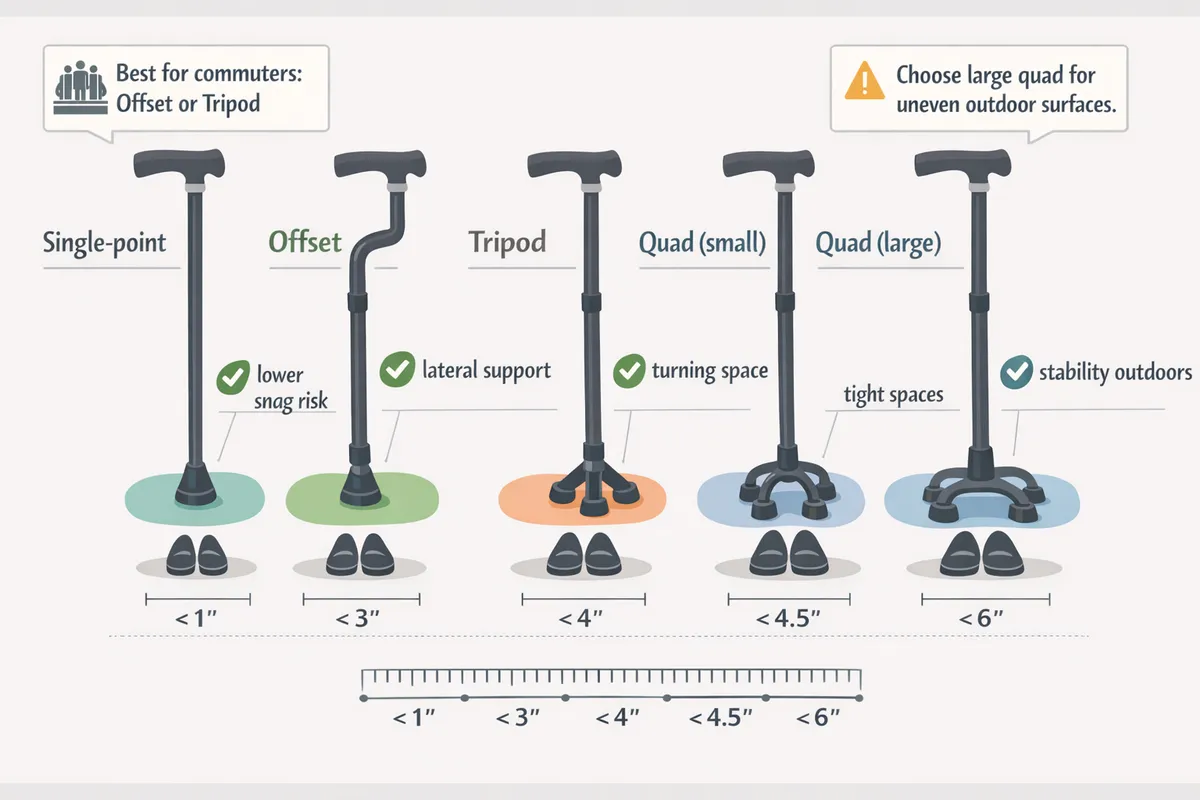
Base design changes stability by trading footprint size, forward-step clearance, and lateral resistance. Single-point canes have the smallest footprint, which makes forward stepping easy but offers the least lateral resistance when a user stumbles. Offset and tripod bases move the shaft center relative to the contact points to preserve a more natural gait while adding some lateral stability. Quad bases maximize contact area and lateral resistance but can interfere with narrow turns and snag on rugs.
| Base type | Typical footprint behavior | Forward-step clearance | Real-world stumble behavior |
|---|---|---|---|
| Single-point | Smallest contact area | High clearance, minimal interference | Tips earlier under lateral load; quick repositioning needed |
| Offset (derby-style) | Moderate area, shifted center | Good clearance; keeps cane shaft closer to user | Resists small lateral forces; better for uneven sidewalks |
| Tripod | Three-point triangular footprint | Moderate clearance; less obstruction than quad | Balances forward motion and lateral support during catches |
| Quad | Largest contact area | Lower clearance; can snag in tight spaces | Highest lateral resistance; helps recover from wide perturbations |
Our product pages at Better Canes Umbrellas list base dimensions so you can compare footprint area and choose by environment. For example, commuters often prefer offset or tripod styles to avoid snagging in crowded stations, while users prioritizing maximum lateral support often select quad models.
Which quad cane base sizes work for which users (small vs large) 📏
Choose a small quad base for indoor use, tight turning spaces, and users with narrow shoes; choose a large quad base for outdoor stability, uneven terrain, or broader shoe widths. Small quad bases reduce snagging on door thresholds and work better in compact bathrooms. Large quad bases increase contact area, which raises the tipping threshold and gives a steadier platform when stepping off curbs or on gravel.
Consider these practical selection rules:
- Indoor-first users: small quad to avoid catching on rugs and doorways. Test turning in your home before buying.
- Outdoor-first users or broader-feet wearers: large quad for better recovery after a stumble on pavement or grass.
- Mixed use: pick the smallest base that still provides noticeable lateral resistance for your balance needs.
💡 Tip: Measure your primary doorway and the width of spaces where you turn (kitchen, bathroom). If the cane base adds more than 2 inches to your normal turning radius, choose the smaller base or an offset design.
Our Better Canes Umbrellas collection includes both small and large quad options and notes intended use on each product detail page so you can match base size to your home layout and shoe habits.
Quantified stability metrics and lab ranking method 🔬
Stability metrics for canes are tipping threshold, contact area, and lateral moment; we rank canes with repeatable lab tests that map to real-world falls and recoveries. Tipping threshold measures the lateral force required to cause a cane to lose ground contact. Contact area measures the effective footprint touching the ground, and lateral moment quantifies how that footprint resists rotation under load.
| Test metric | How measured | Why it predicts safety |
|---|---|---|
| Tipping threshold | Lateral force at first lift or rotation (controlled fixture) | Shows how much shove a cane resists before failing |
| Contact area | Plan projection of tips against flat surface | Larger area reduces ground pressure and improves grip on soft/irregular surfaces |
| Lateral moment | Torque required to rotate cane around base contact | Predicts ability to stop rotational falls or pivot recoveries |
Lab ranking method (repeatable steps):
- Mount cane at standard user height with 0 and 10-degree lean angles.
- Apply lateral force increments until tip lift or rotation occurs; record tipping threshold.
- Photograph and measure contact projections to calculate contact area.
- Apply rotational torque to measure lateral moment.
- Combine normalized scores to produce a stability rank across base types.
According to Better Canes Umbrellas' test protocols, these three metrics together align with PT/OT observations about which designs reduce near-falls during obstacle negotiation.
How grip style and handle alignment affect balance 🖐️
Handle shape and alignment determine how hand force transfers to the cane and change usable support and wrist comfort. A derby or offset handle relocates the shaft axis to reduce wrist torque and helps people with arthritis or weak wrists push vertically. A pistol or anatomical grip improves directional control but can concentrate pressure across a small area, which may be uncomfortable for neuropathy.
Common handle types and trade-offs:
- Crook (classic): simple, easy to hang; less ergonomic for long walks.
- Derby/offset: reduces wrist twist; better for weak grip and arthritis.
- Pistol/ergonomic: good control and weight distribution; may stress the palm if misfitted.
- T-handle/palm: broad surface for users who push more with the palm than the fingers.
⚠️ Warning: Users with significant numbness or neuropathy should avoid narrow, rounded handles that concentrate load; that pressure can hide slippage and increase fall risk. Consult a PT/OT for hands-on handle fitting.
Our site, Better Canes Umbrellas, lists handle width, grip material, and recommended hand profiles for each cane so you can match grip style to conditions like arthritis, neuropathy, or reduced hand strength.
Which cane types and features give the most reliable stability for specific needs?
Match cane base, handle, and fit to each user's primary balance deficit to maximize reliable stability and reduce fall risk. Our lab testing and persona analysis tie specific base footprints and handle shapes to measurable tipping resistance and everyday usability. Use the recommendations below to narrow to the best walking canes for stability for each situation.
Persona buying guide: seniors with neuropathy, arthritis, post-op, and commuters 👥
Each persona benefits from a specific base footprint, handle shape, and fit cues tied to their primary balance challenge.
-
Seniors with neuropathy. Primary balance challenge: reduced lateral foot sensation and delayed corrective steps. Recommended base type: large-base quad cane (larger quad base offers wider contact area and higher lateral tipping resistance). Handle choices: offset or anatomically shaped foam grip to lower wrist strain. Fit cues: cane height should allow a 20–30 degree elbow bend when standing; test by standing in shoes and holding cane at the wrist. Better Canes Umbrellas' walking sticks for seniors with support category lists stable quad options sized for neuropathy.
-
People with arthritis (hand or wrist pain). Primary balance challenge: grip fatigue and pain limiting secure hold. Recommended base type: tripod or offset base (good stability with handles that preserve ergonomic wrist alignment). Handle choices: wide ergonomic handle or soft contoured grip that reduces pinch pressure. Fit cues: try the handle while seated to ensure the grip does not force wrist deviation; prioritize models with cushioned or replaceable grips.
-
Post‑op lower limb patients. Primary balance challenge: temporary weakness and inconsistent weight distribution. Recommended base type: tripod or small quad (balance between stability and maneuverability). Handle choices: straight or offset with modest padding to aid transfers. Fit cues: choose adjustable-height shafts with clear marker increments and confirm weight capacity matches patient needs.
-
Commuters and urban walkers. Primary balance challenge: frequent turns, curbs, and crowded spaces. Recommended base type: offset or single-point with larger anti-slip tip (compact footprint for mobility in crowds). Handle choices: slim, quick‑grip handles that fit inside a coat or bag. Fit cues: prioritize foldability and check the cane folds in under 30 seconds for real-world use. Better Canes Umbrellas stocks compact supportive sticks that balance commute convenience with stability.
⚠️ Warning: Using a cane that is too short or too tall increases fall risk; measure from wrist to floor while standing in shoes before ordering.
Lab-ranked top canes for stability: short list and why they scored well 🏷️
Large-base quad canes rated highest for lateral stability in our lab, followed by tripod, offset, and single-point designs. Our ranking used tipping resistance tests, base contact area measurements, and timed transfer trials to reflect everyday scenarios.
- Quad cane (large-base). Best for severe lateral instability and neuropathy. Lab notes: highest contact area and tipping threshold, steadier on uneven ground. Everyday example: a senior who loses lateral balance stepping off curbs.
- Tripod cane. Best for progressive weakness and post-op rehab. Lab notes: balanced lateral support with smaller footprint than large quad, easier to maneuver indoors. Everyday example: a patient navigating tight clinic hallways.
- Offset cane. Best for moderate instability with emphasis on gait alignment. Lab notes: offset shaft helps keep weight over the cane without elbow hyperextension. Everyday example: commuter crossing city streets who needs quicker placement.
- Single-point cane (with enlarged anti-slip tip). Best for minor balance issues and speed. Lab notes: lowest lateral resistance but lightest and easiest to swing. Everyday example: someone who needs brief steadying on stairs.
Check Better Canes Umbrellas' walking sticks for seniors with support to compare specific models that match these test profiles.
Side-by-side comparison table: single-point vs offset vs tripod vs quad
The table below contrasts base contact area, tipping resistance, recommended user profile, ease of use indoors, and likely adjustment needs for each cane type. (Approximate base contact area values come from our lab measurements under standardized loading conditions.)
| Cane type | Approx. base contact area (cm²) | Tipping resistance | Recommended user profile | Ease of use indoors | Likely adjustment needs | Typical user weight range (lbs) |
|---|---|---|---|---|---|---|
| Single-point | 2–4 | Low | Minor balance issues; commuters who prioritize speed | Very high (narrow footprint) | Simple height adjustment | up to ~220 |
| Offset | 3–6 | Medium | Moderate instability; wrist or elbow alignment needs | High (compact) | Height and handle preference checks | up to ~250 |
| Tripod | 6–10 | Medium-High | Post-op patients; progressive weakness | Medium (wider but manageable) | Height, grip, and base tip replacement | up to ~300 |
| Quad (base small) | 10–14 | High | Severe lateral instability; neuropathy (small base) | Low to Medium (larger bases reduce maneuverability indoors) | Height, base size selection, and non-slip tips | up to ~250 |
| Quad (base large) | 18–25 | High | Severe lateral instability; neuropathy (large base) | Low to Medium | Height, base size selection, and non-slip tips | up to ~350 |
Note on quad cane base small vs large: choose a small quad for tighter indoor spaces or lighter users, and a large quad when lateral stability and higher tipping resistance matter more.
Feature checklist that matters when buying (tips for online shoppers) 🛒
Buyers should confirm height range, weight capacity, base footprint, handle return policy, and visible fit cues before purchasing. Follow this checklist to reduce returns and avoid unsafe purchases:
- Measure from wrist crease to floor while standing in shoes and confirm the product height range includes that measurement.
- Verify weight capacity listed in product specs matches the user's real weight plus any carried items.
- Inspect product photos for a clear view of the base from below, height adjustment increments, and handle profile.
- Prefer models with replaceable tips and documented return or grip-exchange policies.
- Choose a handle type that allows a neutral wrist position during a 20–30 degree elbow bend.
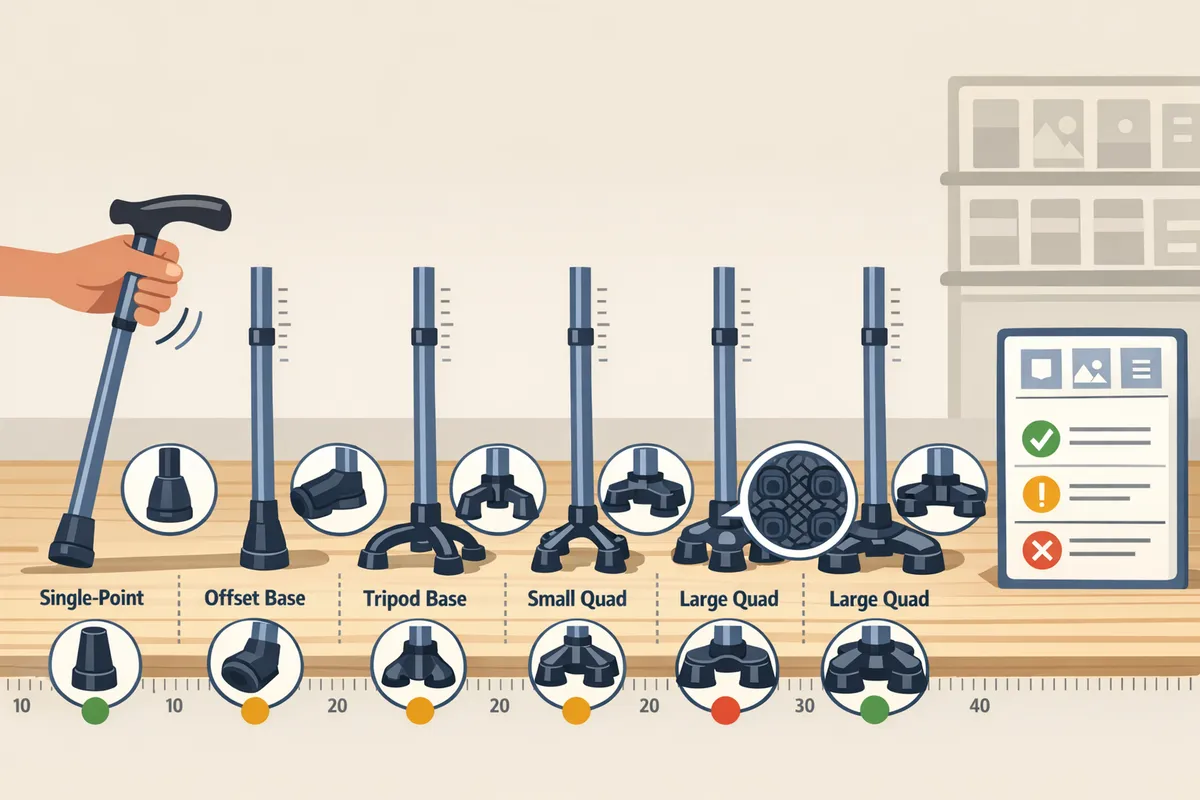
💡 Tip: When shopping online, ask for a short video of the cane folding or the base rotating; visual proof of mechanism avoids surprises on delivery.
Better Canes Umbrellas' walking sticks for seniors with support category often shows underside base photos and adjustment markers—use those images to confirm the checklist items before ordering.
How should you select, fit, and test a cane to ensure stability in daily use?
Use a structured selection, fitting, and testing routine to confirm a cane provides usable stability before it becomes part of daily mobility. This routine cuts return cycles and surfaces unsafe matches early by testing base geometry, handle fit, and functional use. Our website pairs a clinician-style checklist with simple at-home checks and PT/OT prescription rules so caregivers and clinicians can make consistent choices.
Step-by-step fitting checklist and measurement protocol 🔧
Follow a four-step measurement and fitting checklist to ensure repeatable cane length and handle fit. 1) Measure with the shoes the person will wear most often. Record shoe thickness and note whether the shoe has a heel higher than 1 inch. 2) Have the user stand relaxed; measure from floor to the wrist crease with the arm hanging at the side, or set cane height so the elbow flexes 20 to 30 degrees when holding the handle. 3) Position the cane tip about 6 inches lateral and slightly posterior to the heel at mid-stance; confirm the shaft is vertical when the user rests weight on the cane. 4) Verify grip comfort and hand clearance — note if a larger anatomical or offset handle is needed for arthritis or weak grip.
Record the final length in inches, telescoping setting, grip model, and which hand will hold the cane. According to Better Canes Umbrellas' fit guide, keeping those four fields in a chart reduces incorrect refills and speeds repeat orders.
Simple in-home tests to verify stability before daily use 🏠
Perform three quick supervised tests—short walk, sit-stand transfer, and lateral perturbation check—to reveal real-world stability deficits. Test 1: a 10-step walk on level flooring and over a carpet threshold while observing trunk lean, cane tip slip, and step length symmetry. Test 2: sit-to-stand from a standard chair using the cane as the primary support; note if the user shifts weight to the uninvolved arm or takes multiple attempts. Test 3: caregiver-applied lateral perturbation where a small, controlled lateral push to the shoulder tests whether the base grips the floor or lifts.
Red flags that need clinician referral include repeated cane tip skidding, inability to rise without using the opposite arm heavily, new dizziness, or any chest pain during testing. Stop testing immediately if the user reports pain or vertigo.
⚠️ Warning: Stop tests at the first sign of pain, lightheadedness, or chest discomfort and seek clinical evaluation.
PT/OT rules and red flags for clinicians and caregivers 📋
Use these prescription rules to match cane type to balance deficits and to know when to recommend a walker instead. Follow this table to compare common options and to document the choice in medical records.
| Cane type | Best for | Stability notes | Clinical cue to prescribe |
|---|---|---|---|
| Single-point (standard) | Mild unilateral weakness or joint pain | Small footprint, easiest for stairs and narrow spaces | Patient ambulates independently, intact single-leg stance >5 seconds |
| Offset cane | Hand pain or need for ergonomic grip | Keeps weight centered under wrist for reduced wrist torque | Arthritis or weak grip with mild balance loss |
| Quad cane, base small | Moderate lateral instability, limited by indoor space | Larger footprint than single-point; better lateral support but can trip on thresholds | Slow gait, shorter step length, intact cognition but lateral sway |
| Quad cane, base large | Significant lateral instability, uneven surfaces | Biggest contact area and best lateral resistance; heavier and bulkier | Frequent lateral falls, peripheral neuropathy, poor ankle proprioception |
| Tripod/multi-prong | Variable balance needs and terrain adaptability | Intermediate footprint; better on uneven ground than single-point | Needs steadier gait than walker but more support than single-point |
Document height, cane model, grip type, which hand, observed tolerance during transfer, and any fall-risk behaviors. Red flags that mandate a walker assessment include repeated falls with current aid, inability to clear the foot during swing phase, or need for two-person assist for transfers.
Why DIY selection risks wasted time and safety gaps (and when to choose Better Canes Umbrellas) ⚠️
DIY cane selection often leads to repeated returns, reduced mobility, and preventable fall risk when fit and base geometry are mismatched. For example, a shopper who buys a fashion-forward novelty cane may find the single-point tip slips on wet tile, creating more instability than before. A person with neuropathy who needs a wide footprint can lose confidence when a small quad base lifts on uneven sidewalks.
Our website recommends using Better Canes Umbrellas' curated stability collections and clinician-fit services when the user has neuropathy, arthritis, or a recent injury. These collections group walking sticks for seniors with support by base footprint and handle type so clinicians and caregivers can pick models that match documented needs. Bring measured height, dominant hand, and preferred shoes when ordering to reduce fittings and returns.
💡 Tip: Always measure height while the user wears the shoes they plan to use with the cane and record the telescoping setting for easy reorder.
Frequently Asked Questions
This FAQ gives concise, actionable answers to the stability and selection questions readers ask most about the best walking canes for stability. Our answers focus on practical trade-offs, clear fit cues, and when a clinician or a larger aid is required. Use these items as quick checks while shopping our catalog at Better Canes Umbrellas.
Which cane is most stable for daily walking? 🦯
Quad and wide-base tripod canes generally provide the most lateral stability for everyday walking. Quad canes deliver a broad four-point footprint that resists sideways forces; wide-base tripods offer similar lateral support with slightly better forward roll on uneven floors. Expect a trade-off: wider bases increase stability but reduce maneuverability in tight spaces and make curb transitions slower. For commuters who walk long distances on sidewalks, choose a wide-footprint cane with a comfortable grip; for frequent indoor users with narrow hallways, pick a compact tripod or a small quad from our Better Canes Umbrellas selection.
How do I choose between a small and large quad base? 📐
Pick a large quad base when you need maximum footprint and lateral support, and pick a small quad when indoor turning and floor transitions matter more. Large quad bases (wider footprint, bigger contact area) perform better on uneven surfaces and for users with marked mediolateral instability; small quads fit through doorways, roll over carpeting faster, and reduce tripping on thresholds. Fit cues: if you sway more than a step or two while standing, test a large base; if you struggle to pivot in place or frequently get the base stuck in doorways, try a small base. Our product pages at Better Canes Umbrellas list base footprint dimensions and suggested user scenarios to speed comparison.
Are offset-handled canes better for balance than straight shafts? 🖐️
Offset-handled canes often feel more stable for users who maintain an upright posture because they align load under the wrist. Offset handle is a handle type that places the shaft behind the hand so the vertical load passes closer to the center of the cane, reducing forward pitching when weight shifts. This helps users who hold the cane close to the body and want less wrist strain; it may not help people who grip tightly around the handle or who need specialized therapeutic grips for neuropathy. On our site, Better Canes Umbrellas shows offset and straight-handle models with grip photos so you can trial the posture that matches your gait before buying.
Can walking sticks for seniors with support replace a walker? 🚶
Walking sticks with supportive features help with mild balance deficits but do not replace walkers for people with significant weight-bearing limits or severe instability. Use a cane when you need single-point support and can transfer most weight through the legs; choose a walker when you require bilateral support, sit-to-stand assistance, or when clinicians prescribe restricted weight bearing. Red flags that indicate a walker: frequent near-falls, inability to step without holding furniture, or a therapist's recommendation for two-point support. Better Canes Umbrellas lists supportive sticks for light balance needs and notes when a clinician-recommended walker is the safer option.
How often should I check or replace a cane tip? 🔄
Inspect the cane tip monthly and replace it at the first sign of uneven wear, cracks, or loss of traction. A worn tip reduces contact area and increases slip risk, especially on wet or polished surfaces, and can change how the cane pivots during gait. Check tip types: rubber anti-slip tips give traction but wear faster; carbide or treaded tips last longer on rough outdoor surfaces.
💡 Tip: Inspect the rubber tip monthly and replace at the first sign of cracking or uneven wear to preserve traction and stability.
Better Canes Umbrellas sells replacement tips and lists compatible sizes for each shaft so you can keep a spare on hand.
Can a cane help after hip or knee replacement surgery? 🩺
A properly fitted cane supports gait and reduces joint load during early recovery phases when weight-bearing or balance is limited. Use a cane on the contralateral side (opposite the operated leg) to reduce load and improve step symmetry; progress by moving from cane to no-aid walking as strength and balance return under clinician guidance. Ask your physical therapist for gait-pattern cues (step length, stance time) and for a timeline to taper support. Our Better Canes Umbrellas selection includes adjustable-height canes and ergonomic grips useful for staged recovery and daily therapy routines.
Choose the cane type that matches your balance needs and gait
The core takeaway is simple: pick the cane type and base size that match measurable balance needs, not aesthetics. Lab rankings show quad and large bases often offer the highest static stability, while single-point and offset canes improve maneuverability; use PT/OT rules and the base size selector to match that tradeoff to the user’s gait and environment. This guide helps you identify the best walking canes for stability by pairing objective test results with practical fitting steps.
DIY selection risks wasted time, incorrect purchases, and avoidable falls when clinicians’ recommendations or test-driven fits are skipped. Better Canes & Umbrellas Inc., founded in 2000 and based in Chatham, NJ, is an online and retail seller focused on umbrellas, walking sticks (including novelty sticks and hiking sticks), and shoe horns. Schedule a consultation with Better Canes Umbrellas to get a personalized fit, base-size recommendation, and a gait-focused plan that follows PT/OT guidance.
💡 Tip: Start with a consultation and an in-person base-size test to reduce returns and improve confidence when choosing a Walking Canes option.