
Walking Cane Height Calculator
Walking Cane Height Calculator
A mis-sized walking cane, even off by two inches, can worsen posture and increase fall risk during daily walks. A walking cane height calculator is an online tool that converts body measurements into recommended cane lengths using three proven sizing methods. In this best-practices guide in our Walking Cane Guide, our website shows how to measure with the elbow method, the wrist method, and the angling test, how to use the built-in calculator, and how to match the result to items in our catalog. Better Canes & Umbrellas Inc., founded in 2000 in Chatham, NJ, sells walking sticks, hiking sticks, novelty canes, umbrellas, and shoe horns. Which sizing method fits your gait best?
How Do I Calculate the Correct Walking Cane Height?
Use one of three methods: the height-based formula, the wrist-height method, or the ground-to-wrist measurement, then adjust for shoe heel height and cane type. A walking cane height calculator uses inputs such as user height, usual shoe heel height, and wrist crease position to return a single recommended cane length plus alternative options for straight or quad canes. Our catalog at Better Canes Umbrellas maps those results to the product sizes we carry so shoppers choose the best match quickly.
What is a walking cane height calculator? 🧮
A walking cane height calculator is a tool that converts a user's body measurements into a recommended cane length for safe posture and gait. It is a measurement tool that takes height, shoe heel height, and wrist crease or ground-to-wrist measurements and returns one or more target cane lengths. Required inputs for accurate results:
- User height (stand straight, in inches or cm).
- Typical shoe heel height (add this to the base height).
- Wrist crease height or ground-to-wrist measurement (for wrist method).
- Cane type (straight, quad, or hiking stick) to apply small adjustments.
According to common clinical fitting guidance, the height formula (height ÷ 2 + 0.5 inch) is the most frequently used baseline by clinicians and retailers. Better Canes Umbrellas uses the same inputs to suggest both standard-length sticks and alternative sizes for novelty or hiking sticks so you can match fit to style and function.
Quick step-by-step calculator method 📏
Measure standing in the shoes you wear most, note either wrist crease height or total height, enter those numbers, and then apply the chosen method's rounding rule to match product increments. Follow these steps exactly:
- Put on the shoes you will normally wear with the cane. This prevents undersizing from counting barefoot height.
- Stand upright with shoulders relaxed and arm hanging naturally at your side. Have a helper if possible.
- For the wrist method, measure from the floor to the wrist crease (the small fold where your hand meets the wrist). Record this to the nearest 0.5 inch.
- For the height formula, convert total height to inches and compute height ÷ 2 + 0.5 inch. Example: a 5'6" (66 in) person gets 66 ÷ 2 + 0.5 = 33.5 in, which rounds to a 34 in cane for 1-inch product increments.
- Apply cane-type adjustment: add roughly 0.5–1.0 inch for many quad-base canes or bulky hiking-stick grips so the user doesn't lean forward.
💡 Tip: Measure while wearing the shoes you use most. A 1-inch heel changes cane length choice and posture.
Better Canes Umbrellas lists product lengths in 1-inch steps; use the rounding rule above to pick the nearest stocked size.
Cane size chart by height (quick reference) 📋
Use the table below to convert common user heights to standard cane lengths and follow the rounding rule for 1-inch product sizes.
| User height (approx) | Recommended cane length | Rounding rule | Notes for cane type |
|---|---|---|---|
| Under 4'8" (under 56 in) | 28 in | Round to nearest inch | Consider child-sized or short-length canes from our catalog |
| 4'8"–4'10" (56–58 in) | 29–30 in | Round to nearest inch | Straight canes usually fit; novelty grips available |
| 4'10"–5'0" (58–60 in) | 30–31 in | Round to nearest inch | Check shoe heel before final pick |
| 5'0"–5'2" (60–62 in) | 31–32 in | Round to nearest inch | Hiking sticks may need +0.5–1 in |
| 5'2"–5'4" (62–64 in) | 32–33 in | Round to nearest inch | Better Canes Umbrellas stocks many 32–33 in sizes |
| 5'4"–5'6" (64–66 in) | 33–34 in | Round to nearest inch | Example: 5'6" → formula gives 33.5 in → choose 34 in |
| 5'6"–5'8" (66–68 in) | 34–35 in | Round to nearest inch | Quad canes: consider adding 0.5–1 in |
| 5'8"–6'0" (68–72 in) | 35–37 in | Round to nearest inch | Choose longer shafts for taller users |
| Over 6'0" (over 72 in) | 37–39 in | Round to nearest inch | Look for extended-length hiking sticks when needed |
⚠️ Warning: A cane that is too short or too long changes posture and increases trip or fall risk. If fit is borderline, choose the longer size and use a wrist-height check.
Better Canes Umbrellas clearly labels product lengths and recommended uses on each walking stick and hiking stick page so you can match the calculator result to a stocked item without guesswork.

Which Sizing Method Should I Use for Canes vs Hiking Sticks?
Choose a sizing method based on the activity: use the height-based formula for everyday straight canes, the wrist-height method for posture-sensitive walking, and hiking adjustments for outdoor sticks. These three approaches balance speed, accuracy, and the demands of commuting, long walks, or trail use. Match the result from a walking cane height calculator to the type of product you need in the Better Canes Umbrellas catalog to avoid trial-and-error sizing.
Height-based formula: fast everyday option
The height-based formula gives a quick recommended cane length using height ÷ 2 plus 0.5 inch. This method works well for straight canes used by commuters and shoppers who want a fast match without measuring on the body. Pros: very fast, easy to enter into a cane size chart by height, and reliable for users who need occasional balance support. Cons: it does not account for posture quirks or shoe heel height and can leave long-walkers slightly forward-leaning. Example: a 68-inch person gets 68 ÷ 2 = 34, plus 0.5 = 34.5 inches; round to the nearest available cane length (34 or 35 inches). Better Canes Umbrellas lists common straight-cane lengths and clear rounding rules so customers can pick the closest stock size.
💡 Tip: Measure wearing the shoes you normally use. If you wear 1-inch heels daily, add 1 inch to the calculator input to match real-world cane height.
What is the wrist-height method? 🖐️
The wrist-height method sets cane length so the handle sits at the crease of your wrist when your arm hangs naturally. This produces a fit that preserves upright posture and reduces shoulder strain for people who walk long distances or use a cane all day. How to do it: stand upright in your usual shoes, relax your arm at your side, and measure from the floor to the wrist crease; use that number as the cane length or round to the nearest available size. Use this method when posture matters more than speed; physical therapists often prefer it for rehabilitation patients. Better Canes Umbrellas carries adjustable and precisely sized models for shoppers who need wrist-height accuracy without custom fabrication.
How tall should a walking stick be for hiking? 🥾
A hiking stick should fall between your wrist and elbow, adjusted shorter for steep uphill and longer for downhill stability. On flat, moderate trails aim for wrist-height for a natural pole rhythm. If you carry a heavy pack, reduce length by 1 to 2 inches to maintain an efficient forward lean. For steep ascents shorten by 1 to 2 inches to reduce strain on shoulders; for steep descents lengthen by 1 to 2 inches for better braking and balance. Example: if your wrist-height measure gives 36 inches, set 34–35 inches for long uphill sections and 37–38 inches for fast downhill sections. Better Canes Umbrellas offers telescoping hiking sticks so you can make those 1–2 inch changes on the trail without multiple poles.
⚠️ Warning: Using a hiking stick that is too long on steep uphill terrain increases the risk of overreaching and ankle rolls.
Comparison table: height vs wrist vs ground-to-wrist
The table below compares accuracy, measurement time, ideal users, and typical cane-type adjustments for each method.
| Method | Accuracy (fit for long use) | Time to measure | Ideal users | Typical adjustments for cane type |
|---|---|---|---|---|
| Height-based (height ÷ 2 + 0.5) | Moderate. Good for short use or balance aid. Example: fast shopper match. | Fast. One numeric input to a walking cane height calculator. | Commuters, casual users, gift buyers referencing a cane size chart by height. | Straight canes: none. Quad canes: add 0.5–1 inch for stability. |
| Wrist-height (floor to wrist crease) | High. Preserves posture for extended walking. Example: recommended by clinicians for daily users. | Moderate. Requires standing measurement in shoes. | People who walk long distances, rehab patients, posture-focused walkers. | Adjustable-handle canes and offset-handle models benefit from exact wrist measure. |
| Ground-to-wrist (arm relaxed) | High when measured carefully; accounts for limb length anomalies. | Slowest. On-body, requires helper for accuracy. | Users with uneven limb length, prosthetics, or medical conditions. | Quad and bariatric canes often need 1 inch extra; hiking sticks adjust per terrain. |
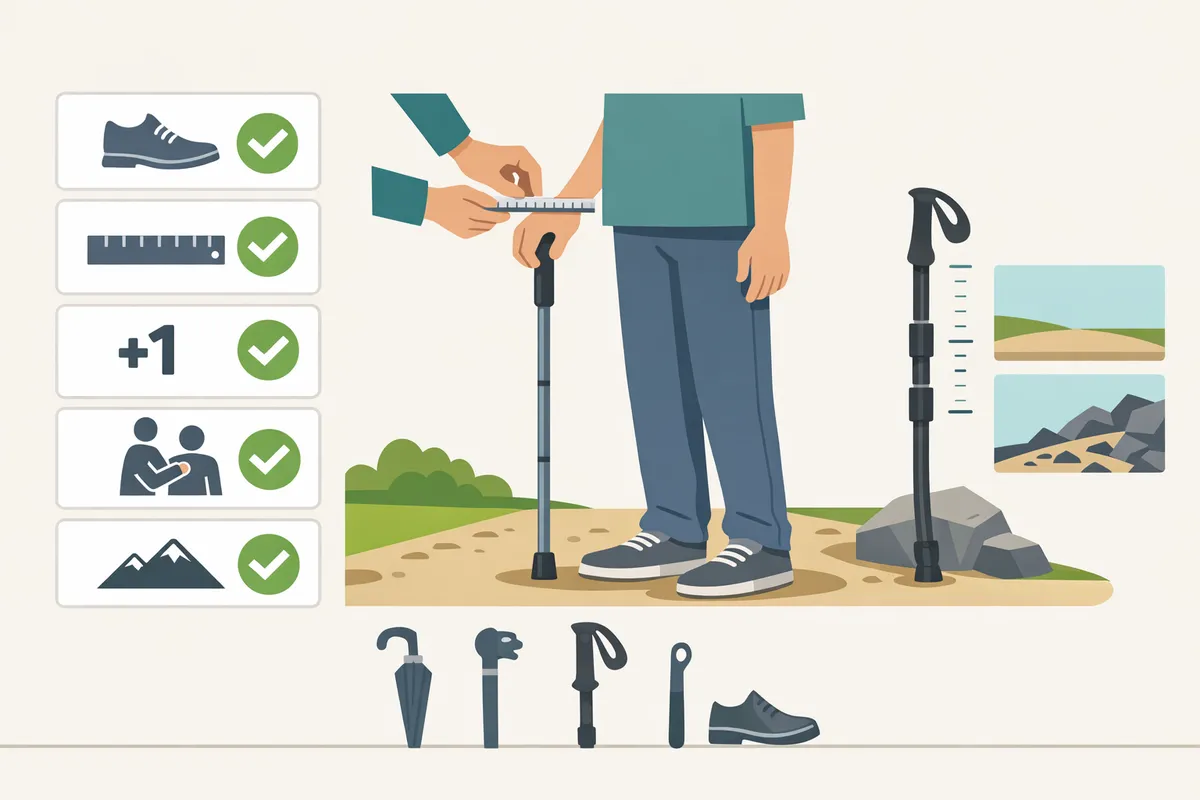
How Do I Measure, Adjust, and Choose a Cane from Our Catalog?
Measure in the shoes you will wear with the cane, apply rounding rules for standard product lengths, adjust by cane type and activity, and then use Better Canes Umbrellas' catalog filters to pick the nearest available model. This process reduces fit errors and return cycles by matching a real-world measurement to the exact lengths we list. Follow the checklists and adjustment rules below to use the walking cane height calculator result and find a cane that fits on the first try.
Exact measurement steps and rounding rules 🧭
Use a consistent method: either the height-based formula, the wrist-height method, or the ground-to-wrist measurement, then round to the nearest standard cane length. The height-based formula is a sizing method that estimates cane length by dividing body height and applying a small offset. The wrist-height method is a sizing method that measures from the floor to the wrist crease while standing relaxed. The ground-to-wrist measurement is a direct measurement from floor to wrist crease that removes conversion steps.
Follow this numbered checklist at home before you consult the walking cane height calculator:
- Put on the shoes you will use most with the cane. This avoids repeated returns and inaccurate fit.
- Stand erect with weight evenly on both feet and your arm relaxed at your side.
- For wrist-height: measure from the floor to the crease at the base of the wrist. Record the number in inches.
- For height-based (if you prefer quick conversion): note your height in inches and apply the calculator's formula. Example: a 68-inch person using the common conversion (height ÷ 2 plus 0.5 inch) gets 68 ÷ 2 + 0.5 = 34.5 inches.
- Round the result to the nearest 1-inch standard length our catalog uses. If the measurement ends in .5, choose the next longer size for better stability.
Example: a measured wrist-height of 34.5 inches should be rounded up to a 35-inch model. Use the walking cane height calculator to confirm and export that target length.
💡 Tip: Measure with the shoes you will wear most often with the cane to avoid repeated returns.
Adjusting length by cane type and activity 🦯
Adjust straight canes minimally, make quad canes about 0.5–1 inch longer for clearance, and shorten hiking sticks for steep uphill use. Quad cane geometry places the base slightly forward and wider, which typically requires a small extra inch so the handle clears clothing and the user maintains upright posture. For example, if your rounded straight-cane target is 35 inches, choose a 35.5–36 inch quad cane when options exist.
Hiking sticks are activity tools rather than posture supports; for downhill use keep them at the base calculated length, and for sustained uphill sections shorten the pole by 1–2 inches to allow a stronger forward lean and better planting. If you plan mixed use—commuting plus weekend hikes—pick an adjustable hiking stick from Better Canes Umbrellas so you can fine-tune length on the trail without buying two poles.
Choose adjustable models when your measurement falls between two standard sizes. An adjustable cane preserves gait mechanics and reduces the risk of shoulder strain compared with an ill-fitting fixed-length model.
How to match your result to Better Canes Umbrellas' catalog 🛍️
Use Better Canes Umbrellas' length filters and product pages to match your calculated length to available models and avoid ill-fitting purchases. Start by entering your rounded target into the walking cane height calculator, then filter the catalog by "length" and "intended use" (everyday, hiking, novelty). Each product page lists available lengths and recommended activities so you can confirm fit before you add to cart.
If a style is only offered in fixed increments and your measurement sits between sizes, pick the next longer size or choose an adjustable version listed on the same product page. For shoppers who value style and function, our catalog separates commuter and hiking categories so you can compare handle shapes and base types without scrolling through unrelated novelty sticks. Better Canes Umbrellas has served customers since 2000 and lists length specs clearly to speed selection and reduce returns.
Special populations and exceptions (children, prosthetics, limited mobility) ⚠️
Children, users with prosthetics, and people with limited range of motion often require professional fitting or an adjustable cane rather than relying only on a calculator. Small adults and children usually need youth-specific lengths or adjustable canes because adult standard increments often skip sizes that fit a growing child. For prosthetic users, the cane must match gait timing and step length; consult a prosthetist or occupational therapist to avoid compensatory posture changes.
When range of motion is limited, the wrist-height method can undercount required reach because the arm cannot hang naturally. In those cases choose an adjustable cane and book a brief fitting with an occupational therapist to set the starting length. Avoid buying fixed-length models for recent surgery or major mobility changes until you have clinical approval.
⚠️ Warning: For major mobility needs or recent surgery, consult a clinician before relying solely on a self-measurement tool.
Frequently Asked Questions
These frequently asked questions answer common sizing, measurement, and product-selection concerns for users of a walking cane height calculator. Our answers focus on practical checks, rounding rules, and when to get professional help so you buy a cane that fits your daily needs. Better Canes Umbrellas recommends verifying any calculator result with a short stance test and a trial walk.
How accurate is a walking cane height calculator? 🧾
A walking cane height calculator gives a reliable starting estimate but cannot replace a stance test and brief trial walk. Use the calculator to narrow choices, then stand upright in your usual shoes, hold the cane next to you, and check that your elbow rests at about a 15–20 degree bend. If the elbow is straighter than 15 degrees, increase cane length by 0.5–1 inch; if the elbow bends more than 20 degrees, shorten by the same amount. Better Canes Umbrellas lists recommended checks on each product page so shoppers can confirm fit before buying.
💡 Tip: Try the cane for at least five minutes on a flat surface and a short corridor to confirm comfort and posture before keeping it.
Can I use the same measurement for a hiking stick and a daily cane? 🥾
You can use the same base measurement, but finalize hiking stick length based on terrain and load. For steep uphill walking, shorten the pole 1–3 inches to reduce shoulder strain; for downhill or heavy-pack sections, lengthen 1–2 inches for added stability. If you plan technical routes, choose an adjustable hiking stick from Better Canes Umbrellas so you can quickly change length on trail without guessing. Consider your pole technique: Nordic-style pole users often prefer slightly longer settings than casual hikers.
What are standard cane lengths and how do I read a cane size chart by height? 📏
Standard cane lengths usually come in 1-inch increments and size charts map height ranges to those increments with clear rounding rules. Locate your height row, apply the chart's rounding rule (for example, round 0.5 inch up to the next full inch), and pick the nearest available model length in the catalog. Example quick chart:
| User height (feet/in) | Recommended cane length (inches) | Rounding note |
|---|---|---|
| 5'2" (62") | 33" | measure with shoes, round to nearest inch |
| 5'6" (66") | 34" | height-based formula typically yields 33.5" → 34" |
| 6'0" (72") | 36" | longer torsos may prefer +0.5–1" for comfort |
Better Canes Umbrellas shows product lengths and size charts on each listing so you can match the calculator result to available cane models.
How do I account for shoe heel height when measuring?
Always measure while wearing the shoes you normally plan to use with the cane or add the heel height to your measurement before applying the sizing rule. For example, if you would otherwise pick a 34-inch cane but normally wear 1-inch heels, choose 35 inches or measure standing in those heels to confirm. Better Canes Umbrellas suggests filtering product listings by adjustable or one-inch increment lengths when users wear variable shoe heels. Measuring barefoot or with different shoes causes predictable sizing errors and increases the chance of posture issues.
💡 Tip: Keep a small notepad of the shoes you use most often (commuter boots, dress shoes, sneakers) and repeat the measurement in each pair when uncertain.
Should a cane tip touch the ground at a specific angle?
The cane tip should contact the ground while your elbow is bent about 15–20 degrees so weight passes through the arm, not the shoulder. Place the cane tip roughly 4–6 inches to the side and slightly ahead of your foot; this position maintains balance and prevents reaching or leaning. If the tip strikes too far forward or backward, adjust length in 0.5-inch steps and recheck posture during a short walk. Product pages at Better Canes Umbrellas include stance diagrams and suggested cane placement for common walking patterns.
When should I see a professional for cane fitting?
See a clinician if you have recent mobility changes, new or worsening joint pain, significant limb length differences, or discomfort after self-measurement. A physical therapist or prosthetist can provide a gait analysis, custom height guidance, and recommend quad bases or orthotic-compatible grips when needed. If you have surgical recovery, progressive neurological conditions, or use a prosthetic limb, professional fitting reduces fall risk and long-term strain. Better Canes Umbrellas recommends professional consultation for those scenarios and offers adjustable and specialty canes that clinicians commonly prescribe.
Confirm the correct cane length with three sizing methods and shop matching products.
A walking cane height calculator is a tool that uses three sizing methods to recommend an optimal cane length. Using that recommended measurement as your baseline lets you compare options quickly and avoid common sizing mistakes. A correct fit reduces wrist strain and improves stability for daily walking or outdoor hikes.
Better Canes & Umbrellas Inc., founded in 2000 and based in Chatham, NJ, is an online and retail seller focused on umbrellas, walking sticks (including novelty sticks and hiking sticks), and shoe horns. The site emphasizes variety across weather protection, mobility, and giftable items while building customer trust through long-standing service. This article forms part of our Walking Cane Guide to help you match measurements to real products.
Match your final measurement to a cane size chart by height, then browse Better Canes & Umbrellas Inc.'s catalog to find the closest length and style that feels stable. Start by measuring while wearing your usual shoes and select the product that follows that measurement. Subscribe to our newsletter for sizing tips, fitting reminders, and new arrival alerts.}