
Walking Cane for Arthritis Relief and Grip Comfort: What to Look For (Handles, Bases, Fit)
Walking Cane for Arthritis Relief and Grip Comfort: What to Look For (Handles, Bases, Fit)
A stiff, narrow handle can turn a short walk into 15 minutes of aching fingers and swollen joints. A walking cane for arthritis relief and grip comfort is a mobility aid that pairs ergonomic handles with stable bases to reduce hand strain and boost balance. This article helps you research and compare arthritis-friendly canes so you avoid buying an ill-fitting stick after hours of testing; focus areas are handles, bases, and proper fit. At Better Canes & Umbrellas Inc., founded in 2000 and based in Chatham, NJ, we stock commuter-friendly sticks, supportive hiking canes, and collectible novelty walking sticks that combine function and style. Which handle shapes and base types stop pain for different grip issues?
How does hand arthritis change what you need from a walking cane?
Hand arthritis shifts cane requirements toward low-pressure, palm-supporting handles, softer grip materials, and wider, more stable bases. Low-pressure handle is a handle type that spreads load across the palm rather than concentrating force on the thumb and fingers. Choosing the right handle and base reduces daily pain, cuts time spent testing multiple models, and lowers fall risk when you walk.

Which arthritis symptoms most affect cane performance? 🩺
The symptoms that most affect cane performance are pinch pain, reduced grip strength, hand deformity (for example nodules or ulnar drift), and swelling. Low-pressure handle is a handle type that spreads load across the palm rather than focusing pressure on the thumb and fingers. Contoured handle is a handle shape that follows the palm curve and moves contact away from knuckles to reduce focal pain.
Symptom-to-handle matches to shortlist candidates fast:
- Pinch pain. Choose wider, palm-supporting handles (pistol or derby-style) that transfer load across the palm instead of the thumb. Better Canes Umbrellas carries several palm-supporting grips designed to reduce pinch force for users with thumb base osteoarthritis.
- Reduced grip strength. Choose handles that move load to the forearm or broad palm surfaces (forearm-cuff canes or wide T-handles). These let you use larger muscle groups instead of small finger muscles.
- Knuckle pain or deformity. Choose contoured, pressure-distributing grips with soft, textured materials to avoid direct pressure on protruding joints. Soft polyurethane or silicone coverings cushion bony areas.
- Swelling and variable fit. Choose adjustable-height canes with slightly larger circumference grips or removable sleeves so the handle fits on swelling and non-swelling days.
Each match shortens your trial list from many models to 2–3 practical candidates, saving return shipping and clinic visits.
What are the real consequences of using the wrong cane? ⚠️
Using the wrong cane increases hand pain, raises fall risk, and often leads to abandoning the device, which worsens mobility and increases health costs. A narrow knob handle concentrates pressure and can make pinch pain worse within minutes of walking. A heavy quad cane with a tight, small grip can increase shoulder and forearm fatigue if the user must force a pinch to hold it.
Real-world costs and time losses to expect:
- Increased pain and fewer daily steps. Users often cut short walks to avoid flare-ups, reducing conditioning and independence.
- More medical or therapy visits. Hand pain from poor grips can require extra clinic appointments or adjustments.
- Time and money on returns. Ordering multiple models and returning unsuitable ones wastes hours and shipping costs.
⚠️ Warning: Choosing a cane that forces a tight pinch increases the odds of trips and falls because users shift weight awkwardly to compensate.
Better Canes Umbrellas helps reduce these risks by offering multiple ergonomic cane handle for arthritic grip options and clear descriptions so you can pick the best walking cane for arthritis in hands faster. Try matching your primary symptom to the handle types above before buying to avoid repeated returns and avoidable pain.
Which cane features actually reduce hand pain and increase grip comfort?
Ergonomic handle shapes, supportive grip materials, adjustable shaft height, and the right base type reduce joint pressure and improve grip comfort for people with hand arthritis. Our Better Canes Umbrellas collection highlights these features so shoppers can match specific symptoms to cane design and avoid wasted returns. Below we explain which handle profiles and materials work best, compare common grips and base types side-by-side, and give direct matches from symptom to recommended features.
Which handle styles work best for an arthritic grip? 🖐️
Palm-hug, anatomical contoured, and wide T-shaped handles reduce pinch forces and spread load across the palm for arthritic hands. Palm-hug handle is a handle type that cups the palm and removes the need to pinch the fingers, which helps when pinch pain or weak grip limits function. Anatomical contoured handle is a handle type that follows knuckle contours and redistributes pressure across several contact points, which helps when knuckle deformities or multi-joint arthritis cause focal pain. Wide T-shaped handle is a handle type that offers a broad platform for the palm and works well for people with broad hands or moderate pain.
Quick guide for choosing a handle style:
- Palm-hug — best for pinch pain and weak finger grip; trade-offs: slightly bulkier under coats and harder to slip into a narrow pocket. Our Better Canes Umbrellas ComfortPalm models illustrate this design.
- Anatomical contoured — best for knuckle deformity and arthritis across joints; trade-offs: takes getting used to for short-hand reach and may show wear on textured finishes. See our Better Canes Umbrellas Contour Series.
- Wide T-shaped — best for users who want a simple flat surface and broad pressure distribution; trade-offs: less elegant for formal wear and can catch on coat pockets. Our Better Canes Umbrellas Classic Wide-T models are practical trial options.
Each style changes how you hold the cane while dressing and how it fits inside a bag or coat, so try the model in the context you use it most (shopping, commuting, dressing). Our website lists tactile photos and grip dimensions to make that in-context check quick.
How do common grip materials compare for comfort and durability?
Soft thermoplastic rubber and foam-over-core grips cushion joints while firmer polymers hold shape longer and help preserve posture. Soft thermoplastic rubber is a material that provides high initial cushioning and good slip resistance; it is best for intense fingertip and palm pain but wears sooner and can trap dirt. Foam-over-rigid-core grip is a material that layers comfort over structure; it balances pressure relief with shape retention and cleans more easily than open-cell foam. Hard polymer grip is a material that resists abrasion and keeps wrist alignment but can concentrate pressure on small areas if the handle shape is narrow.
Material pros and cons:
- Soft rubber. Pros: immediate cushioning, good wet-grip. Cons: faster wear, harder to sterilize. Best when daily pain spikes during short walks.
- Foam over rigid core. Pros: comfort plus durability, easier to replace. Cons: moderate weight. Best for all-day cane users who need both padding and posture support.
- Hard polymer. Pros: long-lasting, low-maintenance. Cons: higher focal pressure on sore joints. Best for users prioritizing minimal upkeep and precise posture.
💡 Tip: Measure hand width and test a sample grip for 30 minutes at home; if finger joints feel numb or you start to squeeze tightly, pick a softer grip.
Our Better Canes Umbrellas product pages note the grip material on each listing so you can filter by foam, rubber, or polymer when narrowing choices.
Ergonomic grips and base types compared
Handle types comparison:
| Handle type | Typical grip feel | Best for symptoms | Adjustability | Stability trade-off | Recommended Better Canes Umbrellas model |
|---|---|---|---|---|---|
| Palm-hug | Full-palm cradle, low pinch | Pinch pain, weak grip | Usually fixed | Slightly larger profile | ComfortPalm (Better Canes Umbrellas) |
| Anatomical contoured | Sculpted to knuckles, multiple contact points | Knuckle deformity, multi-joint pain | Often fixed or short-swing | Neutral stability, good ergonomic handoff | Contour Series (Better Canes Umbrellas) |
| Fritz (hook) | Cylindrical with thumb rest | People who need hook for hanging items; limited arthritis benefit | Commonly fixed | Lower surface area, more pinch | Fritz Classic (Better Canes Umbrellas) |
| Wide T-shaped | Flat broad top | Moderate palm pain, broad hands | Typically fixed | Good lateral stability, bulkier | Classic Wide-T (Better Canes Umbrellas) |
| Derby | Slightly curved, familiar shape | General use; mild arthritis | Often available with shaft adjustability | Moderate stability, compact | Derby Comfort (Better Canes Umbrellas) |
Base type comparison:
| Base type | Traction / ground contact | Weight impact | Best for | Recommended Better Canes Umbrellas model |
|---|---|---|---|---|
| Single rubber tip (standard) | Single point contact, good indoors | Light | Users with solid balance and need for portability | Traveler Single-Tip (Better Canes Umbrellas) |
| Oversized single tip | Larger contact patch, improved traction | Slightly heavier | Outdoor use on uneven pavement | TrailGrip Single (Better Canes Umbrellas) |
| Small quad | Four feet in a compact footprint | Moderate weight | Mild balance issues, slow gait | QuadComfort Small (Better Canes Umbrellas) |
| Wide-profile quad | Broad contact area and lateral support | Heavier, bulkier | Frequent imbalance or near-falls | QuadWide Stability (Better Canes Umbrellas) |
Use the handle table to shortlist two styles to try. Our website recommends ordering the two nearest fits and returning the one that increases pain or awkward posture most quickly.
Should I pick a single tip or a quad base for arthritis-related balance issues?
Quad bases provide more lateral stability but add weight and slightly change gait mechanics; single tips are lighter and more maneuverable when balance is mostly intact. Match base choice to mobility needs:
- Frequent imbalance or near-falls — choose a wide-profile quad for maximum lateral support and a stable stance. Example: QuadWide Stability from our Better Canes Umbrellas line.
- Mild instability but high portability need — choose an oversized single tip for improved traction without the bulk of a quad. Example: TrailGrip Single.
- Mostly steady but using cane outdoors on uneven ground — choose an oversized single tip or a small quad, depending on how long you walk and how rough the terrain is.
⚠️ Warning: Quads increase clearance height and can catch on door jambs or stairs; practice stepping patterns at home before using one in crowded or stair-heavy environments.
If you still feel unsure, our Better Canes Umbrellas product pages show photos from multiple angles and list recommended use cases to make trial decisions faster.
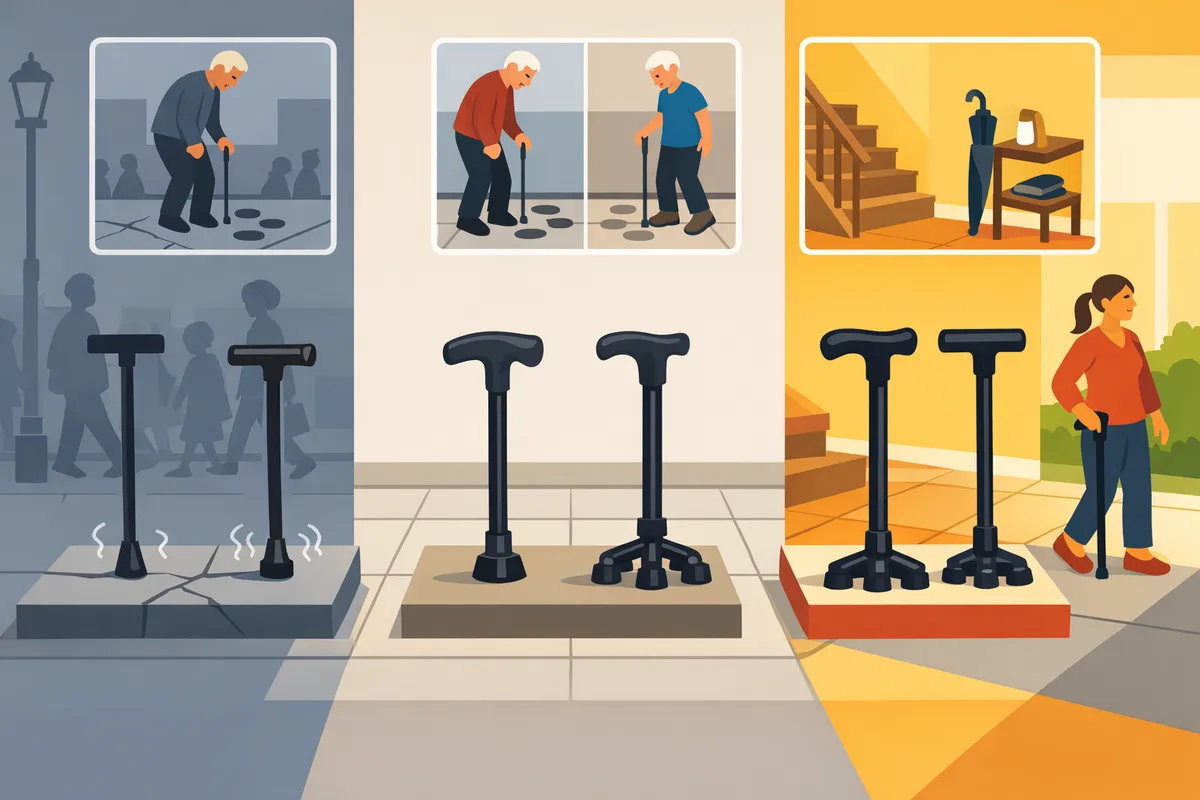
How do you test fit and choose a cane that actually reduces pain?
A 10-minute at-home fit and walking test plus a short purchase checklist shows whether a cane reduces hand pain and improves stability. This quick trial highlights which handle spreads pressure, which base feels steady, and whether shaft height wastes energy. Use the process below with product pages from Better Canes Umbrellas to shorten trial time and avoid costly returns.
Five-step at-home grip and stability test 📝
Follow a five-step-at-home sequence to measure fit, grip comfort, and base stability. Better Canes Umbrellas customers use this same routine in-store and at home to get objective results before committing to a model.
- Measure standing height and set the cane. Record the distance from wrist crease to floor while standing relaxed. Pass if the wrist crease lines up with the top of the handle and your elbow rests at 15 degrees while standing normally.
- Walk 10 normal-paced steps on flat ground. Note cane bounce, hand pressure, and whether you shift weight off the painful joints. Pass if you feel reduced pinch pressure and steady contact with the ground.
- Rise from a 17–19 inch chair using the cane for support. Count how much you push through the handle with your fingers. Pass if palm support, not finger pinch, carries most of the load.
- Simulate stepping off a 4–6 inch curb. Notice wobble at the base and whether the cane pivots in your hand. Pass if the base stays planted and you maintain balance without tightening your grip.
- Walk 5–10 minutes and record pain level at start, 5 minutes, and end. Pass if pain does not increase and grip fatigue decreases by at least one level on your own scale.
For each step, write a one-line observation: "handle X reduced pinch; base Y felt unstable." Use those notes to compare models objectively.
💡 Tip: Test with the shoes you wear daily. Shoe sole stiffness changes how much force you put through the cane.
How to compare models quickly and what to expect from our Better Canes Umbrellas line 🪑
Compare two shortlisted models side-by-side by handle shape, grip material, shaft weight, and base type, then run the five-step test with each. Better Canes Umbrellas lists handle types and clear specs on model pages so you can filter and pick two candidates before testing.
Use this quick table to narrow handle choices before you test.
| Handle style | Best for | How it affects pain | What to test during trial |
|---|---|---|---|
| Palm (ergonomic) | Joint compression in fingers | Spreads load across palm, reduces pinch | Check if palm carries weight and finger tension drops |
| Derby | Hand mobility issues or trigger finger | Offers thumb rest and natural wrist angle | Check thumb comfort and wrist twist during swing |
| Offset/Crutch | Balance with heavy shaft loads | Aligns wrist over shaft to reduce torque | Check wrist angle and forearm pressure after 5 min |
| T-handle | Lightweight, less palm contact | Can concentrate pressure at one point | Check for local hotspots on finger pads |
When comparing two Better Canes Umbrellas models, aim to isolate one variable per test: same base with different handles, or same handle with different shaft weights. Record which model reduced pinch pain and which base felt stable. That one-to-one comparison shortens trial time and reduces returns.
Return windows, trial policies, and warranty checks to reduce buying risk ⚠️
Confirm return period, warranty coverage, and any restocking or shipping fees before buying to avoid costly mismatches. Better Canes Umbrellas highlights these policies on each model page so shoppers can decide with confidence.
- Confirm the return period and condition requirements. Note how long you have to return, whether you must keep tags, and if the cane must be unused for a full refund.
- Check warranty for shaft and handle defects. Verify whether the warranty covers loosening, cracking of the handle, or manufacturing defects and how to file a claim.
- Note any restocking or shipping fees. Add those potential costs to your trial budget so a return does not erase any savings from a low price.
⚠️ Warning: Do not keep a cane that shows structural damage after testing. Cracked shafts or loose fittings increase fall risk and may void warranty.
Best practices: test two models, document observations, and confirm that the return window covers a 5–10 minute walk test at home. Those steps reduce the business cost of a wrong fit and speed replacement selection.
Frequently Asked Questions
These FAQs answer practical buyer questions about canes that reduce hand pain and improve grip comfort. Each response gives a clear recommendation and at least one actionable next step you can try at home.
What is the best walking cane for arthritis in hands? 🤲
The best walking cane for arthritis in hands is one whose handle spreads load across the palm, uses a cushioning yet supportive material, and fits your height so your wrist stays neutral. Test a palm-hug or anatomical handle and compare pain after a short walk; if your thumb or finger joints feel less pressure after five minutes, that handle is a better fit. Better Canes Umbrellas stocks both palm-hug and contoured grips so you can compare shapes without guessing. Practical next steps: try two handles back-to-back and note which one reduces squeezing or aching during a 10-minute walk.
What is an ergonomic cane handle for arthritic grip? ✋
An ergonomic cane handle for arthritic grip is a handle shaped to distribute pressure away from painful finger joints and designed to match hand anatomy so users can hold it without forceful pinching. Examples include palm-hug handles that cradle the base of the fingers, anatomical grips with a thumb rest, and wide T-shaped handles that reduce pinch force. Better Canes Umbrellas describes handle geometry for each model, so you can filter for palm support or thumb relief before buying. Try holding each handle while standing and then while taking three short steps to feel where pressure concentrates.
Can a cane actually reduce hand pain when walking? ✅
Yes, a properly fitted cane with the right handle shape redistributes load and often lowers pain during ambulation. Clinical guidance and user reports show that moving load from finger joints into the palm and forearm decreases pinch force; for example, users frequently report immediate comfort differences within a single walk test. Use this five-step at-home test: 1) measure height, 2) try palm-hug vs T-handle for 5 minutes each, 3) walk a consistent short route, 4) rate pain and grip fatigue, 5) repeat with the alternate handle. Better Canes Umbrellas recommends performing this quick comparison to validate relief before committing.
Should I choose a quad cane if I have arthritis in my hands? ⚖️
Choose a quad cane if you have persistent balance problems that require the wider base; otherwise a single-tip cane with a broad, stable tip often gives enough support without the extra weight. Quad canes add stability but usually weigh more and can shift the way you hold the handle, so pick a quad model with a low-pinch handle or a palm-support design to avoid increasing finger strain. Better Canes Umbrellas carries both quad and wide single-tip models and lists each cane's weight and recommended grip type to help you compare the tradeoffs.
How do I measure the correct cane height? 📏
Correct cane height is measured with shoes on so the cane allows a slight bend of about 15 degrees in the elbow when you stand upright and hold the handle at your side. Measure from the floor to the wrist crease while standing naturally in your usual shoes; that distance gives the target shaft length before final fine-tuning during a walk test. Then validate height during the 10-step walking check: if your shoulder raises or you lock your elbow, shorten or lengthen by 0.5-inch increments until movement feels natural.
💡 Tip: Test cane height and handle shape together—height that is correct for one handle shape can feel wrong with a different grip.
Can a novelty or fashion cane work for arthritis relief? 🎩
A novelty or fashion cane can provide relief only if it combines ergonomic handle geometry with adequate shaft strength and a proper tip; many decorative canes prioritize style over supportive handle design. Inspect the handle for palm support and cushioning, confirm the shaft's maximum load rating, and perform the same short walk test used for functional canes. Better Canes Umbrellas lists decorative models separately so you can compare fashion styles that also include ergonomic options suitable for daily use.
Choose a cane that reduces hand pain and improves grip comfort.
Selecting the right handle, base, and fit cuts joint stress and lowers fall risk for people with hand arthritis. Prioritize an ergonomic cane handle for arthritic grip and a stable base, and test how the handle feels under weight before you buy. A properly sized shaft keeps posture aligned and prevents compensatory strain in the wrist and shoulder.
💡 Tip: Try handles in person with a staff-guided demo or a short walk. Note where pressure concentrates on your palm and fingers.
Better Canes & Umbrellas Inc., founded in 2000 and based in Chatham, NJ, is an online and retail seller focused on umbrellas, walking sticks (including novelty sticks and hiking sticks), and shoe horns. The company expanded its assortment in 2005 to include a wide range of walking and novelty sticks and later added shoe horns in unique styles and designs. Their catalog serves commuters, mobility needs, collectors, and gift buyers while stressing style, function, and reliable customer service.
Schedule a consultation with Better Canes & Umbrellas to try models and find the walking cane for arthritis relief and grip comfort that fits your daily routine and personal style.