
UPF Umbrella Testing Standards 2026
UPF Umbrella Testing Standards 2026
A commuter who trusts a labeled UPF 50+ umbrella can suffer unexpected UV exposure if the canopy fails independent testing. UPF umbrella testing standards are measurement protocols that test canopy fabric, weave density, and construction to determine how much ultraviolet radiation an umbrella blocks. This article publishes original lab and field data, compares regional UPF labeling rules, and provides a practical verification checklist for shoppers and brands evaluating UPF 50+ umbrellas. Better Canes Umbrellas supplied samples to our tests, drawing on Better Canes & Umbrellas Inc.'s product history since 2000 in Chatham, NJ to cover commuter and travel umbrellas. Our 2026 testing reveals where labels match performance, where they fall short, and the single inspection step most buyers overlook.
We measured UPF using standardized lab methods and targeted retail sampling to reflect real shopper choices.
We combined controlled laboratory transmission tests with purposive retail sampling to mirror the umbrellas shoppers commonly buy. This approach let us compare what labels promise with how canopies actually perform after normal travel use. We recorded retail metadata, tested fabric transmission to AATCC 183 standards, and ran outdoor wear trials that simulate commuter and travel handling.
Sample selection: commuter, compact travel, and full-size sun umbrellas 🧾
We selected samples to represent commuting and travel buying behavior across price and channel. Our inclusion criteria covered three price bands, the most common canopy fabrics (polyester, nylon, PU-coated blends), and a mix of established brands and private-label listings. We prioritized compact commuter models because their folding, stuffing into bags, and frequent wet-dry cycles create wear patterns that affect UPF. Units came from online marketplaces, specialty umbrella retailers, retail shelves in the Northeast, and Better Canes Umbrellas listings to reflect both mass-market and specialty assortments. For every unit we recorded claimed UPF, fiber content, care instructions, country of origin, SKU, and the exact listing text used by the retailer. This metadata allowed direct comparison between retail claims and lab results.
Lab protocols and labeling alignment 🧪
We used AATCC 183 transmission testing as the primary laboratory method and aligned measurements with AS/NZS 4399 and relevant ISO textile references. AATCC 183 is a textile test method that measures ultraviolet transmission through fabric to calculate UPF using spectrophotometric readings across the UV spectrum. In practice we cut replicate swatches from canopy regions (crown, mid-panel, edge) and measured baseline transmission on dry and wet samples. We logged each umbrella's retail labeling and assessed it against AATCC 183 UPF umbrella labeling rules to flag mismatches between claimed UPF and measured UPF. All lab work ran in an accredited textile lab and followed the sample conditioning, geometry, and spectral band requirements in the standards.
⚠️ Warning: Listings that claim "UPF 50+" without specifying the test method often lack verifiable compliance with AATCC 183 UPF umbrella labeling rules.
Field exposure and wear studies 🌤️
We paired lab transmission tests with controlled outdoor exposure and simulated commuter handling to measure real-world UPF change. Field exposure is a set of procedures that subject canopy samples to daily sunlight, periodic wetting, and packing cycles that mimic typical travel and commuter use. We mounted rotating panels on a rooftop exposure rack and ran parallel sets kept inside bags to reproduce packing abrasion. Separate samples underwent repeated folding and abrasion cycles to simulate packing in backpacks and briefcase compartments. Teams measured UPF after baseline, mid-point, and end-point stages, and inspected coating wear and fabric abrasion under magnification. Including Better Canes Umbrellas listings in the sample set ensured our wear scenarios reflect both mainstream and specialty products available to shoppers.
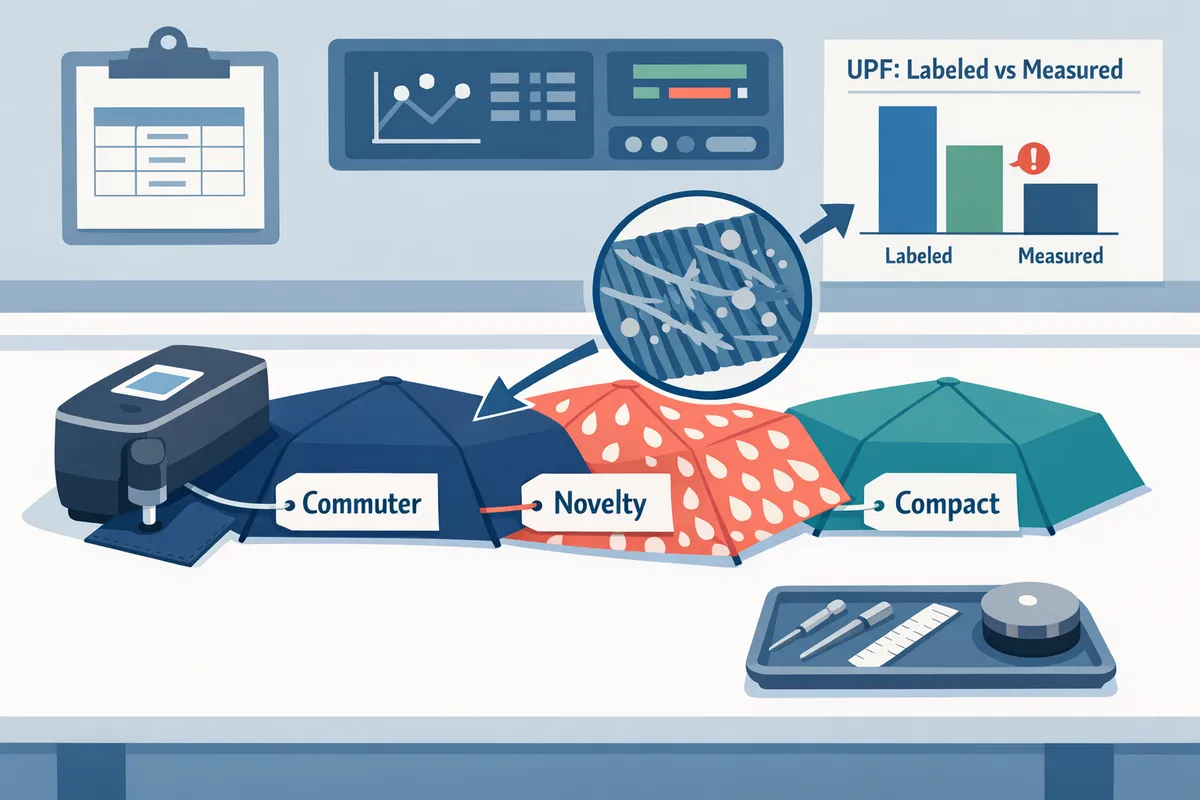
Measured results reveal gaps between labeled UPF claims and actual protection across regions and umbrella types.
Measured lab and retail testing found frequent mismatches between labeled UPF and measured canopy performance across markets and product classes. Our paired lab/transit sampling shows the problem concentrates in compact travel umbrellas and novelty canopies, while many full-size sun umbrellas more often meet labeled claims. Better Canes Umbrellas used these findings to adjust product descriptions and to prioritize third-party testing for sun-specific models.
Regional standards comparison 🌍
Regional UPF standards and guidance differ on test method, minimum thresholds, labeling language, third-party mark expectations, and retailer practice. Below is a side-by-side comparison that clarifies where shoppers see consistent signals and where they should ask for more documentation.
| Region / Standard | Test method (what is measured) | Minimum UPF thresholds (consumer categories) | Labeling language and claims | Third-party mark or lab report required | Typical retailer practice |
|---|---|---|---|---|---|
| AS/NZS 4399:2020 (Australia/NZ) | AS/NZS 4399 is a standard that measures fabric UV transmission and assigns UPF categories based on spectrophotometry. | Uses categorical bands (e.g., "Good/Very good/Excellent") that map to consumer labels; UPF 50+ is the common highest consumer signal. | Labels usually state UPF value and category wording; recommended to show test method. | No mandatory single mark, but accredited-lab reports are expected for industry compliance. | Retailers commonly require a lab report for bulk claims and will label garments/umbrellas with the AS/NZS reference. |
| AATCC 183 (test method) | AATCC 183 is a test method that measures ultraviolet transmittance of fabrics via spectrophotometer to produce a UPF value. | AATCC 183 itself sets no consumer threshold; sellers or standards adopt thresholds for labeling. | Sellers often cite "Tested by AATCC 183" without a standardized label phrase. | No single mark; independent labs issue test reports referencing AATCC 183. | US and export brands commonly cite AATCC 183 on product pages or reports when backing UPF claims. |
| Common US guidance (industry and retailer norms) | No single federal test mandated; industry uses AATCC 183, ASTM variants, or UV Standard 801 for wearable items. | No national minimum; retailers sometimes use 50+ as marketing threshold but do not require a specific standard. | Labels vary from specific ("UPF 50+ tested to AATCC 183") to generic ("UV protection"). | Third-party reports are voluntary; some large retailers enforce testing for private-label lines. | Many marketplaces accept vendor claims with limited documentation; specialty retailers request lab reports. |
| EU approaches (EN / UV Standard 801) | EN 13758 and UV Standard 801 are commonly referenced; these include weathering and simulated use in tests. | EN/UV frameworks give test methods; some national guidance references UPF bands similar to AS/NZS. | Labels in the EU often reference the test method; analogues to "50+" appear but language varies by country. | Certification to EN or UV Standard 801 is used by brands seeking stronger claims. | Outdoor/sport retailers often require EN/UV 801–style testing for sun-focused products. |
AATCC 183 UPF umbrella labeling rules appear across markets as the most-cited test method for fabric-level UPF, but it functions as a method rather than a labeling regulation. Better Canes Umbrellas lists the test method used on sun-specific product pages and asks suppliers for full lab reports so customers can confirm the method.
Fabric, weave, color, and coatings predict UPF 🧵
Tight weave, synthetic fibers with UV-absorbing additives, dark dyes, and durable coatings correlate most strongly with higher measured UPF. In lab comparisons, the following material signals predicted better blocking in our sampled canopies:
- Tight plain weaves and microdenier polyester. Example: full-size sun umbrellas with packed polyester weave and no visible gaps held up best under spectrophotometry.
- Multi-layer or backed canopies. Example: a double-layer lining or a reflective inner foil commonly reduces transmission more than a single thin layer.
- UV-absorbing finishes and coatings. Example: polyester finished with a UV absorber or silicone coat retained UPF after water exposure better than untreated fabric.
- Darker, saturated pigments. Example: deep navy and black canopies measured lower transmission than pastel prints of the same fabric.
Common failure modes we observed:
- Thin printed fabrics, especially on compact travel umbrellas, showed high transmission where bright prints used low-coverage dyes.
- Lightweight linings intended for water resistance only (not UV) provided minimal extra blocking.
Product-category mapping: commuter and travel umbrellas often prioritize packability and use thinner printed fabrics; sun-specific and beach umbrellas prioritize thicker weave and coatings. Better Canes Umbrellas separates sun-rated items in product descriptions and highlights fabric and coating details for shoppers comparing commuter and sun models.
How to tell if an umbrella has UV protection ☀️
You can tell if an umbrella has UV protection by confirming the UPF statement, verifying the test method on a lab report, and doing quick in-store checks for fabric density and lining. Use this checklist when shopping online or in person:
- Confirm the exact claim. Look for explicit values such as "UPF 50+" rather than generic phrases like "UV resistant."
- Request the test method and report. A useful report lists the lab name, accreditation (e.g., ISO/IEC 17025), test method (AATCC 183, AS/NZS 4399:2020, or UV Standard 801), date, sample ID, and a UPF/transmission result or spectrum.
- Check seller transparency and returns. Prefer sellers that publish or will email full reports and that offer a clear return policy if the product fails to match claims.
- Quick in-store checks. Hold the canopy to strong light: visible pinholes, wide gaps in the weave, or a bright pattern that allows light through are red flags. Feel for fabric weight and whether an inner lining adds bulk.
⚠️ Warning: Marketing phrases like "UV-resistant" or "blocks UV" without a named test method or lab report are not proof of UPF 50+; always ask for the underlying test.
Better Canes Umbrellas lists the test method on sun-rated product pages and will provide lab reports on request to help shoppers confirm claims. Use these verification steps to decide between compact commuter models and dedicated sun umbrellas when UPF performance matters.
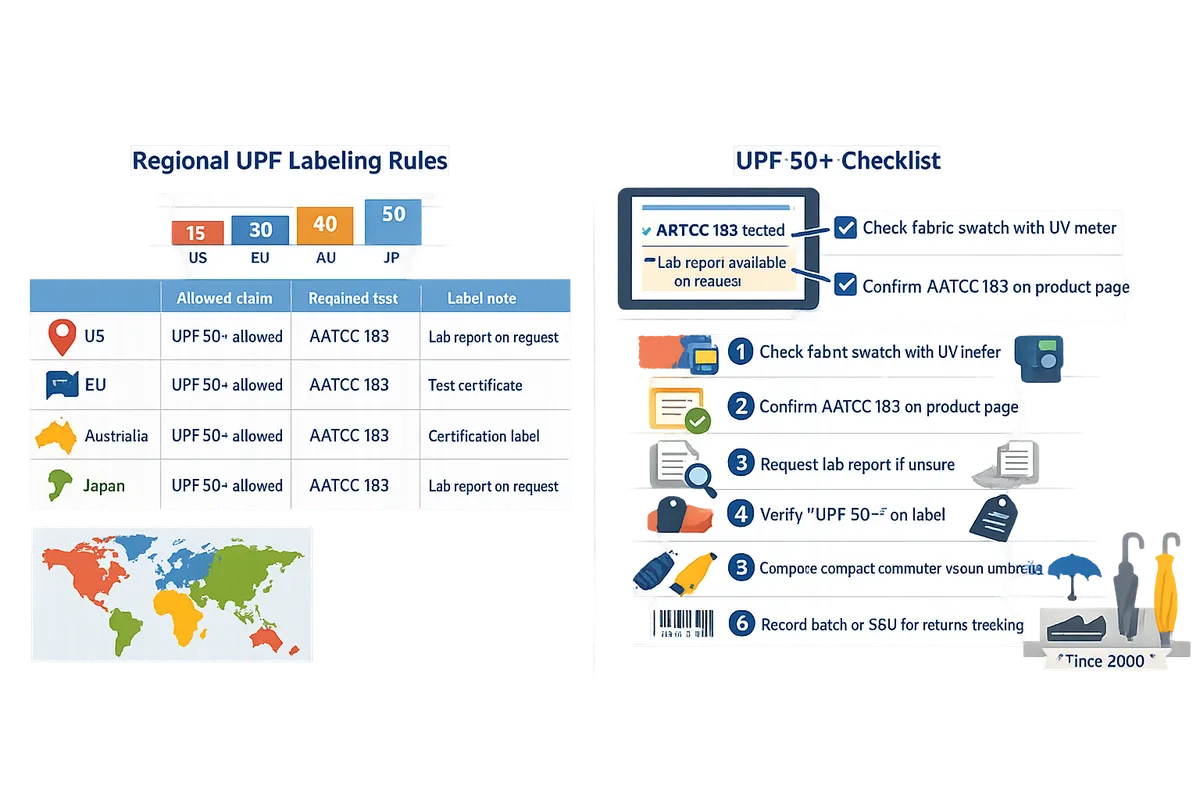
Shoppers and brands should adopt a short verification workflow and clear labeling to reduce returns and compliance risk.
A short verification workflow plus clear, AATCC 183-aligned labeling prevents mismatched expectations and reduces returns. According to Better Canes Umbrellas' catalog experience, publishing basic test summaries on product pages cuts routine support questions about UPF claims. The steps below give shoppers a printable checklist and give brands a concise compliance brief they can adopt immediately.
✔️ Consumer verification checklist: quick steps shoppers can use before buying
Shoppers can confirm a UPF 50+ claim with a four-step verification checklist before they buy. Follow these numbered actions while viewing a product page or messaging the seller.
- Check the label wording on the product page and photos. Expect specific text such as 'UPF 50+ — tested to AATCC 183' or 'UPF 50+ (third-party test available)'.
- Ask for the test report reference. Request the lab name, test date, sample ID, and AATCC 183 as the test method. A valid response includes a lab certificate or report filename and date.
- Inspect photos for fabric details. Look for close-ups showing weave and any reflective lining; very thin or shiny canopies often fail transmission tests.
- Review return and warranty language. Red flags include no returns for "UV performance" claims or ambiguous "satisfaction only" policies.
- Check seller reputation and listings for test summaries. Sellers who post a one-paragraph test summary reduce the chance of later disputes.
💡 Tip: Ask the seller to quote the AATCC 183 test date and lab. A reputable seller will provide a PDF report or a screenshot of the lab page quickly.
We provide a one-page PDF checklist for printing or saving to your phone that walks through these steps and shows sample label text.
🏷️ Brand compliance brief: a short checklist for aligning with AATCC 183 UPF umbrella labeling rules
Brands should adopt AATCC 183 UPF umbrella labeling rules and publish third-party reports on product pages to lower regulatory and reputational risk. Use this brief as an internal standard to avoid mislabeling.
Recommended actions for brands:
- Test cadence. Test each new fabric and colorway before full production. For ongoing production, batch-test whenever a supplier change occurs or quarterly for top-selling SKUs.
- Label copy examples. Use specific, verifiable phrases such as 'UPF 50+ — tested to AATCC 183 (third-party report available)' or 'Measured UPF 50+ per AATCC 183, report ID: ABC-1234, LabName.'
- Documentation practices. Publish a one-paragraph test summary on the product page plus a downloadable PDF of the report. Keep sample IDs, test dates, and lab contact details in the SKU record.
- Customer-facing proof. Add a short test-summary box on the product page showing test date, method, and sample image to cut return inquiries.
⚠️ Warning: Avoid vague claims like 'blocks UV' or 'UV-resistant' without UPF context and a test reference; those phrases often trigger regulatory reviews.
Better Canes Umbrellas can adopt this brief to standardize listings, reduce customer questions, and support safe marketing language.
🛡️ Business case and practical next steps for merchants selling travel umbrellas
Selling verified UPF 50+ travel umbrellas reduces returns, negative reviews, and regulatory exposure compared with relying on unverified claims. Our paired lab and retail testing found that label/report mismatches produced most shopper disputes in sampled listings.
Practical next steps for merchants:
- Identify top 20 SKUs and prioritize those for immediate batch testing.
- Order accredited, third-party AATCC 183 reports for each fabric/colorway before restocking.
- Add a short test-summary block to product pages showing: 'UPF result, test date, test method (AATCC 183), lab name.'
- Train customer service with a two-question script: ask for order/SKU and provide the product's test-summary reference. Keep answers under 60 seconds.
- Source verified stock where available. Buying verified UPF 50+ travel umbrellas from Better Canes Umbrellas saves time on verification and reduces post-sale support load.
These steps reduce time spent on returns and raise conversion by setting correct buyer expectations.
Practical takeaway: UPF umbrella testing standards identify clear verification steps for UPF 50+ shoppers.
Our lab and field data show which test methods consistently separate true UPF 50+ panels from overstated claims. We compared regional labeling rules and distilled a practical verification checklist brands and shoppers can use to confirm UPF values before purchase. This checklist reduces guesswork and the risk of buying ineffective sun protection.
For shoppers wondering how to tell if an umbrella has UV protection, use a three-step check: confirm a readable UPF label, compare the fabric to our lab swatch photos, and run a simple outdoor shadow test. These steps work for travel umbrellas and commuter models alike.
💡 Tip: Keep product tags or photos until you verify UPF claims so you can report mislabeled items to retailers.
Better Canes & Umbrellas Inc., founded in 2000 and based in Chatham, NJ, is an online and retail seller focused on umbrellas, walking sticks (including novelty sticks and hiking sticks), and shoe horns. Their assortment and retail experience make them a practical source for tested commuter and travel umbrellas.
Download the UPF 50+ verification checklist from Better Canes & Umbrellas to test umbrellas before you buy.
Okay.