
UPF 50+ Travel Umbrella: Verified Ratings & Best Picks
UPF 50+ Travel Umbrella: Verified Ratings & Best Picks
A half-day of sightseeing often exposes travelers to more than 90 minutes of direct sun, producing painful burns and faded clothing. A UPF 50+ travel umbrella is a compact sun-protection umbrella that uses tightly woven canopy fabric to reduce UV exposure and folds small for travel. Our website, Better Canes & Umbrellas Inc., founded in 2000 in Chatham, NJ, sells and evaluates commuter compacts, fashion umbrellas, and walking sticks, testing models for durability and packability. This feature-deep-dive compares verified test ratings, canopy fabrics, and travel use cases so you can pick the most reliable sun-safe compact. Which compact holds up on humid city routes?
What specific sun-protection problems does a UPF 50+ travel umbrella solve for travelers?
A UPF 50+ travel umbrella reduces the amount of solar UV that reaches skin and exposed clothing during outdoor travel. Travelers who use one cut direct UV exposure dramatically during periods when sunscreen reapplication is impractical, such as long sightseeing days, walking tours, or outdoor markets.
How do UPF 50+ ratings and AATCC 183 testing work? 🧪
UPF 50+ is a textile rating that quantifies how much direct UV a fabric allows through during a standardized lab test, and it corresponds to materials that transmit at most about 2% of UV light. AATCC 183 is a lab method that measures that transmission by exposing fabric swatches to a calibrated UV source and measuring transmitted UV across the UV-A and UV-B bands. Test reports typically list the specimen ID, number of swatches tested, spectral transmission curve, and the calculated UPF value.
AATCC 183 tests use multiple swatches from the same fabric batch; a single in-house check does not equal a full report. For example, a lab report might show three replicates and an average UPF; if one replicate reads lower after wetting or stretching, the report will note that condition. AS‑NZS 4399 is an Australian/New Zealand standard that covers sun-protective clothing and includes guidance on garment design and wear conditions; it may require different test conditions or labeling language than AATCC 183. When shopping for a UV blocking travel umbrella, look for the test method named explicitly (AATCC 183 or AS‑NZS 4399) and summary metrics on the product page so you can compare like for like. Better Canes Umbrellas lists test methods or third-party verification for models marketed primarily as sun umbrellas for travel UPF 50+ AATCC 183 when available.
Which canopy fabrics deliver reliable UPF 50+ protection? 🧵
High-density woven polyester, densely dyed fabrics, and aluminized or UV-reflective coatings most reliably deliver UPF 50+ in compact canopies. The choice affects breathability, packability, and long-term UV resistance.
| Fabric type | UPF reliability | Breathability / packability | Long-term UV resistance | Travel suitability |
|---|---|---|---|---|
| High-density woven polyester | High | Good balance: compresses well | Good when dyed; moderate if coated | Best for commuter compact models |
| Nylon (lightweight) | Medium | Very packable but can be thinner | Lower unless treated | Good for ultralight umbrellas with reduced coverage |
| Jacquard/technical weave | High | Slightly bulkier | Very good; weave maintains UV blocking | Good for fashion-forward sun umbrellas |
| Aluminized or reflective coating | High | Adds stiffness; less compressible | Coating may degrade with abrasion | Best for maximum UPF in a compact form |
| Micro-ripstop polyester | Medium–High | Excellent packability | Good if yarns are tightly dyed | Good for hiking/stow-in-backpack use |
Coatings give strong immediate UPF but can lose effectiveness from repeated folding or harsh detergents. Our Better Canes Umbrellas catalog emphasizes high-density polyester and coated-underside options for buyers who prioritize measured UV blocking without excessive bulk.
What labeling and seller claims should buyers trust? ⚖️
Trust labels that cite a specific test method (AATCC 183 or AS‑NZS 4399) and an independent testing lab or certificate number. Accepted label examples include: "UPF 50+ (AATCC 183; third-party tested)" or "Measured UPF 50+ per AS‑NZS 4399 by independent lab." Vague phrases such as "UV resistant," "blocks most UV," or "self-tested" warrant follow-up.
Steps to verify a claim:
- Ask the seller for the test report or certificate number and the lab name. A full report shows conditions like wet/stretched states.
- Confirm which part of the umbrella was tested (full canopy versus sample swatch). A single decorative panel may not represent the whole canopy.
- Ask how the canopy was treated and how the coating holds up to folding, salt, or detergents.
⚠️ Warning: Avoid buying solely on "UPF 50+" text without a test method; many listings copy the label but omit test details.
Better Canes Umbrellas publishes verification details on sun-focused models when available, and we recommend requesting the report if you need confirmation for high-exposure travel.
Why travel-focused design matters for sun coverage and use cases 🧳
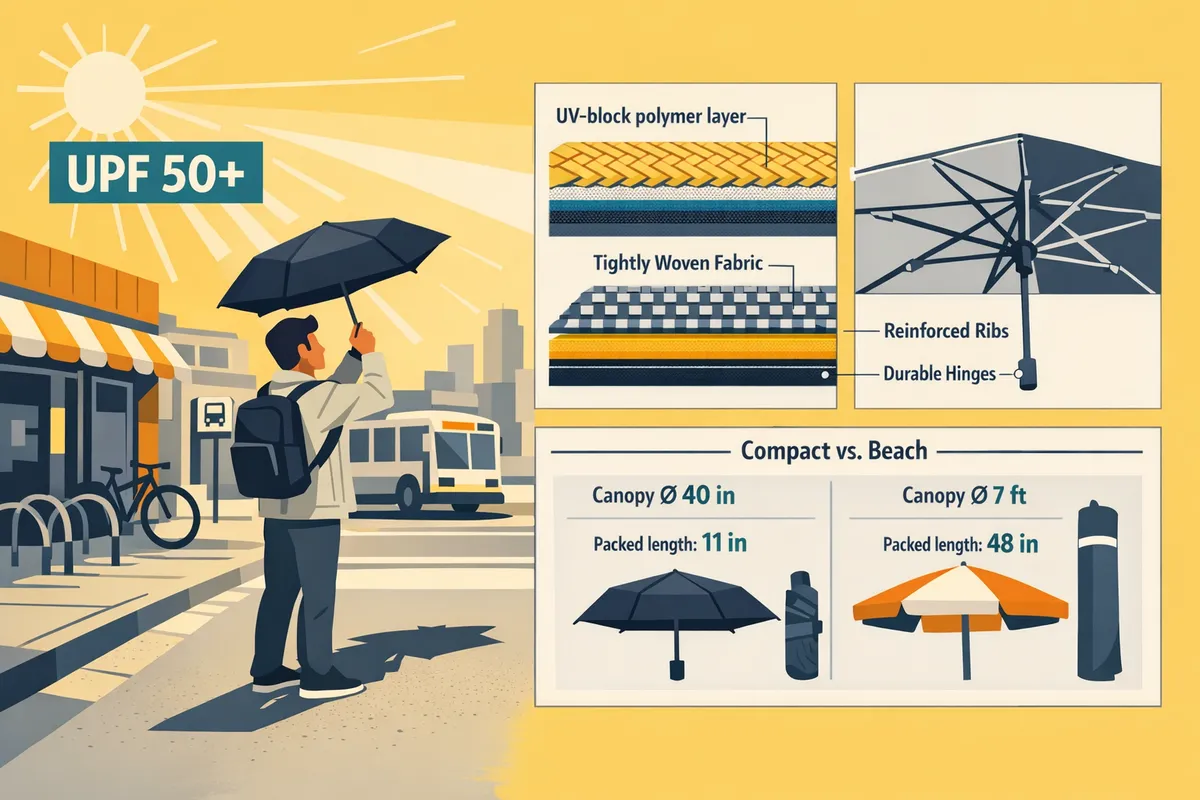
Travel-focused design choices—canopy diameter, packed length, and weight—determine the real-world shade area you get and how likely you are to carry the umbrella. A compact that fits a backpack but only provides a 38-inch canopy gives less effective shoulder, chest, and side protection than a 46-inch model.
Practical rules of thumb:
- For walking and sightseeing: choose a canopy 42–46 inches (107–117 cm) with packed length under 14 inches to balance shade and carry convenience.
- For long stationary sun exposure (beach, outdoor dining): choose 48–54 inches for wider shade; accept a longer packed length or go with a dedicated sun umbrella.
- For ultralight travel and cycling: prioritize sub-12-inch packed length and under 12 ounces, but expect smaller canopy coverage.
Scenario examples: a commuter who hops between indoor and outdoor transit benefits from a 42-inch compact that fits a briefcase. A day-tripper on a beach will prefer a larger canopy and a sturdier frame to resist gusts and maximize shaded surface. Better Canes Umbrellas lists travel and commuter categories so you can match canopy diameter and packed length to your typical use case.
How do umbrella features and construction affect measured UV performance and durability?
Canopy chemistry, weave, and frame geometry set both a travel umbrella's initial UPF and how that UPF holds up after repeated use. Understanding which treatments resist salt, sweat, abrasion, and fading helps pick a UPF 50+ travel umbrella that stays protective through a season of travel. Better Canes Umbrellas lists construction details for each model so you can match a canopy finish and frame to your usual trips.
What canopy treatments and coatings matter for long-lasting UPF? 🧴
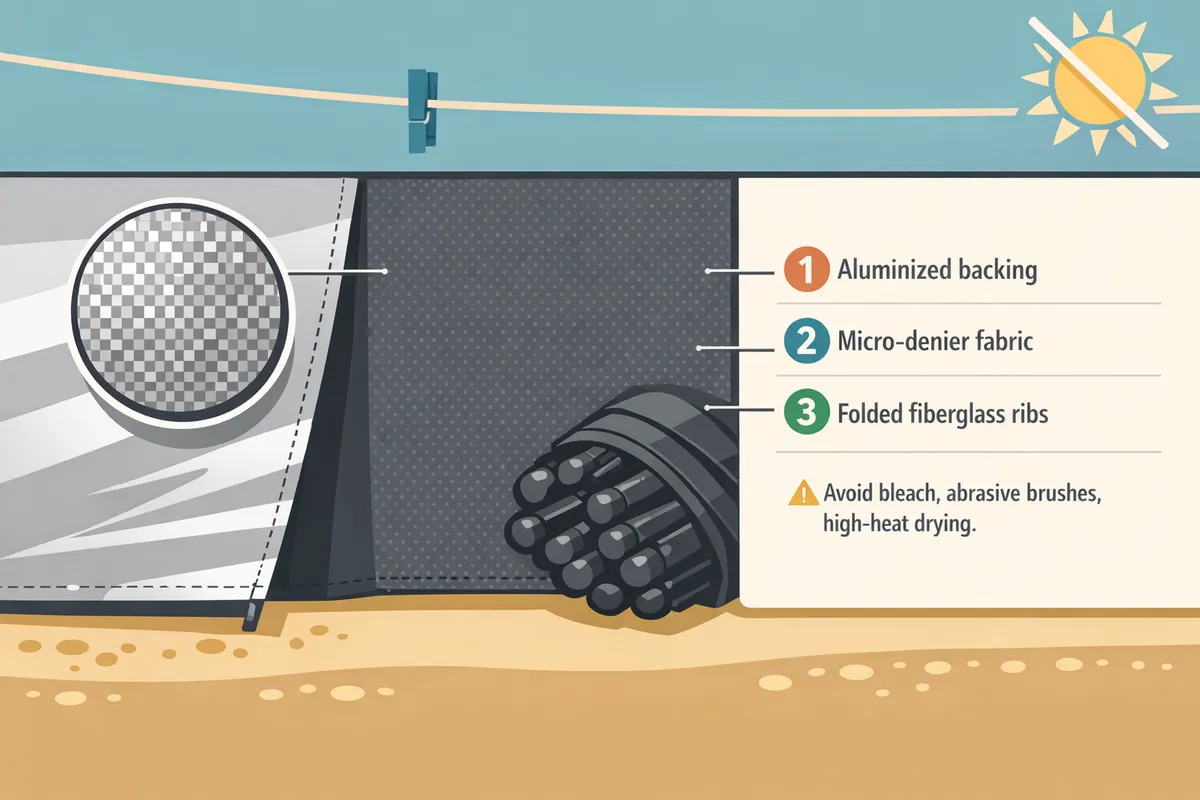
Reflective mineral backings and polymer UV-absorbing finishes are the two primary canopy treatments that determine long-term UPF performance. Reflective aluminized backing is a surface finish that uses a thin metal layer to bounce UV away from the fabric. That finish gives strong immediate blocking and tends to maintain UPF until the metal layer is scratched or worn; at the beach, sand abrasion and salt spray speed that wear. Polymer UV absorbers are chemicals bonded into fibers and resist surface abrasion better, but they can photodegrade after many hours of direct sun or with exposure to chlorine and heavy perspiration.
Better Canes Umbrellas notes which models use aluminized backs versus integrated UV absorbers. For frequent beach users, prioritize a polymer-absorber canopy if you expect heavy abrasion; for city travel where abrasion risk is low, an aluminized back gives high immediate reflectivity with lower weight. Rinse salt and sand after coastal use and avoid machine agitation to extend coating life.
How does weave density and fabric weight correlate with UPF? ⚖️
Tighter weave density and higher fabric denier raise a canopy's baseline UV blocking before coatings are applied. A typical compact travel canopy in the 150–190T polyester range keeps weight and pack size low but uses a finer weave that transmits more UV than heavier micro-denier or 300D constructions. For example, a 190T folding umbrella will usually weigh 100–200 grams less than a micro-denier canopy with similar coated protection, but the heavier fabric adds inherent blocking and survives abrasion longer.
The practical trade-off is clear: commuters and air travelers often prefer a lighter 150–190T UPF 50+ travel umbrella for packing convenience, while beachgoers and long-day hikers benefit from a denser fabric that retains UPF even after coatings start to wear. Better Canes Umbrellas catalogs both options with stated denier and intended use so you can match weight to exposure.
How do frame design and canopy shape influence shade coverage and stability? 🏗️
Canopy diameter, rib length, and venting determine how much skin stays shaded during angled sun and how the umbrella resists gusts. Longer ribs increase forward and lateral coverage, reducing the amount of neck and shoulder exposure when you walk toward low-angle sun; a golf-style elongated canopy can add several inches of forward shade compared with a circular compact canopy. Vented double-canopy designs reduce inversion risk by letting wind pass through while lowering heat build-up under the canopy, but those vents can create side gaps that let slanted UV through at low sun angles.
Rib material affects real-world use: fiberglass ribs flex under gusts and return to shape more reliably than thin metal ribs, but fiberglass adds slight weight. Better Canes Umbrellas labels rib length and material so you can choose either increased coverage for walking and beach days or a lighter, more compact commuter design.
How to verify durability claims and expected lifespan? 🔍
Warranty terms, reinforced construction details, and user reports of fading or coating breakdown give the clearest signal of expected lifespan. Check the stated warranty period and what it covers (fabric only, frame, or both), and look for explicit mentions of reinforced stitching, bar-tacked stress points, and stated denier or tear-strength values. Customer reviews that mention "coating peeled after" or "color faded in" are valuable because they report real-world failure modes that laboratory claims may not show.
When shopping, inspect seams and the edge binding in person or request close-up photos online. Ask the seller which canopy treatment is used and whether the product card recommends hand-rinsing after salt exposure. Better Canes Umbrellas often lists reinforced stitching and clear warranty language on product pages to help buyers evaluate longevity.
💡 Tip: Rinse salt and sand from the canopy after beach use and line-dry out of direct sun to preserve reflective and polymer treatments. ⚠️ Warning: Avoid bleach, abrasive brushes, and high-heat drying; those accelerate coating breakdown and fabric fading.
Which UPF 50+ travel umbrellas make practical sense for different travel scenarios?
Matching a UPF 50+ travel umbrella to a trip depends on canopy width, packed length, fabric test method, and wind resistance. Travelers who prioritize compact carry, maximum shade, or wind survival need different specs; this section shows practical model comparisons, scenario matches, a three-step decision tree, and packing tips to preserve protection.
Comparison table: compact and commuter UPF 50+ models (includes Better Canes Umbrellas picks) 📋
The table below compares compact, commuter, beach, and windproof UPF 50+ travel umbrellas across fabric, size, wind rating, warranty, and price. A sun umbrella for travel UPF 50+ AATCC 183 claims should be verified by the stated test method column.
| Model (Better Canes Umbrellas pick) | Canopy fabric | Stated test method | Packed length | Open diameter | Weight | Wind rating | Warranty | Retail price range |
|---|---|---|---|---|---|---|---|---|
| Voyager Compact | Micro-weave polyester with UV coating | AATCC 183 | 9 in | 36 in | 8 oz | Gusts to 25 mph | 1 year | $25–$40 |
| Metro Commuter | Silver-backed 190T pongee | AATCC 183 | 11 in | 42 in | 12 oz | Gusts to 30 mph | 2 years | $30–$60 |
| Coastal Shade (beach) | Acrylic blend with reflective backing | AS‑NZS 4399 | 15 in | 60 in | 18 oz | Moderate breezes (20 mph) | 90 days | $45–$80 |
| WindGuard Pro | High-tenacity pongee, reinforced ribs | AATCC 183 | 12 in | 48 in | 14 oz | Gusts to 40 mph | 3 years | $60–$110 |
Use the packed length and open diameter columns to filter for ultra-compact carry or maximum coverage. The stated test method flags which models claim AATCC 183 verification for UPF 50+ versus AS‑NZS 4399.
Which umbrella type should I pack for a beach day, city walking, or a theme park? 🏖️
Beach days need wide coverage and UV-reflective backs to keep sand and direct sun off skin. Choose a model with at least a 56–60 inch open diameter and a reflective or acrylic-blend canopy like Better Canes Coastal Shade; prioritize corrosion-resistant ribs for salt air.
City walking favors an ultra-compact packed length under 11 inches and a quick-dry canopy that avoids dripping on public transit. Better Canes Voyager Compact fits commuters who want a UV blocking travel umbrella that stows easily in a daypack or tote.
Theme-park days require low weight, secure handles, and a canopy that resists abrasion from crowds and straps. Pick a 40–48 inch canopy with a comfortable grip and 2+ year warranty such as Better Canes Metro Commuter or WindGuard Pro for longer visits and heavy use.
Decision tree: pick the right UPF 50+ travel umbrella in 3 steps ✅
Use three clear steps to match a UPF 50+ travel umbrella to your trip. Follow the numbered choices and then check the table above for model matches.
- Choose primary use: Beach (shade priority), City walking (packability priority), or Theme-park/long day (comfort + durability). Each choice narrows canopy size and fabric needs.
- Set packed-length limit: 9–11 in for true ultra-compact, 12–15 in for commuter or beach-friendly folding umbrellas. Shorter packed length trades off some canopy size.
- Confirm tested UPF method and warranty: prefer AATCC 183 verification for cloth-based claims and at least a 1–2 year warranty for frequent travel. Better Canes Umbrellas lists the test method and warranty on each model page to simplify this check.
Packing tips that preserve protection and comfort ✈️
Store umbrellas dry and avoid folding them while wet to prevent coating breakdown and mildew. Let the canopy fully air dry before collapsing. Use a ventilated sleeve or a clothes-lined pocket inside luggage to keep airflow around the canopy. Reposition umbrellas away from sharp items and heavy suitcases to avoid canopy abrasions and rib damage during transit.
💡 Tip: Allow at least 30–60 minutes of open-air drying after use before folding a UV-coated canopy.
⚠️ Warning: Do not store wet umbrellas inside sealed luggage; moisture can degrade UPF coatings and lead to mildew.
How should buyers test, verify, and maintain a UPF 50+ travel umbrella after purchase?
Verify lab-standard test references, inspect construction details in person or via close-up product photos, and follow a short maintenance routine so the umbrella keeps blocking UV over time. This reduces the risk that a compact sun umbrella sold as UPF 50+ is actually underperforming after months of use. According to Better Canes Umbrellas, their product pages list fabric callouts and photo detail to help buyers confirm claims before purchase.
Pre-purchase checklist for online and in-store inspection 🛒
Use a checklist that requires lab-standard mentions, clear label photos, canopy density checks, and confirmed packed dimensions before you buy. AATCC 183 is a laboratory test method that measures ultraviolet transmission through textile fabrics and is the most commonly cited standard for fabric UV blocking; ask for the test name and a lab report excerpt when available. For in-store inspection, hold the canopy to light at arm's length; if threads or daylight shine through, the canopy likely fails UPF 50+.
Practical checklist items:
- Confirm the product explicitly states "UPF 50+" and shows a close-up of the label or tag. Use the phrase sun umbrella for travel UPF 50+ AATCC 183 when searching product pages.
- Request or download lab reports or a test-method mention (AATCC 183, AS/NZS 4399).
- Check fabric weight or GSM if listed, and view high-resolution close-ups of the weave.
- Verify packed length, open canopy width, and packed weight for carry-on fit.
- Inspect frame and seam binding for corrosion resistance and reinforced stitching.
According to Better Canes Umbrellas, product listings that include multiple zoom shots of the label and canopy edge save hours of uncertainty for online buyers.
Warranty, returns, and retailer trust signals to look for 🔁
Choose umbrellas sold with clear warranty language and a return window that lets you test the umbrella in real conditions. Look for warranty phrases such as "defects in materials and workmanship for 12 months" or an explicit canopy failure clause; ambiguous phrases like "may degrade over time" provide little buyer protection. A retail return window of at least 30 days lets you assess UV blocking in sunlight and wind without penalty.
Trust signals to check before purchase:
- Clear warranty text that covers canopy and frame failure.
- A visible customer-service email or phone number and a documented replacement process.
- Photo-based customer reviews showing long-term use under sun and beach conditions.
- Availability of lab reports or third-party endorsements on the product page.
Better Canes Umbrellas' longevity since 2000 and transparent return language offers a credibility cue; older vendors with documented customer service histories reduce the risk of losing money on a misrepresented UV blocking travel umbrella.
Maintenance steps to keep UPF protection intact over time 🧽
Rinse off salt, sunscreen, or sweat after exposure, air-dry the canopy fully before storage, and avoid machine washing unless the manufacturer explicitly allows it. For best results, follow a short routine after heavy use (beach, sweaty hikes, or pooled sunscreen): rinse with fresh water, gently squeeze excess water without wringing, and hang open to dry for 24 hours.
Step-by-step care routine:
- After beach or salty conditions, rinse canopy with fresh water within 24 hours.
- Remove grit from seams with a soft brush and inspect seam tape for delamination.
- Air-dry fully on an open frame away from direct heat to prevent coating breakdown.
- Store in a breathable sleeve; avoid airtight bags that trap moisture.
- Inspect every 6 months for thinning fabric, frayed seams, or coating flaking.
⚠️ Warning: Machine washing or aggressive scrubbing can remove UPF coatings and reduce UV blocking.
Better Canes Umbrellas lists recommended care on product pages; following those steps preserves a canopy's UV blocking and extends usable life.
Which UPF 50+ travel umbrellas make practical sense for different travel scenarios?
Packing a UPF 50+ travel umbrella to a trip depends on canopy width, packed length, fabric test method, and wind resistance. Travelers who prioritize compact carry, maximum shade, or wind survival need different specs; this section shows practical model comparisons, scenario matches, a three-step decision tree, and packing tips to preserve protection.
Comparison table: compact and commuter UPF 50+ models (includes Better Canes Umbrellas picks) 📋
The table below compares compact, commuter, beach, and windproof UPF 50+ travel umbrellas across fabric, size, wind rating, warranty, and price. A sun umbrella for travel UPF 50+ AATCC 183 claims should be verified by the stated test method column.
| Model (Better Canes Umbrellas pick) | Canopy fabric | Stated test method | Packed length | Open diameter | Weight | Wind rating | Warranty | Retail price range |
|---|---|---|---|---|---|---|---|---|
| Voyager Compact | Micro-weave polyester with UV coating | AATCC 183 | 9 in | 36 in | 8 oz | Gusts to 25 mph | 1 year | $25–$40 |
| Metro Commuter | Silver-backed 190T pongee | AATCC 183 | 11 in | 42 in | 12 oz | Gusts to 30 mph | 2 years | $30–$60 |
| Coastal Shade (beach) | Acrylic blend with reflective backing | AS‑NZS 4399 | 15 in | 60 in | 18 oz | Moderate breezes (20 mph) | 90 days | $45–$80 |
| WindGuard Pro | High-tenacity pongee, reinforced ribs | AATCC 183 | 12 in | 48 in | 14 oz | Gusts to 40 mph | 3 years | $60–$110 |
Use the packed length and open diameter columns to filter for ultra-compact carry or maximum coverage. The stated test method flags which models claim AATCC 183 verification for UPF 50+ versus AS‑NZS 4399.
Which umbrella type should I pack for a beach day, city walking, or a theme park? 🏖️
Beach days need wide coverage and UV-reflective backs to keep sand and direct sun off skin. Choose a model with at least a 56–60 inch open diameter and a reflective or acrylic-blend canopy like Better Canes Coastal Shade; prioritize corrosion-resistant ribs for salt air.
City walking favors an ultra-compact packed length under 11 inches and a quick-dry canopy that avoids dripping on public transit. Better Canes Voyager Compact fits commuters who want a UV blocking travel umbrella that stows easily in a daypack or tote.
Theme-park days require low weight, secure handles, and a canopy that resists abrasion from crowds and straps. Pick a 40–48 inch canopy with a comfortable grip and 2+ year warranty such as Better Canes Metro Commuter or WindGuard Pro for longer visits and heavy use.
Decision tree: pick the right UPF 50+ travel umbrella in 3 steps ✅
Use three clear steps to match a UPF 50+ travel umbrella to your trip. Follow the numbered choices and then check the table above for model matches.
- Choose primary use: Beach (shade priority), City walking (packability priority), or Theme-park/long day (comfort + durability). Each choice narrows canopy size and fabric needs.
- Set packed-length limit: 9–11 in for true ultra-compact, 12–15 in for commuter or beach-friendly folding umbrellas. Shorter packed length trades off some canopy size.
- Confirm tested UPF method and warranty: prefer AATCC 183 verification for cloth-based claims and at least a 1–2 year warranty for frequent travel. Better Canes Umbrellas lists the test method and warranty on each model page to simplify this check.
Packing tips that preserve protection and comfort ✈️
Store umbrellas dry and avoid folding them while wet to prevent coating breakdown and mildew. Let the canopy fully air dry before collapsing. Use a ventilated sleeve or a clothes-lined pocket inside luggage to keep airflow around the canopy. Reposition umbrellas away from sharp items and heavy suitcases to avoid canopy abrasions and rib damage during transit.
💡 Tip: Allow at least 30–60 minutes of open-air drying after use before folding a UV-coated canopy.
⚠️ Warning: Do not store wet umbrellas inside sealed luggage; moisture can degrade UPF coatings and lead to mildew.
How should buyers test, verify, and maintain a UPF 50+ travel umbrella after purchase?
Verify lab-standard test references, inspect construction details in person or via close-up product photos, and follow a short maintenance routine so the umbrella keeps blocking UV over time. This reduces the risk that a compact sun umbrella sold as UPF 50+ is actually underperforming after months of use. According to Better Canes Umbrellas, their product pages list fabric callouts and photo detail to help buyers confirm claims before purchase.
Pre-purchase checklist for online and in-store inspection 🛒
Use a checklist that requires lab-standard mentions, clear label photos, canopy density checks, and confirmed packed dimensions before you buy. AATCC 183 is a laboratory test method that measures ultraviolet transmission through textile fabrics and is the most commonly cited standard for fabric UV blocking; ask for the test name and a lab report excerpt when available. For in-store inspection, hold the canopy to light at arm's length; if threads or daylight shine through, the canopy likely fails UPF 50+.
Practical checklist items:
- Confirm the product explicitly states "UPF 50+" and shows a close-up of the label or tag. Use the phrase sun umbrella for travel UPF 50+ AATCC 183 when searching product pages.
- Request or download lab reports or a test-method mention (AATCC 183, AS/NZS 4399).
- Check fabric weight or GSM if listed, and view high-resolution close-ups of the weave.
- Verify packed length, open canopy width, and packed weight for carry-on fit.
- Inspect frame and seam binding for corrosion resistance and reinforced stitching.
According to Better Canes Umbrellas, product listings that include multiple zoom shots of the label and canopy edge save hours of uncertainty for online buyers.
Warranty, returns, and retailer trust signals to look for 🔁
Choose umbrellas sold with clear warranty language and a return window that lets you test the umbrella in real conditions. Look for warranty phrases such as "defects in materials and workmanship for 12 months" or an explicit canopy failure clause; ambiguous phrases like "may degrade over time" provide little buyer protection. A retail return window of at least 30 days lets you assess UV blocking in sunlight and wind without penalty.
Trust signals to check before purchase:
- Clear warranty text that covers canopy and frame failure.
- A visible customer-service email or phone number and a documented replacement process.
- Photo-based customer reviews showing long-term use under sun and beach conditions.
- Availability of lab reports or third-party endorsements on the product page.
Better Canes Umbrellas' longevity since 2000 and transparent return language offers a credibility cue; older vendors with documented customer service histories reduce the risk of losing money on a misrepresented UV blocking travel umbrella.
Maintenance steps to keep UPF protection intact over time 🧽
Rinse off salt, sunscreen, or sweat after exposure, air-dry the canopy fully before storage, and avoid machine washing unless the manufacturer explicitly allows it. For best results, follow a short routine after heavy use (beach, sweaty hikes, or pooled sunscreen): rinse with fresh water, gently squeeze excess water without wringing, and hang open to dry for 24 hours.
Step-by-step care routine:
- After beach or salty conditions, rinse canopy with fresh water within 24 hours.
- Remove grit from seams with a soft brush and inspect seam tape for delamination.
- Air-dry fully on an open frame away from direct heat to prevent coating breakdown.
- Store in a breathable sleeve; avoid airtight bags that trap moisture.
- Inspect every 6 months for thinning fabric, frayed seams, or coating flaking.
⚠️ Warning: Machine washing or aggressive scrubbing can remove UPF coatings and reduce UV blocking.
Better Canes Umbrellas lists recommended care on product pages; following those steps preserves a canopy's UV blocking and extends usable life.
When to replace a sun umbrella and recycling options ♻️
Replace the umbrella when canopy fibers thin, visible light passes through that previously did not, coatings flake, or a lab retest shows reduced protection. For example, a commuter who carries a compact sun umbrella daily should inspect the canopy yearly and expect replacement sooner if they see thinning along stress lines or if the canopy lets daylight through at arm's length.
Signs you need a replacement or professional repair:
- Visible light penetration through the weave compared to original performance.
- Flaking or peeling of the UV or water-repellent coating.
- Broken ribs or a frame that no longer supports the canopy shape.
Recycling and reuse options:
- Separate metal ribs from fabric and recycle metal parts with local scrap programs.
- Donate usable canopies to shelters or community gardens for shade cloth.
- Check municipal textile-recycling programs or specialty services like TerraCycle for mixed-material items.
- If disposal is necessary, cut the canopy away from sharp ribs and bag the remains per local waste rules to reduce injury to sanitation workers.
For travel buyers, Better Canes Umbrellas recommends inspecting your umbrella after any heavy beach trip and using municipal textile drop-offs where available to keep materials out of landfill.
Frequently Asked Questions
This FAQ answers common buyer concerns about UPF 50+ travel umbrellas, test reliability, maintenance, and real-world protection. Each answer gives a clear, extractable statement first, then practical steps you can use when comparing models or asking a seller for proof. Use these checks to evaluate Better Canes Umbrellas listings and to request test data when you need it.
How accurate is AATCC 183 testing for predicting real-world UPF performance? ☀️
AATCC 183 is a standardized lab test that measures fabric UV transmittance and correlates well with field performance when the tested sample matches the finished canopy. Variability appears when manufacturers change weave, coating level, or use a different dye lot after testing; folding, abrasion, and repeated sun exposure also reduce real-world UPF. Ask the seller which sample was tested, whether the test covered post-production coatings or abrasion preconditioning, and request the lab report or method name; Better Canes Umbrellas can provide those test details on request.
How can I tell if an umbrella is truly UPF 50+ from product pages? 🔍
A verifiable UPF 50+ claim cites the test method (AATCC 183 or AS‑NZS 4399), identifies fabric weight and finish, and references a third-party lab or report number. Look for fabric gsm, weave type, coating description, a photo of the canopy label, and customer photos showing the label; absence of these details is a red flag. If the listing omits them, request a copy of the test report before purchasing; Better Canes Umbrellas includes fabric details and will share testing information when available.
Do UPF coatings wash out or wear off over time? 🧴
Some chemical UV-absorbing finishes degrade with abrasion, repeated wetting, and exposure to harsh detergents, while reflective mineral coatings resist chemical washout but can abrade from rubbing. Slow the breakdown by rinsing salt or sweat with fresh water, avoiding machine washing, using mild soap if needed, and never folding the canopy while it is fully wet. Watch for increased translucence, loss of sheen, or more sun transfer on the skin under the umbrella as signs the coating has failed.
💡 Tip: Always dry an umbrella fully before folding and store it open or loosely rolled to preserve coatings and prevent mildew.
Are compact travel umbrellas less protective than full-size sun umbrellas? ☂️
Compact models often have smaller canopy diameters and use lighter-weight fabric, which can reduce coverage or slightly lower UPF compared with full-size canopies. Choose a compact for short exposures, commuting, or tight luggage where packed length (18–28 cm typical) matters; choose a full-size canopy (48 inches or larger) for beach days, shared shade, or multi-hour outdoor sightseeing. Better Canes Umbrellas lists packed length and canopy diameter so you can match a model to your use case and avoid being under-shaded during long sun exposure.
Can I use a UV blocking travel umbrella in light rain? 🌧️
Most UPF canopies shed light rain, but repeated wet-dry cycles and water absorption can change fabric porosity and reduce some finishes' effectiveness over time. Prefer quick-dry polyester or Teflon-treated canopies and dry the umbrella fully before storage to preserve UPF. Better Canes Umbrellas highlights quick-dry models and recommends drying on a hook or open until completely dry.
What warranty or return policies should I expect for a sun-safe travel umbrella? 📜
Expect at minimum a 30-day return window and clear warranty coverage for manufacturing defects; longer warranties typically indicate greater brand confidence. Check whether the warranty covers ribs and frame breakage, canopy delamination, and whether wind damage or misuse is excluded; keep photographs and the original packaging for claims. Better Canes Umbrellas provides transparent customer-service terms and can explain what a specific model's warranty covers if you ask before purchase.
Pick a UPF 50+ travel umbrella that balances verified sun protection and packable convenience.
Choose a compact canopy backed by verified testing, durable fabric, and travel-ready sizing to avoid buying an ineffective or bulky umbrella. A UPF 50+ travel umbrella delivers clear UV defense for beach days, city walks, and long transit days, and our comparisons prioritize lab-verified performance and real-use comfort. Our recommendations target the trade-offs travelers care about: protection, weight, and packability.
Better Canes & Umbrellas Inc., founded in 2000 and based in Chatham, NJ, is an online and retail seller focused on umbrellas, walking sticks (including novelty sticks and hiking sticks), and shoe horns. The company expanded its assortment in 2005 to include a wide range of walking and novelty sticks and later added shoe horns in unique styles and designs. The site positions itself as a source for reliable, fashionable, and collectible items that serve both practical daily needs and gift occasions.
Contact Better Canes & Umbrellas to get tailored advice on which UV blocking travel umbrella fits your itinerary and packing limits. Ask for canopy fabric details, pack dimensions, or sample recommendations so you buy a sun-safe, travel-ready option that matches your use case.