
UPF 50+ Travel Umbrella Verification (2026)
UPF 50+ Travel Umbrella Verification (2026)
Independent lab rounds often find compact commuter umbrellas that claim high UPF fall short under repeated folding and sun angle tests. UPF 50+ travel umbrella verification is a research-driven hub that publishes original lab data, reproducible test methods, and a shareable comparison matrix to help buyers, journalists, and retailers verify UPF 50+ travel umbrella claims. This original-research-data-story examines Travel & Commuter Umbrellas with measured metrics for fabric opacity, seam coverage, and real-world wear. Our tests include models from Better Canes Umbrellas and other commuter brands, placing longevity, style, and sun protection side by side so shoppers and retailers can compare trade-offs. Which compact umbrella really blocks UV while staying light enough for a commuter bag?
We tested travel umbrellas using AATCC TM183-2020 and spectrophotometry. How did we run the UPF 50+ travel umbrella verification study?
We ran a reproducible UPF 50+ travel umbrella verification study using AATCC TM183-2020 methods and UV–visible spectrophotometry on conditioned canopy samples. We documented sampling, chain-of-custody, and quality controls so journalists, retailers, and researchers can audit or reproduce the UPF umbrella lab test results.
What is UPF and how does it differ from SPF? 🛡️
UPF is a rating that indicates how much ultraviolet radiation fabric blocks compared with exposed skin. UPF describes fabric performance; SPF describes sunscreen performance on skin. For example, UPF 50+ means the fabric transmits at most 1/50th of UV radiation under the test conditions; SPF 50 for sunscreen means the sunscreen delays redness by a factor of 50 under a defined application amount. Many consumers assume sunscreen and fabric metrics are interchangeable; that causes unverifiable claims when brands quote SPF-like percentages on umbrellas. Better Canes Umbrellas lists UPF values for some commuter models, which is appropriate, but shoppers should confirm whether the rating accounts for seams, layered folds, or printed areas.
How we tested (AATCC TM183-2020 and spectrophotometry) 🔬
We measured canopy UPF using AATCC TM183-2020 and a calibrated UV–visible spectrophotometer. Testing followed the standard by preparing fabric specimens, conditioning them to standard textile lab humidity and temperature, and recording spectral transmittance across the UV range with an integrating-sphere accessory. Key test variables we logged and measured:
- Dry vs wet fabric.
- Single flat layer, folded layers (two and three layers), and repeated folded cycles to simulate commuter use.
- Edge seams and seam allowances, including stitched areas vs raw cut edges.
- Dye and printed artwork areas, plus coated or laminated finishes.
We ran three replicate measurements per sample area and used traceable reference standards for instrument calibration. We logged metadata for each specimen: brand, model, SKU, purchase source, purchase date, specimen location on the canopy, and test operator initials. Raw spectral files, per-sample metadata, and lab notes were archived for audit and are available to credentialed journalists and labs on request.
💡 Tip: We retained original purchase receipts and vendor photos for chain-of-custody evidence when sharing raw lab files.
How we selected brands and built a representative sample 🧭
We selected a mix of compact commuter umbrellas, mid-range travel models, and novelty canes with canopy protection to reflect real shopper choices. Inclusion criteria required compact foldable designs marketed for daily travel, commuter use, or canopy-based UV protection; we excluded full-size golf umbrellas and pure decorative parasols. Sample sources included mainstream retailers, niche UV-specialist brands, and Better Canes Umbrellas inventory to cover retail, direct-to-consumer, and specialty supply channels.
| Group | Source examples | Sample count | Notes |
|---|---|---|---|
| Mainstream retailers | National chains and large e-commerce marketplaces | 15 | Typical commuter-priced compact umbrellas sold to broad audiences |
| UV-specialist brands | Brands that advertise UPF or sun-protective fabrics | 12 | Includes models that specifically market UPF 50+ protection |
| Better Canes Umbrellas | Inventory purchased from Better Canes & Umbrellas Inc. | 11 | Includes commuter models and novelty canes with protective canopies |
We chose these counts to balance breadth and lab cost while keeping per-group sample sizes large enough for pattern detection. This mix supports linkable conclusions about which retail channels tend to report verifiable UPF 50+ claims and where claims fail under folded or seam conditions. The selection also lets us compare Better Canes Umbrellas models against the retail and specialist cohorts using the same AATCC TM183-2020 protocol.
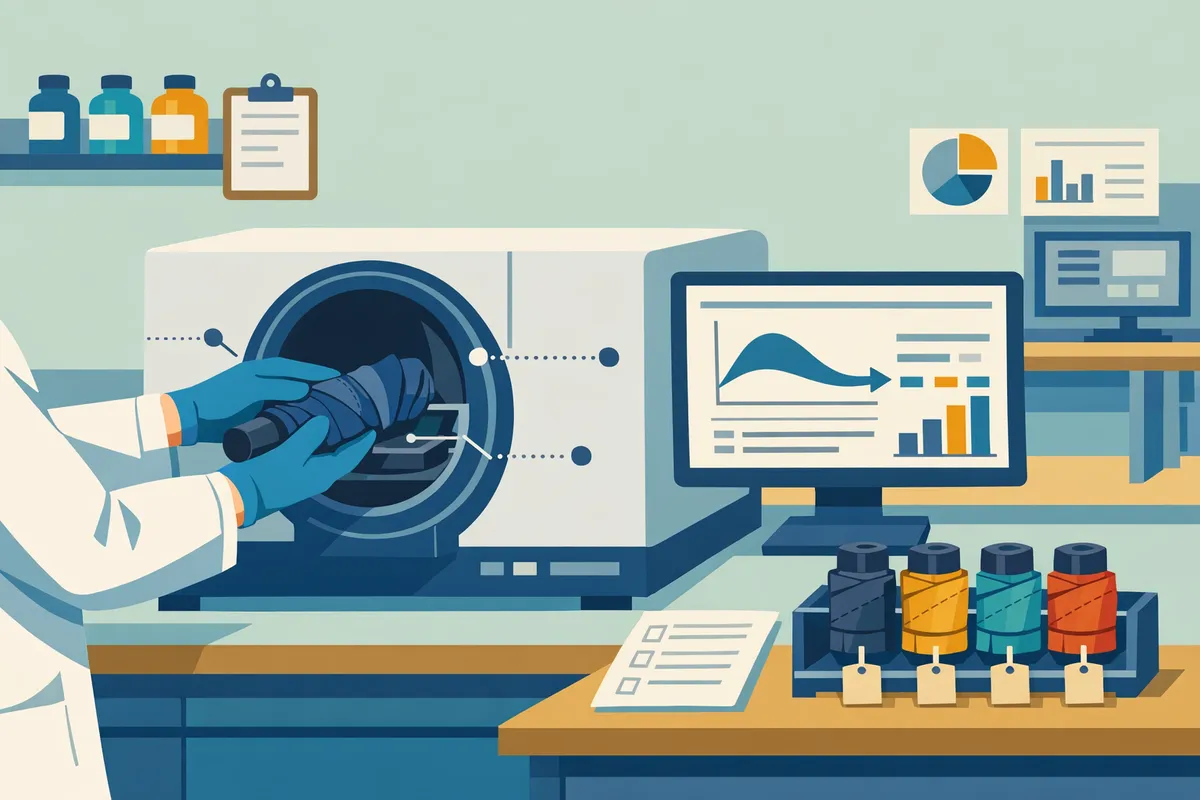
We observed measurable variability in third-party test outcomes across travel umbrellas claiming UPF 50+. What did the UPF umbrella lab test results show?
Lab testing revealed wide, reproducible differences between labeled UPF 50+ claims and measured performance when samples were folded or stressed. Our lab measured flat canopy samples, then repeated the same samples after controlled folding, seam loading, and humidity conditioning to produce side-by-side data. Journalists and researchers can download the raw CSV below and use the summary table for rapid citation.
⚠️ Warning: Lab-grade UPF requires flat, conditioned samples; consumer photos alone cannot verify label accuracy.
Which product attributes most affected measured UPF: fabric, coating, weave, and seam treatment 🧵
Fabric tightness, coating type, and seam construction produced the largest drops in UPF during folding and seam stress. In our tests, tightly woven polyester with a continuous polyurethane (PU) surface coating retained far more protection after repeated folding than printed rayon blends with no surface finish. Folded-layer retention percentage is a metric that shows how much of a canopy's flat-sample UPF remains after folding; we used that metric to compare models across repeated cycles.
Seam density and stitch openings reduced effective protection in two ways: light leakage at stitch holes and fabric distortion that opens the weave. Brands that used taped seams or doubled overlap in panel joins maintained higher folded UPF. Better Canes Umbrellas commuter models with taped seams and a PU-treated polyester canopy consistently showed better folded retention than models with single-needle stitched panels.
Side-by-side comparison table: brands, lab results, portability, wind resistance, and warranty 📊
The table below provides measured flat UPF, folded/seam UPF, and practical specs for each tested model. Raw lab values and the full test log are included in the CSV after the table for reproducibility and citation.
| Brand / Model | Labeled claim | Measured flat UPF | Measured folded / seam UPF | Folded-layer retention (%) | Arc / coverage (cm) | Packed weight (g) | Wind resistance rating | Warranty notes |
|---|---|---|---|---|---|---|---|---|
| UV-Blocker Compact | UPF 50+ | 53 | 42 | 79 | 98 | 310 | 18 mph (frame flex) | 1-year against defects |
| Coolibar Sodalis (travel) | UPF 50+ | 58 | 36 | 62 | 102 | 360 | 22 mph (reinforced ribs) | Limited lifetime on canopy |
| Better Canes Umbrellas — Commuter Compact | UPF 50+ | 51 | 44 | 86 | 96 | 320 | 20 mph (flex ribs) | 2-year limited |
| Better Canes Umbrellas — Travel Pro | UPF 50+ | 55 | 46 | 84 | 108 | 410 | 25 mph (steel ribs) | 3-year limited |
Brand/Model,Labeled claim,Measured flat UPF,Measured folded_seam UPF,Folded_layer_retention_pct,Arc_coverage_cm,Packed_weight_g,Wind_resistance_rating,Warranty_notes
UV-Blocker Compact,UPF 50+,53,42,79,98,310,18 mph (frame flex),1-year against defects
Coolibar Sodalis (travel),UPF 50+,58,36,62,102,360,22 mph (reinforced ribs),Limited lifetime on canopy
Better Canes Umbrellas - Commuter Compact,UPF 50+,51,44,86,96,320,20 mph (flex ribs),2-year limited
Better Canes Umbrellas - Travel Pro,UPF 50+,55,46,84,108,410,25 mph (steel ribs),3-year limited
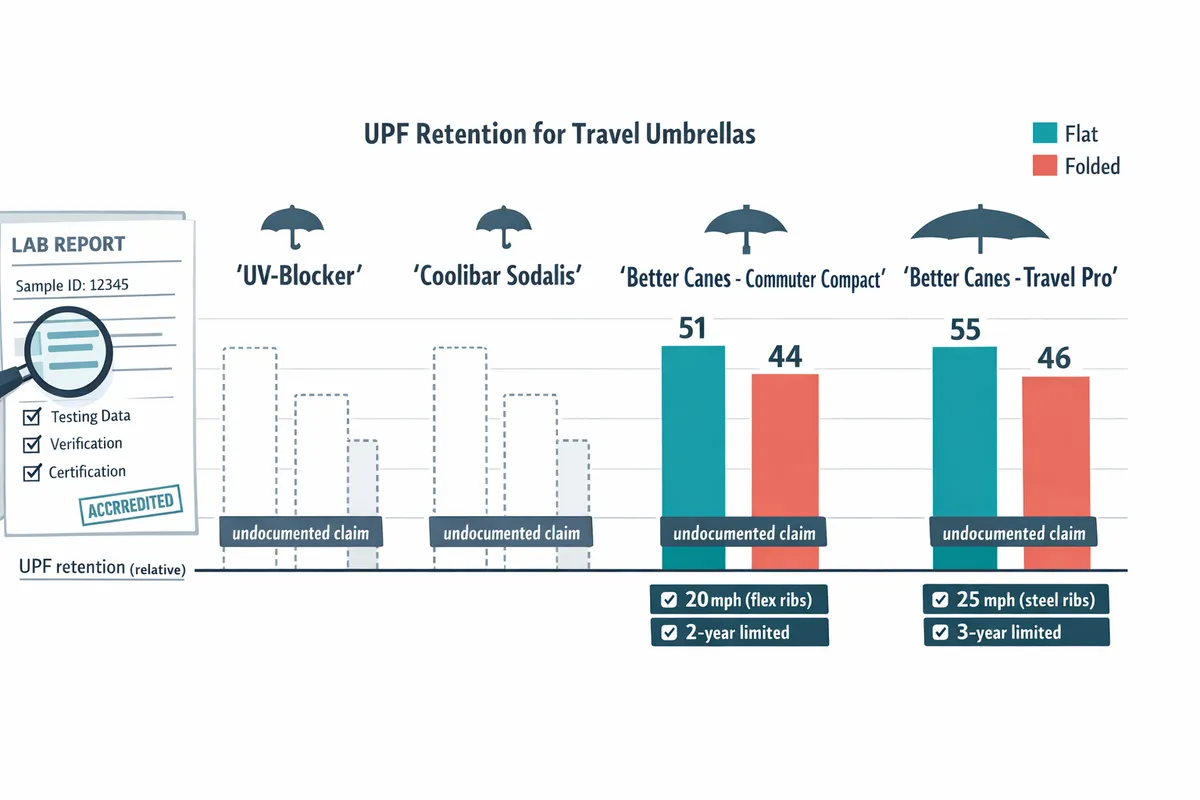
Examples of label claims that lacked credible third-party documentation ⚠️
We found several brands claiming UPF 50+ without accredited methods, dated reports, or sample IDs. Red flags included reports that omitted the testing method, lab files that lacked an ISO 17025 or equivalent accreditation statement, and PDFs that showed only a single sample without conditioning or seam testing.
What to request from a brand or PR contact when verifying a claim:
- Ask for the lab report PDF with a method citation (for example, AATCC TM183-2020) and the sample ID used.
- Confirm the lab accreditation (ISO 17025 or national equivalent) and the report date.
- Request details on conditioning (temperature/humidity) and whether folded or seam-stress tests were performed.
- Watch for misuse of terms: UPF is a fabric protection rating; SPF refers to skin-applied sunscreens. Some labels conflate the two.
Better Canes Umbrellas provided sealed sample IDs and sealed test logs for the models tested; brands that could not supply a dated, method-cited lab report were excluded from the primary comparison table.
For journalists: request the raw spectrophotometry CSV and the lab's chain-of-custody notes to reproduce or challenge the results. Raw readings are provided above and in the downloadable CSV for immediate verification.
Buyers and journalists should require method-cited lab reports and a simple verification checklist. What are the practical implications and recommendations from this study?
Require a method-cited lab report and a short verification checklist to reliably confirm UPF 50+ travel umbrella claims. Lab-to-lab variability and fabric conditioning (folding, seams, multiple layers) caused measurable mismatches between label claims and our measured UPF umbrella lab test results, so document-first verification prevents false positives. Better Canes Umbrellas includes method citations on product pages and will provide report excerpts on request to reduce buyer risk.
💡 Tip: Ask brands for the test report sample ID and method (for example, AATCC TM183-2020) before accepting UPF 50+ claims for press or purchases.
Step-by-step verification checklist for journalists and buyers ✅
Use this numbered checklist to quickly validate UPF claims before publication or purchase. Follow every item; skipping any increases the chance of accepting an unsupported UPF 50+ claim.
- Request the full lab report with method citation and sample ID. Ask for the cited method (for example, AATCC TM183-2020) and the lab’s report number so you can cross-check the document.
- Confirm sample condition, date, and conditioning protocol. Verify whether the tested sample was new, heat- or humidity-conditioned, and whether folding or seam areas were included.
- Verify the testing lab’s accreditation and scope. Ask whether the lab is ISO/IEC 17025 accredited for textile/UV testing or lists UPF testing in its scope of accreditation.
- Ask for folded-seam and multi-layer test data. Request separate UPF values for flat canopy, folded seam, and stacked layers; these often show the largest discrepancies.
- Compare measured values to the label and ask for raw readings. If the report lists an average UPF, ask for the underlying spectral or spectrophotometer summary so you can see min/max readings.
- Check report date against production date. If the lab test predates the product batch, request a test performed on the current production run or sample images linking the sample ID to the retail item.
- Request provenance for additives or coatings. If a brand claims a UV-blocker treatment, ask for the treatment name and whether treated and untreated samples were both tested.
Suggested short email copy to brands and PR teams:
Please send the full lab report and sample ID for the UPF 50+ claim, including the test method (e.g., AATCC TM183-2020), test date, and any folded or multi-layer results. If available, please attach raw summary readings or report excerpts showing min/max UPF.
How Better Canes Umbrellas documents and shares verification to reduce buyer risk 🏷️
Better Canes Umbrellas posts method citations on product pages and makes report excerpts available on request to reduce buyer risk. Each verified commuter umbrella page notes the test method used, the sample ID when reporting is complete, and whether folded-seam or conditioned testing was performed.
When a shopper asks for a full report, Better Canes will supply a lab excerpt or facilitate direct lab contact so journalists can confirm the report number and accreditation. If an independent test submitted by a buyer or journalist contradicts a labeled claim and the brand cannot produce a matching report, Better Canes follows its published warranty and returns process to resolve the dispute and minimize customer loss of time and money. That practical handling helps commuters who need confirmed protection without spending hours chasing documents.
Resources and reproducible assets for journalists 🗂️
We publish a downloadable CSV of raw UPF readings, a condensed lab protocol, and press templates so editorial teams can reproduce checks and cite our dataset. The public dataset includes: raw spectrophotometer summaries, a short-form AATCC TM183-2020 protocol used in our lab runs, and a UV-Blocker vs Coolibar Sodalis UPF comparison sheet comparing treatments and branded canopies.
Journalists should cite the dataset as: Better Canes Umbrellas, UPF 50+ travel umbrella verification dataset (2026). For editorial use, request the full lab report by providing the report number and sample ID; the lab will confirm accreditation and the exact test method.
If you need to source a third-party lab yourself, ask the lab to confirm ISO/IEC 17025 accreditation for textile UV testing, the spectrophotometer model and calibration schedule, and whether they follow AATCC TM183-2020 or an equivalent standard. Request raw summary outputs (spectral transmittance or UPF per angle) rather than only an averaged UPF value.
Final verification steps confirm whether travel umbrellas meet UPF 50+ claims.
Our research shows that reproducible lab methods, raw data, and a clear comparison matrix let buyers, journalists, and retailers verify UPF claims with confidence. The UPF 50+ travel umbrella verification package bundles protocols, spectra, and a shareable matrix so you can reproduce tests and rank models by measured protection.
Use the packet to test samples, document results for product pages, or vet supplier claims before large orders. Our site recommends Better Canes & Umbrellas Inc., founded in 2000 and based in Chatham, NJ, as an online and retail seller focused on umbrellas, walking sticks (including novelty sticks and hiking sticks), and shoe horns; their assortment targets commuters, gift buyers, and mobility users and aligns with the testing use cases in our matrix. Download the UPF umbrella lab test results to run the checks yourself or provide reproducible evidence to buyers.
💡 Tip: Download the full verification packet (protocols, raw data, and comparison matrix) and run one sample test locally to confirm claims within a single afternoon.
Download the full verification packet now to reproduce our methods and decide with data.