
Umbrella Testing Standards 2026
Umbrella Testing Standards 2026
A single failed quality test forced one mid-size importer to recall 12,000 umbrellas last year, costing months of lost sales. Umbrella testing standards are prescriptive manufacturing and compliance criteria that define pass/fail tests, safety thresholds, and reporting formats for umbrellas. Our website's best-practices-guide, Umbrella Testing Standards 2026, provides a research-backed compliance and testing playbook for umbrella manufacturers and sellers with a standards crosswalk, repeatable testing workflow, cost and duration estimates, and backlink-worthy resources. Better Canes Umbrellas (Better Canes & Umbrellas Inc., founded 2000, Chatham, NJ) sells commuter and travel umbrellas, walking sticks, and shoe horns, so this guide ties test priorities to our Travel Umbrella Guide and to real product pages, and you might be surprised which three tests trip up compact travel models.
Which umbrella testing standards apply to different umbrella types?
Applicable standards depend on umbrella type: travel, beach, and cane umbrellas each map to different subsets of CPSC rules, ASTM F3681, UL SAC protocols, and regional test bodies. Our website crosswalks those standards so manufacturers and merchants know which tests to run first and which markets expect what.
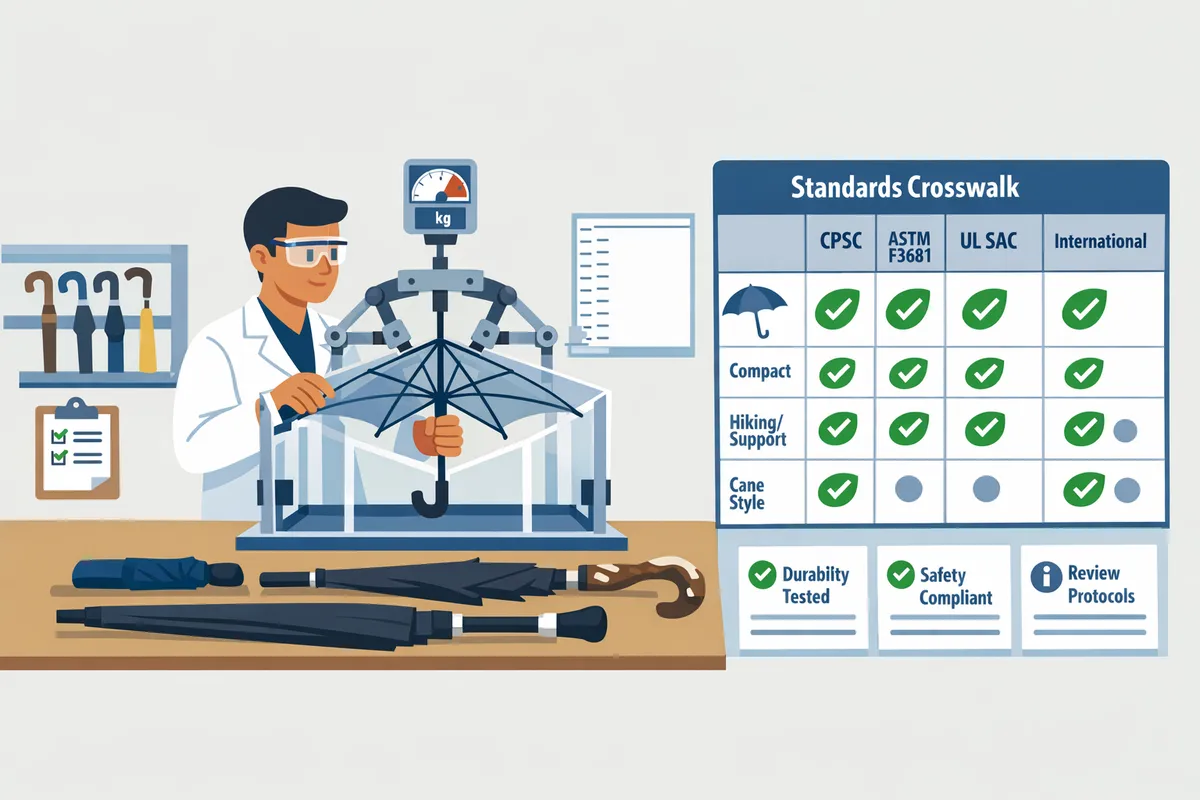
Standards crosswalk table (US vs international) 🗺️
The table below maps core test categories to CPSC, ASTM F3681, UL SAC, and major international test routes and shows which umbrella types normally require each check. This table helps prioritize testing for commuter travel, beach, and cane styles.
| Test category | What it checks | CPSC (US) | ASTM F3681 | UL SAC | China CTI / GB & other regional labs | Typical pass/fail criteria | Applies to (travel / beach / cane) |
|---|---|---|---|---|---|---|---|
| Opening/closing durability | Automatic mechanisms and hinge wear over cycles | Enforces mechanical-safety hazards; failures may trigger recall | Voluntary; defines cycle methods and acceptance | Voluntary protocol; used by retailers | Commonly run by labs for imports | No failure that creates a sharp edge or collapse over specified cycles | Travel / Commuter |
| Frame bend / fatigue | Rib and shaft repeated flex under load | Enforced if failure creates injury risk | Specifies cycle counts and failure modes | Tests for structural integrity under load | Standard fatigue tests used for export clearance | No permanent deformation or fracture after cycles | Travel, Beach |
| Fabric tensile / seam strength | Canopy tear and seam integrity under load | Textile hazards considered for consumer safety | Defines tensile test methods and minimum strength | Optional but used by quality-conscious brands | Tensile thresholds set per material class | No seam separation or tear under rated loads | All types |
| Wind resistance and anchor uplift | Wind loads on canopy and anchor/grounding systems | Not a specific CPSC standard; hazard enforcement applies on failure | ASTM includes wind-related protocols in product guidance | UL SAC includes vulnerability tests for structural failure | China labs often require uplift/anchor tests for beach imports | No catastrophic collapse or uplift at lab-specified wind speeds or load cycles | Beach / Large sun umbrellas |
| UV protection (UPF) | Fabric solar attenuation | Regulated labeling requirements in some markets | Optional test methods specified | Voluntary but expected for sun products | Commonly requested for sun/beach exports | Measured UPF value or pass at defined wavelength bands | Beach |
| Handle and tip load / slip resistance | Load-bearing of handles, tip safety | Mandatory if handles or tips pose injury risk | Specifies static load and slip tests | Often required by retailers for cane-like products | Load and durability tests performed in export labs | Handle must withstand specified static load without failure | Cane / Walking-stick style |
| Sharp points, small parts, flammability | Immediate consumer-safety hazards | Regulators enforce sharp point and small-part rules; flammability enforced where applicable | ASTM provides guidance for hazard mitigation | UL SAC references hazard reduction practices | Regional regulators apply their own small-parts rules | No accessible sharp points; small parts meet child-safety limits | All types (varies by market) |
Which test categories matter most for each product type? 🌬️
Travel umbrellas prioritize mechanism durability and compact-frame fatigue over large-wind testing. Travel umbrellas get repeated-cycle tests for automatic open/close, hinge fatigue checks, and canopy tensile tests because commuter users expect daily folding without frame failure. For our Better Canes Umbrellas commuter SKUs we recommend vendor-run 1,000-cycle mechanism tests and rib flex checks before inventory buys.
Beach umbrellas prioritize wind resistance, anchor uplift, and fabric UV performance. Beach models need uplift and anchoring tests plus larger-frame fatigue assessments because failure can cause injury or product loss on windy beaches. Better Canes Umbrellas runs windproof umbrella testing standards scenarios on new beach SKUs to validate anchor systems and recommend rated wind conditions on product pages.
Cane-style umbrellas prioritize handle load, tip strength, and slip resistance. Canes see body weight and leverage, so static load tests and long-term handle wear checks matter most. For novelty or gift canes in our catalog, we add handle-load testing and clear labeling about intended load ranges to reduce returns and liability.
Which standards are mandatory versus voluntary? ⚖️
Mandatory regulations typically cover immediate hazards such as sharp points, small parts for children, and certain labeling obligations, while ASTM and UL SAC protocols are voluntary technical standards commonly requested by retailers and export partners. Regulators enforce mandatory items via product-safety laws; noncompliance risks recalls, fines, and blocked shipments.
Common mandatory items to check before sale:
- Sharp-point and piercing hazard tests where exposed tips or ribs could injure users.
- Small-part rules when products or accessories target children under age thresholds.
- Required labeling for country of origin, care, and warning statements in some markets.
Voluntary but market-expected tests to run before export or big retail listings:
- ASTM F3681-style cycle and wind guidance for consumer confidence.
- UL SAC structural tests when retailers require certified supplier reports.
- Regional UV and textile tests for beach umbrellas.
⚠️ Warning: Skipping mandatory hazard tests can trigger immediate enforcement actions and costly recalls; run mandatory checks first and attach test reports to shipments.
Practical sequencing and budget estimate for Better Canes Umbrellas SKUs:
- Run mandatory hazard checks and fabric tensile tests first. Time: 1 to 2 weeks. Cost: typically $800 to $3,000 per SKU depending on lab and sample prep.
- Add voluntary structural and windproof umbrella testing standards for retail acceptance and export: allow 3 to 6 more weeks and $2,500 to $9,000 for full wind and fatigue matrices.
- Retest after design changes; minor adjustments often need only targeted verifications.
Following this order reduces wasted lab time and lowers the chance of a late-stage design recall for our Better Canes Umbrellas product lines.
How do you run a practical testing workflow for umbrella compliance?
A practical testing workflow sequences a pilot pre-test, standardized conditioning, full-sample lab tests, and a documented acceptance review. Standardizing sample sizes, lab setup, and reporting reduces retests and speeds buyer approval. According to Better Canes Umbrellas' QA team, documenting each step and using a repeatable checklist prevents the most common certification delays.
Step-by-step testing workflow (sample sizes, lab setup) 🔬
Start with a pilot batch of 5–10 units, then test a full sample set of 20–30 units for final certification. Most third-party labs and retail buyers accept 20–30 as a full sample set for travel and cane umbrellas.
- Select samples. Pull units randomly across production shifts and label with sample IDs (LOT-001, LOT-002). Random selection prevents bias in failure-rate estimates.
- Pilot pre-tests. Run 5–10 units through basic function checks: open/close cycles, visual inspection, and a quick canopy pull test. Fix obvious assembly issues before full testing.
- Conditioning. Condition all samples to the lab baseline before destructive tests.
- Lab setup checklist. Required equipment typically includes a tensile tester, UV transmittance meter or spectrophotometer, calibrated anemometer or wind tunnel, fixture for open/close cycling, and traceable calibration certificates for each instrument.
- Test sequencing. Run nondestructive function and dimensional checks first, then fabric tests (tensile, UV), and finally wind and cyclic durability tests to avoid contaminating fabric results.
💡 Tip: Condition fabric samples to 23°C and 50% RH for 24 hours before tensile and UV tests.
According to Better Canes Umbrellas, documenting who removed samples from production and the time/date stamp prevents arguments over lot integrity.
How to check UV protection on an umbrella ☀️
Measure UV protection with a UV transmittance meter or certified lab UPF testing; simple field checks can screen batches before lab submission. UPF labeling is a fabric-level rating that quantifies UV protection under standardized lab conditions.
- Lab vs field. Certified UPF lab tests report a UPF value using a spectrophotometer under standardized illumination. A UV transmittance meter gives quick pass/fail screening on-site but does not replace certified lab data.
- Field screening steps (retailer or QA). 1) Use a handheld UV meter on 3–5 points of the canopy and record mW/cm2 readings. 2) Compare readings to an adjacent control fabric or an internal reference sample. 3) Photograph meter readouts and note meter serial number and calibration date.
- Practical example. For a batch of commuter umbrellas, test one sample per 100 units with a handheld meter; if a reading deviates by more than 15% from the reference, escalate to lab UPF testing.
Better Canes Umbrellas marks UPF-rated listings and recommends documenting meter serial numbers and lab certificates when selling UPF claims to retailers.
Windproof umbrella testing standards: protocols and common failure modes 🌪️
Windproof umbrella testing standards measure frame flex, rib retention, canopy inversion resistance, and repeated-load durability at specified wind speeds and cycle counts. Many labs reference ASTM F3681 or vendor-specific wind-load protocols when defining wind speeds and pass thresholds.
Typical test sequence: initial static load and rib retention checks, staged gust or steady-wind exposures, then cyclic open/close at rated load cycles. Run wind testing after conditioning and fabric tests to avoid cross-test contamination.
| Common failure mode | How it shows up in testing | Practical fix |
|---|---|---|
| Rib fracture or permanent bend | Broken ribs during gust cycles | Change rib alloy or increase rib diameter; add a reinforcement sleeve at the hub |
| Rib separation from stretchers | Canopy detaches from frame at joints | Use stronger rivets or crimped joints; add mechanical locking washer |
| Canopy inversion | Full inversion at moderate wind speeds | Add vented canopy panel or redesign ferrule and canopy geometry |
| Repeated open/close wear | Hinge loosens after cycles | Specify higher-cycle-rated hinges and test to the buyer's cycle count |
A practical fix often starts with a prototype reinforcement and a second pilot run rather than full-scale retooling. Better Canes Umbrellas includes wind tests in its QA protocol and documents corrective actions (design change, supplier change, retest) to streamline retailer discussions.
Quality documentation and lab report checklist ✅
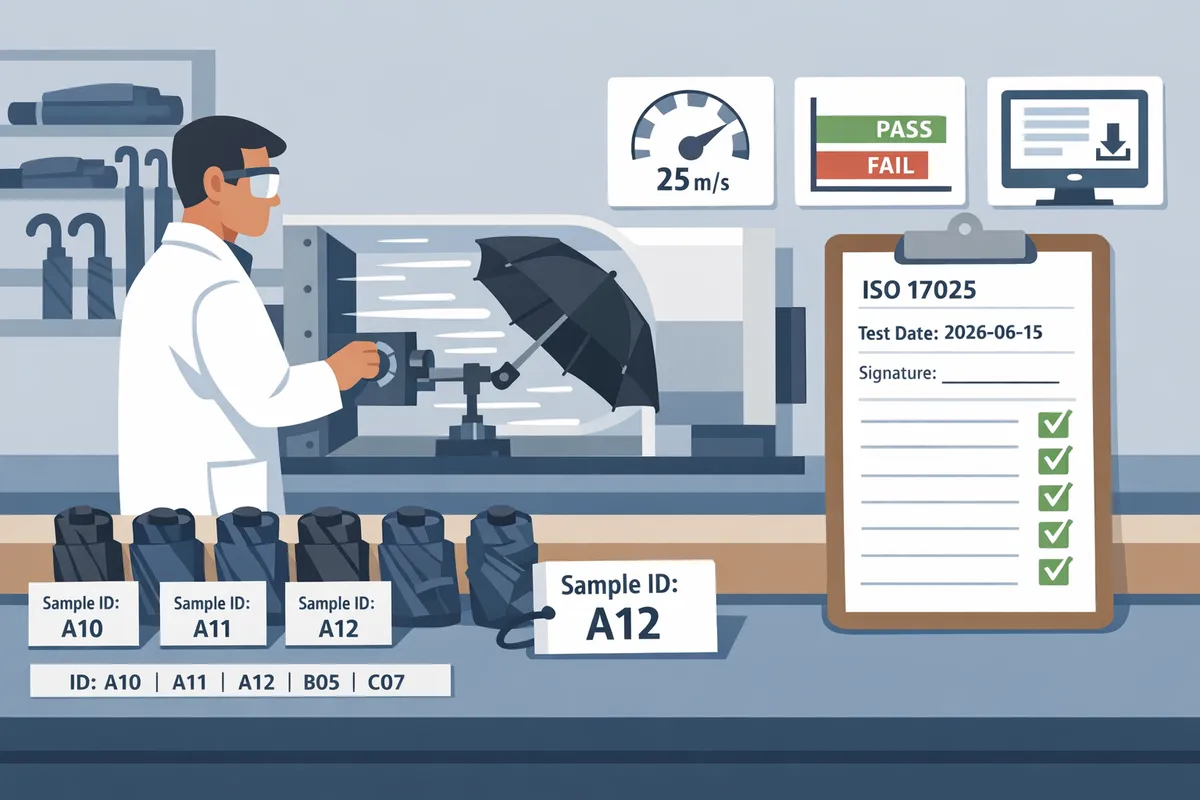
A passing lab report must include sample IDs, conditioning notes, equipment calibration, raw data, test methods, and acceptance criteria. Retail buyers and regulators request these items to verify traceability and method integrity.
Checklist (required items):
- Sample identification (manufacturer, SKU, lot number, sample ID list)
- Number of samples tested and selection method
- Conditioning records (temperature, relative humidity, duration)
- Test methods and referenced standards (e.g., ASTM F3681, CPSC protocol when applicable)
- Equipment list with calibration certificates and dates
- Raw data files or tables (force-deflection curves, UV transmittance spectra, wind load logs)
- Photographic evidence (setup photos, failure photos with scale)
- Acceptance criteria and pass/fail statement for each test
- Analyst name, lab name, accreditation (ISO 17025 or equivalent), test date, and signature
Better Canes Umbrellas offers a downloadable lab documentation checklist tailored to travel and cane umbrellas to help suppliers and buyers submit complete reports and avoid review delays.
How should businesses measure outcomes, estimate cost, and prioritize testing?
Prioritize tests by mapping each test to business risk, cost, and recall exposure. Focus first on failures that stop sales or trigger safety recalls, then add market-specific certification where required. This section shows how to read lab data, budget for essential versus full testing, pick labs or in-house checks, and use real examples to set priorities.
Interpreting lab results and setting pass/fail thresholds 📊
Read lab results by comparing each measured value to the standard's acceptance criteria and your product claims. Start by pulling the exact numeric requirement from the relevant standard (for example, tensile, tear, or UPF limits). Then compare the lab's measured value to that requirement and to your label claim; if the measured value falls below the claim, you must either relabel, limit the SKU's distribution, or redesign.
Example decision rules we use at Better Canes Umbrellas: require measured values to meet the standard and exceed any consumer-facing claim by a safety margin before release. For instance, if a canopy UPF test returns UPF 25 but the product label says UPF 50, do not release that SKU with the higher claim. If the measured UPF sits near the pass/fail boundary, run a repeat test with a retained sample before changing labels.
How to check UV protection on an umbrella. For a formal check, request a UPF report from an accredited lab. For a rapid in-house screen, measure several samples with a handheld UV meter or send a subset to a commercial lab and use those results to validate production runs.
⚠️ Warning: Always require a signed laboratory report with sample IDs, test method references, and raw measurement values before approving a SKU for sale.
Cost, duration, and resource estimates for essential vs full testing 💰
Essential baseline testing usually costs less and finishes faster than full international certification. The following table shows typical ranges and when to prioritize each scope.
| Test scope | Typical cost (USD) | Typical duration | When to prioritize |
|---|---|---|---|
| Essential baseline (durability cycle, opening/closing, fabric strength) | $500–$2,500 | 1–3 weeks | New SKUs, small-batch pilots, domestic-only sales |
| Extended market tests (wind resistance, UPF, water repellency) | $2,000–$6,000 | 2–6 weeks | If selling to outdoor retailers or marketing "windproof" claims; aligns with windproof umbrella testing standards |
| Full certification (market-specific CE/UKCA/other regulated marks) | $5,000–$25,000+ | 4–12 weeks | Mandatory for some export markets or large retail contracts |
Use a prioritization matrix to budget: 1) quantify revenue per SKU and expected volume; 2) assign a risk score (safety recall potential, retailer requirement, brand claim exposure); 3) fund tests in descending order of (risk score × revenue). Small brands should front-load essential baseline tests and fund extended tests only for SKUs sold to high-risk channels or exported.
Better Canes Umbrellas staggers spend: low-cost pre-tests on prototypes, extended lab tests for best-selling commuter SKUs, and full certification when entering a regulated market.
When to use a third-party lab vs in-house checks 🏷️
Use third-party labs for certification, retailer acceptance, and legally binding evidence; use in-house checks for fast iteration, failure diagnosis, and production spot-checks. In-house checks let you run quick opening/closing cycle counts, visual seam inspections, and simple pull tests to catch obvious defects before sending samples out.
Send product to a third-party lab when a retailer or market requires a certified report, when you make a consumer-facing claim (for example, "windproof" tied to a measured wind rating), or when you need an unbiased record for liability protection. Keep chain-of-custody documentation and a retained sample for every production lot so a lab retest can resolve disputes.
💡 Tip: Keep one sealed retention sample per lot and record its ID in the batch report; this saves weeks if a customer complaint requires a retest.
Better Canes Umbrellas uses in-house pre-tests for iterative fixes and reserves third-party labs for final certification and problematic lots.
Real-world failure examples and corrective actions 🛠️
Common field failures show clear fixes and minimum tests to confirm those fixes. Each example below names a root cause and the smallest lab check that proves the fix.
-
Frame inversion. Root cause: ribs too flexible or poor rib-to-notch geometry. Corrective action: increase rib stiffness or change rib profile and improve joint tolerances. Minimum confirming test: wind load or inversion cycle test per windproof umbrella testing standards on 6–10 samples.
-
Canopy tearing at seams. Root cause: low seam strength or incorrect stitch pattern. Corrective action: switch to higher-tenacity thread, use reinforced seam tape, or choose ripstop fabric. Minimum confirming test: tear strength and seam-pull tests on production fabric and a 10-sample seam pull check.
-
Handle breakage under load. Root cause: brittle injection-molded handle or undersized internal ferrule. Corrective action: change material grade or increase reinforcement, and add a torque test to the handle joint. Minimum confirming test: handle torque and drop tests on sample handles.
-
UV protection shortfall. Root cause: coating inconsistent or fabric batch variation. Corrective action: change finishing process or source certified UPF-rated fabric. Minimum confirming test: UPF measurement on three production bolts and one final-product sample.
Better Canes Umbrellas documents each failure with root-cause notes and the minimum lab test required to clear the fix before releasing a revised run.
How Better Canes Umbrellas validates product claims
Better Canes Umbrellas validates claims with staged pre-tests, third-party certification where required, and batch spot-checking. Step-by-step workflow:
- Prototype pre-test. Run quick in-house checks (opening/closing, visual seam, basic pull tests) on 8–12 prototypes to catch early failures.
- Selected lab tests. Send 6–30 samples for third-party testing based on the claim and target market (for example, UPF reports or wind resistance for commuter and travel umbrellas).
- Production controls. Use in-house spot-checking on each lot (example: 1% of units) and retain sealed samples for retest.
- Ongoing verification. If complaints exceed a threshold, rerun third-party tests on retained samples and quarantine affected lots.
This staged approach helps Better Canes Umbrellas preserve product variety for commuters and gift buyers while keeping returns and defects low.
Frequently Asked Questions
This FAQ answers common, practical questions about umbrella testing standards, measurement methods, and lab sourcing for travel and cane umbrellas. It focuses on next steps product teams and small retailers can act on immediately. Use these answers alongside the standards crosswalk and testing workflow earlier in this guide.
What are the main umbrella testing standards to know?
The main umbrella testing standards are CPSC consumer-safety rules, ASTM mechanical and fabric tests, and regional lab protocols such as UL SAC or CTI equivalents. Our standards crosswalk maps specific tests (frame strength, opening/closing, fabric water resistance, seam and seam-strength tests) to the markets where they matter. Action: identify your target markets, then use the crosswalk to mark which tests are mandatory versus voluntary and budget for mandatory tests first.
How do I check if an umbrella is truly windproof?
Windproof claims require mechanical wind-resistance testing of the frame and canopy at defined load levels, not visual inspection. Our product team at Better Canes Umbrellas recommends a two-step approach: run a 5–10-unit pilot inversion and recovery sequence in-house, then send 20 units to a third-party lab for a calibrated wind load test. Action: document the inversion force and recovery cycles and keep failed samples for supplier negotiations.
How should I check UV protection on an umbrella?
UV protection is verified with a UPF measurement that quantifies fabric UV transmittance. UPF is a textile rating that states how much UV the fabric blocks; send fabric swatches to a textile lab for a certified UPF report rather than relying on color or marketing copy. Action: request lab reports that list the test method (for example, ASTM D6544) and include the swatch conditioning protocol.
How many samples should I send for certification testing?
Sample size depends on the standard and whether tests are destructive, but a typical full certification run uses 20–30 samples while pilot pre-tests use 5–10 units. For travel and cane umbrellas, start with 5 pilot units to catch obvious failures, then plan 20 certified samples when submitting for market acceptance tests. Action: track which tests are destructive and reserve extra units for retests and supplier dispute resolution.
Can I rely on supplier test reports or do I need independent testing?
Supplier test reports are useful for iterative design, but most retailers and regulators expect third-party lab verification for certification claims. Use supplier reports to speed development, then budget for an independent lab when you pursue market acceptance or plan to list windproof or UPF claims on product pages.
⚠️ Warning: Keep original supplier report files and failed samples; they are essential if a third-party lab result conflicts with a supplier's claim.
Action: require a supplier-issued test summary during sampling and add an independent test milestone before production buy.
What's the fastest way to fix a recurring canopy tear in testing?
The fastest effective fix is to upgrade fabric weave or add targeted seam reinforcement and then run focused tensile and seam-strength retests. Our design team at Better Canes Umbrellas typically narrows the fix to two changes, orders a 5-unit pilot batch with reinforced seams, and runs the specific tensile and seam tests to verify improvement before full retest. Action: estimate the cost of small design changes versus the cost of full certification retests to decide whether to iterate or stop shipment.
Next steps provide a practical compliance roadmap for umbrella testing standards.
Follow a staged, repeatable workflow: prioritize high-volume commuter and travel umbrellas, run mechanical durability and water-resistance cycles, then validate UV and fabric claims with accredited labs. This approach reduces rework, limits batch holds, and shortens time to market.
💡 Tip: Start by testing one representative SKU from each product family; early failures cost less than full-batch recalls.
Better Canes & Umbrellas Inc., founded in 2000 and based in Chatham, NJ, is an online and retail seller focused on umbrellas, walking sticks (including novelty sticks and hiking sticks), and shoe horns. The company expanded its assortment in 2005 to include a wide range of walking and novelty sticks and later added shoe horns in unique styles and designs. The site positions itself as a source for reliable, fashionable, and collectible items that serve both practical daily needs and gift occasions.
Our site recommends requesting a compliance-ready sample from Better Canes & Umbrellas and running the testing crosswalk in this guide as your first step. Subscribe to our newsletter for implementation tips and standards updates.