
Types of Walking Canes Explained (2026): Straight, Offset, Quad, Tripod, and Hemi‑Walker—How to Choose the Right Support
Types of Walking Canes Explained (2026): Straight, Offset, Quad, Tripod, and Hemi‑Walker—How to Choose the Right Support
A misfitted cane often causes pain and increases fall risk for seniors who rely on them daily. Types of walking canes are categories of mobility aids that differ by base shape, shaft angle, and support level. This how-to guide explains common cane styles, including straight, offset, quad, tripod, and hemi-walker, compares their support and use cases, and gives step-by-step fitting and buying advice for seniors and caregivers. Our website Better Canes & Umbrellas Inc., founded in 2000 in Chatham, NJ, carries commuter canes, hiking sticks, novelty collectible canes, umbrellas, and shoe horns to match support needs with personal style. Our comparisons help you avoid hours of trial-and-error shopping. Which cane gives steady support without sacrificing style or gift appeal?
Which walking cane type matches my balance, condition, and daily tasks?
Match cane type to your balance and tasks by prioritizing base-of-support, handle ergonomics, and portability. Our website uses practical examples and condition-specific guidance so you can pick a cane that reduces fall risk and fits your daily routine. Below are clear, condition- and task-focused recommendations tied to real-world use cases.
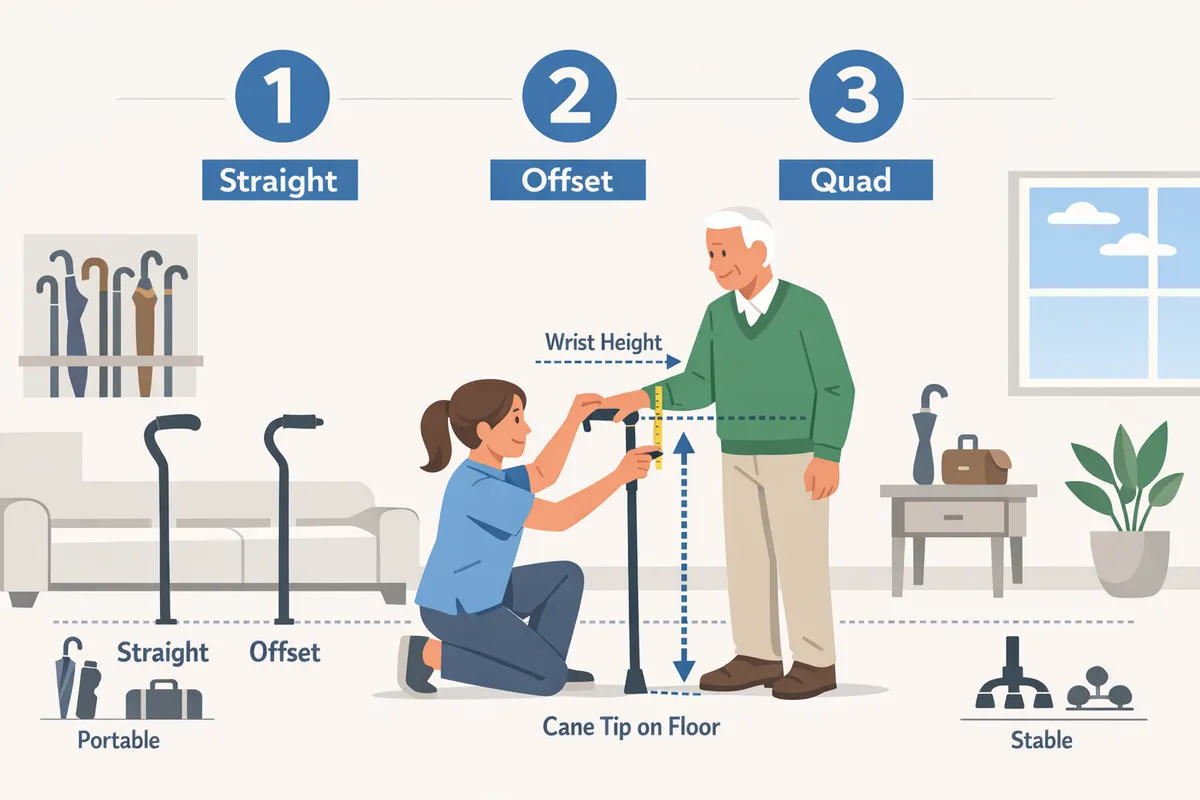
Straight cane 🦯
A straight cane is a single-point mobility cane that provides light support and maximum portability. A straight cane works best for occasional imbalance, mild weakness on one side, or short walks to the mailbox. For example, a commuter who walks two blocks and needs occasional stabilization will favor a lightweight straight cane that fits under a seat.
- Ideal users: people with good upper-body strength and steady gait.
- Pros: very portable, easy to store, often cheapest option.
- Cons: less lateral stability on uneven ground; not for progressive balance loss.
Our website recommends straight models from Better Canes Umbrellas for commuters who need a compact, reliable walking stick. Measure wrist-to-floor height while standing to get an effective fit.
Offset cane 🪑
An offset cane is a cane whose handle aligns load over the shaft to reduce wrist strain. Clinicians often recommend offset handles for arthritis, weak grip, or wrist pain because the load sits directly above the shaft rather than pushing the wrist outward.
- Handle shapes to consider: derby (big thumb rest), anatomical (contoured), and T-handle (broad surface).
- Best when you need comfort plus single-point support during longer walks or errands.
- Comparison note: straight vs offset cane, choose offset when wrist comfort and shock distribution matter more than absolute portability.
Better Canes Umbrellas stocks several offset-handle options in derby and anatomical styles suitable for users with hand pain.
Quad cane 🧭
A quad cane is a cane with a four-point base that increases lateral stability while standing and walking slowly. People with poor balance, progressive instability, or those who pause frequently benefit from the broader support surface a quad cane provides.
- Use-cases: indoor walkers with frequent turns, people recovering from a stroke, and those who need help rising from chairs.
- Drawbacks: bulkier shaft, slower gait, harder to use on stairs.
- Tip choices: swivel-tip quads for carpets and hard floors; larger flat-base tips for stable contact on hard surfaces.
⚠️ Warning: A quad cane can catch on uneven outdoor surfaces; choose a large-base tip for mixed indoor-outdoor use.
Better Canes Umbrellas offers quad canes designed for indoor stability and models with replaceable tips for outdoor use.
Tripod cane 🪵
A tripod cane is a three-legged cane that adds lateral support with less bulk than a quad cane. Tripod canes suit users with moderate balance loss who need side-to-side help but still want a lighter option than a quad.
- Best situations: uneven sidewalks, short hikes, and places where you need quick lateral correction.
- Advantage over straight cane: provides directional support when stepping crosswise or turning slowly.
- Practical tip: choose a tripod cane with a low center-of-gravity base and a comfortable handle for walking longer distances.
Better Canes Umbrellas carries tripod models that balance durability and portability for outdoor use.
Hemi-walker 🚶
A hemi-walker is a walker-like device with a broad base and handle that provides substantial unilateral support. Clinicians recommend a hemi-walker when a patient needs walker-level stability on one side but still wants to maneuver in tight spaces.
- Sizing: handle height sits slightly higher than a cane, and the base footprint is larger than most canes.
- Common users: post-hip or knee replacement patients who need strong lateral support on one side.
- Business consequence of DIY choice: buying the wrong size wastes time, risks poor posture, and may delay recovery.
Better Canes Umbrellas lists hemi-walker options for caregivers who need a sturdy, single-sided support device for assisted mobility.
Folding, seat, and novelty canes 🎁
Folding and seat canes add portability or a built-in rest, while novelty canes prioritize style over clinical support. Folding canes suit travelers and commuters who store a cane in luggage or under a seat. Seat canes help users who need occasional rest during long waits or events.
- Pros: portability, convenience, and giftability.
- Cons: folding mechanisms and seats reduce maximum load capacity; novelty canes often lack proper ergonomic handles and tip stability for daily use.
Our website features folding and seat cane models from Better Canes Umbrellas for commuters and travelers, and offers novelty sticks for gift occasions when function is secondary to style.
Quick comparison table 📊
The table below compares base of support, best use-case, portability, recommended user profile, and typical price range for common cane types.
| Cane type | Base of support | Best use-case | Portability | Recommended user profile | Typical price range |
|---|---|---|---|---|---|
| Straight cane | Single point | Short walks, commuters | Excellent | Occasional imbalance, good strength | $20–$60 |
| Offset cane | Single point with aligned load | Wrist pain, longer walks | Good | Arthritis, weak grip | $30–$90 |
| Quad cane | Four-point base | Indoor stability, slow gait | Fair | Poor balance, progressive instability | $50–$120 |
| Tripod cane | Three-point base | Uneven terrain, directional support | Good | Moderate balance loss | $45–$100 |
| Hemi-walker | Large single-side base | Strong unilateral support | Low (bulkier) | Post-op patients, significant weakness | $60–$150 |
| Folding / Seat cane | Varies (folding) | Travel, resting during outings | Excellent (folded) | Travelers, event attendees | $40–$120 |
| Novelty cane | Decorative, varied | Gifts, costumes | Varies | Collectors, occasional use | $25–$200 |
💡 Tip: If you split activities between city streets and indoor spaces, carry a folding offset cane to balance wrist comfort and portability.
How do I measure, fit, and test a cane? (Step-by-step guide with visuals)
Measure the cane to the wrist crease, choose a handle that keeps the wrist neutral, pick a base that matches balance and walking speed, then validate the fit with a short trial walk. These steps cut fall risk by ensuring the cane supports weight where the body is strongest and does not introduce awkward posture. Follow the numbered steps below and use our Better Canes Umbrellas selection to try options that match each need.
Step 1: Measure the user for cane height 📏
Measure cane height from the wrist crease to the floor while the user stands relaxed in the shoes they wear most. Standing wrist-crease method: have the user stand upright with shoes on and arms relaxed at the sides; measure from the wrist crease (where the hand meets the forearm) straight to the floor. Seated elbow-angle check: with the user seated, hold the cane beside them and confirm the elbow bends about 20 to 25 degrees when they grip the handle. Common mistakes: measuring barefoot, using the shoulder instead of wrist, or measuring while the user is slouching. Our Better Canes Umbrellas sizing notes recommend measuring in the same shoes the user walks in and re-checking after trying the cane for five minutes.
Step 2: Choose handle type and test wrist comfort 🖐️
Choose a handle that aligns force over the forearm to reduce wrist strain and test by having the user grip and shift body weight onto the cane briefly. Crook handle is a handle style that hooks over the arm and suits light-use or quick stops. Derby handle is a handle style that offsets the grip to distribute load toward the forearm and helps users with weaker hands. Offset handle is a shaft design that places the shaft behind the grip so the wrist stays straighter; compare straight vs offset cane when wrist pain or forward flexion is present. Anatomical handles are handle styles that contour to the palm to lower pressure points and aid arthritis. Quick test: have the user hold the cane and transfer about 10 to 15 percent of their weight for 5 seconds; watch for wrist pain, numbness, or grip slippage. Our Better Canes Umbrellas catalog lists derby, anatomical, and offset options so you can try the handle shapes that reduce discomfort.
💡 Tip: For hand arthritis choose a larger-surface anatomical or foam-covered handle to spread force and reduce pain during the weight-transfer test.
Step 3: Select the right base for stability needs ⚖️
Pick a base that matches the user's balance and walking speed; larger, multi-point bases give more static stability but slow forward roll. Use the short functional checks below to decide which base fits daily needs.
| Base type | Stability level | Best for | Mobility trade-off |
|---|---|---|---|
| Single-point (standard) | Low to moderate | Users with steady gait and normal walking speed | Easiest to swing but least stable when standing still |
| Tripod | Moderate | Users needing slightly wider lateral support | Slightly bulkier than single-point |
| Quad | High | Users with frequent sway, slow gait, or standing support needs | Slower gait and heavier to carry |
| Hemi-walker | Very high | Users who need continuous lateral support or single-side walker replacement | Restricts arm swing and is bulkier for travel |
Quick checks: standing sway test (stand feet together and see if the cane prevents lateral sway), short walk (50 feet at normal pace), and turning test (turn sharply and note recovery). Prefer quad or hemi-walker over single-point canes when a user needs support while standing, takes multiple steps to regain balance, or reports frequent near-falls. Our Better Canes Umbrellas assortment includes single-point and quad options so caregivers can compare stability vs portability in person.
Step 4: Adjust length, lock mechanisms, and try a 5-minute walk 🚶
Adjust the cane so the handle aligns with the measured wrist crease and verify the locking mechanism secures before using it for mobility. Steps to follow: 1) Set telescoping pins or push-button to the measured height and listen for a solid click. 2) Check that the rubber tip sits flat on the floor and does not rock. 3) Fasten any wrist strap so the cane cannot fall when released. 4) Walk for five minutes on typical surfaces and observe stride symmetry, hand fatigue, trunk lean, and whether the cane slips or sinks. Observable red flags requiring re-fit or different cane type: persistent wrist pain, marked trunk lean, frequent loss of balance during turns, or the cane tip slipping on a typical surface. If any red flag appears, try a different handle, a wider base, or consult a clinician.
⚠️ Warning: Do not shorten a cane to compensate for slouched posture. Shortening increases forward lean and raises fall risk.
Our Better Canes Umbrellas models include adjustable shafts and replacement tips to support correct fitting and quick fixes.
Step 5: Use visuals and a simple decision flow to finalize choice 🗂️
Confirm fit with photos or diagrams showing correct posture, hand placement, and cane position at heel strike, then follow a one-page decision flow to select a final type. Visual checklist to capture:
- Side photo with user standing relaxed and cane handle at wrist crease. 2. Close-up of the grip showing neutral wrist alignment. 3. Photo of cane position at heel strike: cane tip placed about 6 inches lateral and slightly forward of the opposite foot. 4. Short video clip of a 10-second turn to check recovery.
Decision flow (one page you can print):
- Does the user need standing support or frequent rests? Yes → consider quad or hemi-walker. No → go to 2. 2. Is wrist pain or weak grip present? Yes → prefer offset or anatomical handle; try padded grip. No → go to 3. 3. Is portability for commuting required? Yes → lightweight straight or folding cane from our Better Canes Umbrellas commuter selection. No → prioritize the best walking cane for balance and stability using stability tests above.
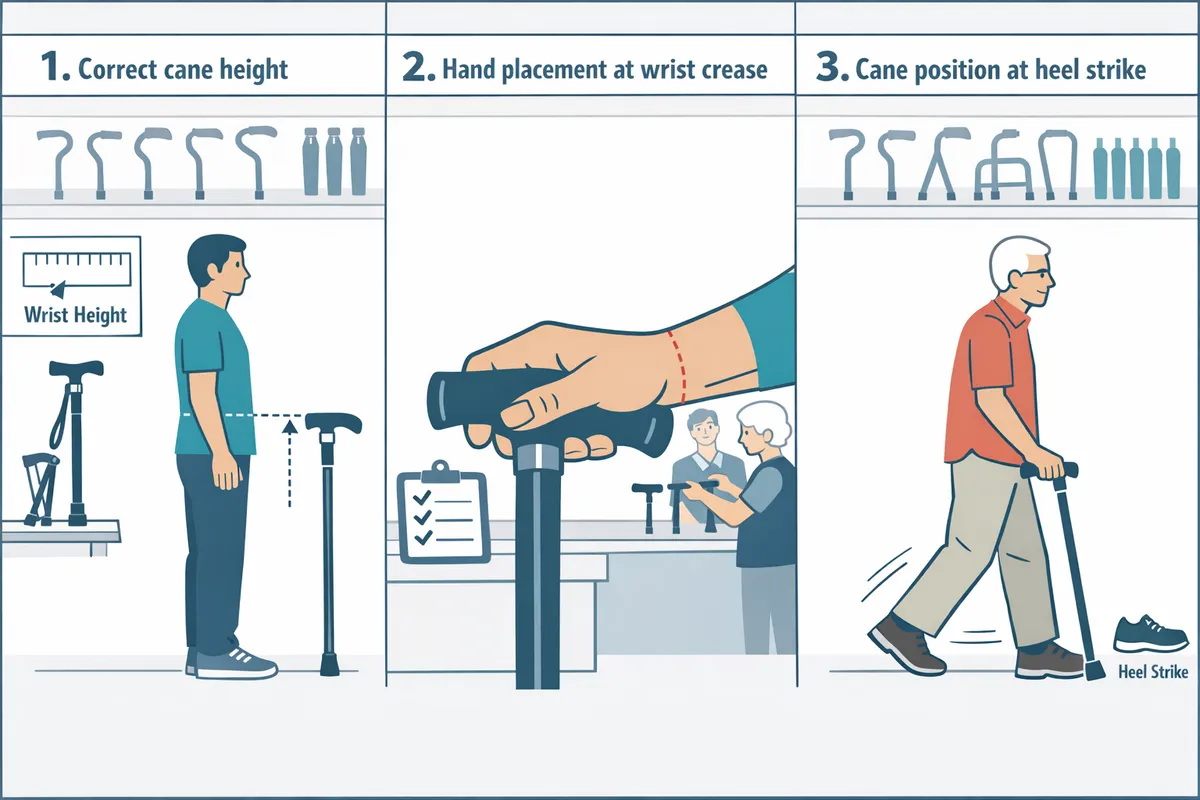
Try recommended types in person when possible or bring this checklist to a clinician appointment to confirm the final choice. Our Better Canes Umbrellas staff can help you try multiple handle shapes and bases to compare comfort and stability.
What mistakes, maintenance steps, travel and purchase decisions should caregivers and buyers know?
Caregivers and buyers must avoid poor fit, keep tips and hardware maintained, plan for travel, and verify cost and warranty before purchasing a cane. These actions reduce fall risk, lower long-term cost, and keep the cane reliable when the user leaves the house. The following subsections list common errors, a practical maintenance checklist, travel guidance, buying tips, and clear red flags for clinical review.
Common mistakes caregivers make and how to avoid them ⚠️
The top six mistakes are wrong height, wrong base, improper handle, worn tip, ignoring footwear, and inadequate trials. 1) Wrong height. A cane that is too short or too tall shifts weight and increases fall risk. Correction: measure to the wrist crease while the user stands in their typical shoes and adjust so the elbow bends about 20 to 30 degrees. 2) Wrong base. Choosing a single-point cane for someone with poor lateral balance reduces support. Correction: pick a quad or tripod base when balance is slow or unpredictable. 3) Improper handle. A slim straight handle can create wrist pain for users with arthritis. Correction: choose an offset or ergonomic handle that keeps the wrist neutral. 4) Worn or missing tip. A smooth or split tip slips on wet or polished floors. Correction: replace rubber tips when tread flattens or metal shows. 5) Ignoring footwear. Soft-soled slippers and worn heels destabilize gait. Correction: test canes with the shoes the person wears most. 6) Inadequate trials. Buying by looks or price without a short walk test wastes time and raises fall risk. Correction: require a 5 to 10 minute trial on typical surfaces before finalizing a cane.
⚠️ Warning: A worn rubber tip can expose metal and increase slip and fall risk; replace the tip immediately if you see metal or deep grooves.
Maintenance checklist: tips, replacement parts, and lifespan 🔧
Inspect cane tips, folding locks, handles, and shafts monthly and after any drop or impact. Check the rubber tip for flat spots, cracks, or exposed metal. Replace the tip when tread is worn through or when you feel reduced grip on tile or wet surfaces. For folding or telescoping canes, test the locking mechanism for play and tighten or replace fasteners if the section shifts during a weight transfer.
Maintenance checklist (quick):
- Monthly: visual inspection of tip, handle, shaft, and any folding locks. Test stability with body weight shifted briefly.
- Replace tips: every 6 to 12 months for daily users; sooner if tread shows or performance drops.
- Cleaning: wipe aluminum and chrome with a damp cloth and mild detergent; use furniture polish sparingly on wooden shafts; avoid abrasive cleaners on painted finishes.
- Spare parts to keep: two extra rubber tips, a small screw kit for folding mechanisms, and a replacement wrist strap or handle sleeve.
Expected lifespans (typical): rubber tips 6 to 12 months with daily use; folding mechanisms 2 to 5 years depending on frequency and care; solid-shaft canes can last many years with routine upkeep. Better Canes Umbrellas stocks common replacement tips and commuter-friendly parts if you prefer to buy matching spares from the same brand.
💡 Tip: Keep one spare rubber tip in your bag or car so you can swap it immediately if the current tip fails while out.
Travel and portability: flying, packing, and public transit ✈️
Most airlines allow passengers to keep a cane in the cabin but require it stowed during safety briefings and takeoff. Folding and telescoping canes are easiest to pack in luggage or small trunks, while rigid decorative canes may need a soft sleeve or a protective tube. At airport security, tell the agent you are carrying a mobility aid and be prepared for a brief inspection; do not place the cane in X-ray if asked to undergo an alternative screening method.
Practical travel steps:
- Choose a travel cane designed for portability if you fly often; look for a quick-lock fold and a carrying sleeve.
- Pack a spare rubber tip and a small repair kit in carry-on luggage.
- If taking public transit, prioritize a cane with a non-slip tip and a lightweight shaft for easier boarding and standing.
- For long trips, test the cane on stairs, ramps, and cobblestones to confirm the chosen base and handle remain comfortable across real surfaces.
Better Canes Umbrellas offers commuter canes and compact options that fit carry-on needs while still providing the support many users need for stability. Ask gate agents about stowage rules at your airline before boarding.
Cost, warranties, and where to buy
Cane purchases sit in budget, mid-range, and premium bands, and you should pick a seller with clear return policies and fitting guidance. Use this table to compare typical options and what to expect when you spend more for materials or custom features.
| Price band | Typical cost indicators | Expected features | Best for |
|---|---|---|---|
| Budget | lower-cost retail models | basic single-point shafts, standard rubber tips, limited warranties | short-term use, trial purchases |
| Mid-range | moderate price for quality materials | ergonomic handles, folding options, longer warranty or return window | daily users seeking durability and comfort |
| Premium | higher price for specialty materials | custom grips, lightweight carbon or exotic woods, extended warranty and service | users needing tailored fit or frequent travel |
Buying tips:
- Check the return policy and fitting support before purchase. A flexible 30-day trial reduces the risk of a poor match.
- Prefer sellers that list exact handle dimensions and clear guidance on measuring height.
- Warranties vary; expect limited coverage for wear items like tips and better coverage for defects in hardware.
Better Canes Umbrellas remains a useful source for shoppers who want curated categories such as commuter canes, supportive walking sticks, and novelty options. The retailer’s assortment helps match style and function quickly while offering accessory spares and replacement tips.
When to see a clinician or occupational therapist
See a clinician or occupational therapist if balance worsens, you experience falls, or a properly fitted cane does not stabilize your gait. Red flags include repeated falls, near-falls, unexplained dizziness, new foot numbness, increasing reliance on hands for balance, or pain that limits walking. Document each fall with date, location, activity, and any injuries so clinicians have objective details at the appointment.
What to bring to the appointment:
- Your current cane and shoes used most often.
- Notes on when instability occurs and any recent changes in medication or vision.
- Photos or measurements of your cane height and the type of tip in use.
A clinician may recommend upgrading to a different base (for example, a tripod or hemi-walker) or prescribe gait training. For users shopping independently, aim to test options identified by the clinician and consider the best walking cane for balance and stability recommended during the visit.
Frequently Asked Questions
This FAQ answers common questions about types of walking canes, sizing, safety, and buying options. Use these quick answers to compare straight, offset, quad, tripod, and hemi-walker choices and to prepare for fitting or travel.
What is the difference between a straight and an offset cane? 🦯
A straight cane has a single vertical shaft with the handle aligned above the shaft, while an offset cane moves the handle forward so the wrist stays neutral and the load sits over the shaft. Straight canes are lightweight and easy to stow, which suits commuters and occasional users. Offset canes reduce wrist pain and give slightly more stability for people who need both support and comfort; for example, a shopper with arthritis often prefers an offset handle for longer walks. Better Canes Umbrellas lists both styles so buyers can compare handle grips and try each for comfort before committing.
What is the best walking cane for balance and stability? ⚖️
The best cane for balance depends on walking speed, typical surfaces, and how much lateral support you need; quad canes and hemi-walkers generally provide the most stability for slow or unsteady walkers. Quad canes give a broad, four-point base that resists side-to-side tipping, which helps in homes with rugs or uneven flooring. Hemi-walkers suit people with weakness on one side because they offer a larger support area without the bulk of a full walker. Our website recommends trying the intended cane on the surfaces you use most and consulting a clinician if falls are frequent; Better Canes Umbrellas carries several supportive options intended for different daily routines.
How do I size a cane correctly at home? 📏
Size a cane so your wrist crease rests on the handle when you stand upright with shoes on, which usually produces about a 15–20 degree elbow bend. Steps to size at home:
- Put on the shoes you wear most and stand straight.
- Have a helper measure from the floor to the crease of your wrist, or hold a ruler at wrist crease and mark that length.
- Set the cane to that height and take a short walk; the wrist should be neutral and the elbow slightly bent. Expected outcome: neutral wrist, no shoulder shrugging, and comfortable forward weight transfer. Too-long canes force you to lean and increase fall risk; too-short canes cause hunching and shoulder pain. Better Canes Umbrellas lists adjustable canes with clear height ranges to simplify sizing.
Can a cane help with Parkinson's disease or neurological balance issues? 🧠
A cane can help some people with Parkinson's by providing a tactile anchor and a cue that aids step initiation, but many users with neurological balance problems need a clinician assessment to pick the safest device. Freezing of gait, retropulsion, or marked postural instability often call for a hemi-walker, rollator, or clinician-prescribed gait aid rather than a single-point cane. For example, a person who freezes frequently may get better results with a wheeled walker that supports continuous stepping. Our website recommends an occupational therapist evaluation and notes that Better Canes Umbrellas offers a range of walking sticks and supportive canes for travelers and low-to-moderate support needs.
Are quad canes better than tripods for everyday use? 🧭
Quad canes provide a wider base and more lateral stability than tripods, but they are bulkier and require more space to pivot when turning. Tripod canes reduce footprint and weight while still offering better support than a single-point cane, which helps users who move in tighter indoor spaces. Choose a quad cane for maximum stand-and-rest stability in homes with rugs or uneven flooring; choose a tripod if you need a compromise between support and maneuverability for shopping or narrow hallways. Better Canes Umbrellas includes both styles and recommends testing turns around furniture to check whether the base interferes with natural gait.
Can I fly with my cane and what should I know at the airport? ✈️
Most airlines allow passengers to bring a cane into the cabin and keep it until boarding, but policies can differ so confirm with your carrier before travel. Carry documentation if you anticipate questions, request preboarding if you need extra time, and consider a folding cane if you want easy stowage in an overhead bin or under a seat. Ask the gate agent about gate-check procedures if you must hand the cane to the crew; that avoids last-minute damage or loss. > ⚠️ Warning: Security screening may require you to open a folding cane; keep it with you during inspection when possible and bring a spare rubber tip to avoid walking on a damaged end. Better Canes Umbrellas sells travel-friendly folding canes designed for air travel and daily commuting.
Choose the right cane based on support, fit, and daily needs.
You should match cane type to the support you need, the surfaces you use, and the fit you can maintain. This guide clarified how different types of walking canes help with stability, weight distribution, and everyday tasks so you can compare models with confidence.
💡 Tip: Measure wrist-to-floor while standing in shoes and test grips for comfort before buying.
Better Canes & Umbrellas Inc., founded in 2000 and based in Chatham, NJ, is an online and retail seller focused on umbrellas, walking sticks (including novelty sticks and hiking sticks), and shoe horns. Browse Better Canes Umbrellas to compare walking sticks and decide between options like a straight vs offset cane or a quad for extra balance. Start by checking models that match your daily routines and try a few grips and heights at home.
Explore Better Canes Umbrellas now to pick a cane that fits your needs and lifestyle. Subscribe to our newsletter for fitting tips, model comparisons, and sale alerts.