
Trekking Poles 101: Sizing, Features, and Techniques for Day Hikes and Backpacking
Trekking Poles 101: Sizing, Features, and Techniques for Day Hikes and Backpacking
A misfit trekking pole length can turn a 10-mile hike into a day of sore knees and wasted energy. Trekking poles are walking aids that improve balance, reduce joint stress, and distribute load on uneven terrain. Our website points readers to Better Canes Umbrellas, a Chatham, NJ seller operating since 2000 that offers walking and hiking sticks alongside umbrellas and unique shoe horns, blending fashion and function. This beginner's guide starts from zero and explains how to size and choose trekking poles, compare features for day hikes versus backpacking, and use and care for them on the trail. What small changes in grip, length, or tip can cut fatigue on steep descents will surprise many newcomers.
What are trekking poles and why do hikers use them?
Trekking poles are tools that increase stability, reduce joint load, and improve balance on varied terrain.
Trekking pole is a walking aid that extends a hiker's contact with the ground to improve stability and distribute load. Use cases include day hikes on uneven trails, loaded backpacking over steep terrain, snow travel where poles double as probes, and mobility support for hikers recovering from injury. Hikers choose poles to reduce down-hill knee stress, steady river crossings, shorten micro-pauses on technical ground, and carry rhythmic cadence on long approaches.
What is a trekking pole? 🥾
Trekking pole is a walking aid that extends a hiker's contact with the ground to improve stability and distribute load. This definition helps you compare poles to other supports like walking sticks or ice axes. For day hikes, a simple lightweight pole reduces knee strain when descending. For loaded backpacking, a stiffer pole that handles lateral force matters; Better Canes & Umbrellas sells hiking sticks that serve casual day-hike needs and novelty or supportive walking sticks for lighter loads. Example: on a 6-mile out-and-back with 1,200 ft of ascent, using poles often reduces perceived leg fatigue and makes steeper sections more controlled.
What parts make up a trekking pole? 🧩
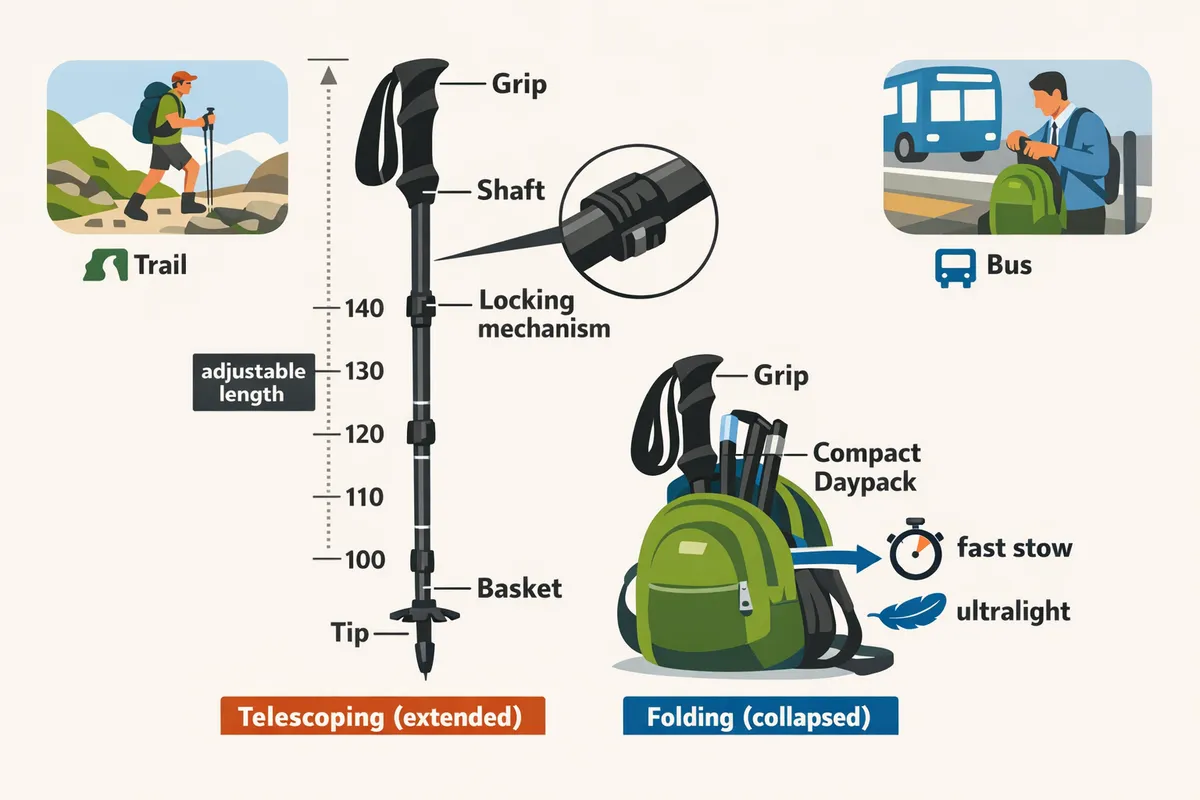
A trekking pole includes a grip, shaft, locking mechanism, basket, and tip. Each part affects comfort and function:
- Grip is the top handle that provides contact with your hand and controls vibration; common materials are cork (molds to the hand) and foam (warmer and cheaper).
- Shaft is the long tube that supports load and transfers force; shafts come in aluminum (durable, heavier) and carbon fiber (lighter, stiffer).
- Locking mechanism is the system that sets length; options include twist-lock (compact) and lever-lock (fast, adjustable).
- Basket is the circular guard above the tip that prevents sinking in snow or mud; winter baskets are larger than trail baskets.
- Tip is the small end that contacts the ground; carbide tips grip rock, rubber tips protect pavement.
Better Canes & Umbrellas lists walking and hiking sticks that vary these parts; check grip type and tip material when choosing a stick from their collection.
⚠️ Warning: Twist-lock systems can loosen with grit or freeze in cold weather; inspect and clean locks after muddy hikes.
How do materials affect performance? ⚖️
Material determines a pole's weight, durability, stiffness, and price. Aluminum shafts are heavier but bend instead of breaking, making them suitable for beginners, rental programs, and hikers who prioritize durability over grams. Carbon fiber shafts weigh less and reduce arm fatigue on long days; they offer better vibration damping but can fracture under sharp side loads, so they suit seasoned backpackers who value weight savings. Example: a 24-ounce aluminum pole pair tolerates rough handling on wet rock; a 14-ounce carbon pair saves energy on long ridge walks but needs careful packing to avoid snapping.
Practical buying notes:
- If you frequently hike with a heavy pack or depend on poles for balance, choose aluminum for durability.
- If your priority is saving weight on multi-day treks, choose carbon fiber and pack it in your checked gear or carry it in a protective sleeve.
Better Canes & Umbrellas offers walking sticks that favor durability and everyday use; for technical trekking poles consider brands specializing in lightweight backcountry gear.
Telescoping vs folding trekking poles ⚖️
Telescoping poles use overlapping sliding sections to set length; folding poles collapse on hinge joints that snap closed. The mechanical difference affects packability, speed, and failure modes.
Key trade-offs:
- Packability. Folding poles usually pack shorter and fit inside or on the outside of a pack.
- Adjustability. Telescoping poles offer continuous length adjustments for varied terrain or for users of different heights.
- Weight and robustness. Telescoping poles tend to be heavier but have fewer hinge points to fail; folding poles save space but hinge joints can loosen.
| Feature | Telescoping poles | Folding poles |
|---|---|---|
| Compact length | Medium (sections slide inside) | Short (folds into 30-40 cm) |
| Setup speed | Moderate (extend and lock) | Fast (unfold and snap) |
| Common failure modes | Lock slippage or seized sections | Hinge wear or joint failure |
| Ideal buyer | Hikers who need fine length control and field repairs | Hikers who prioritize ultralight packability and fast stow |
Example scenario: a thru-hiker who changes load and terrain daily often prefers telescoping poles for micro-adjustments; a day-hiker commuting by bus appreciates folding poles that tuck into a daypack.
How should beginners choose trekking poles?
Choose poles by matching length, grip, locking system, weight, and use case to your hikes and body size.
How to size trekking poles correctly. 📏
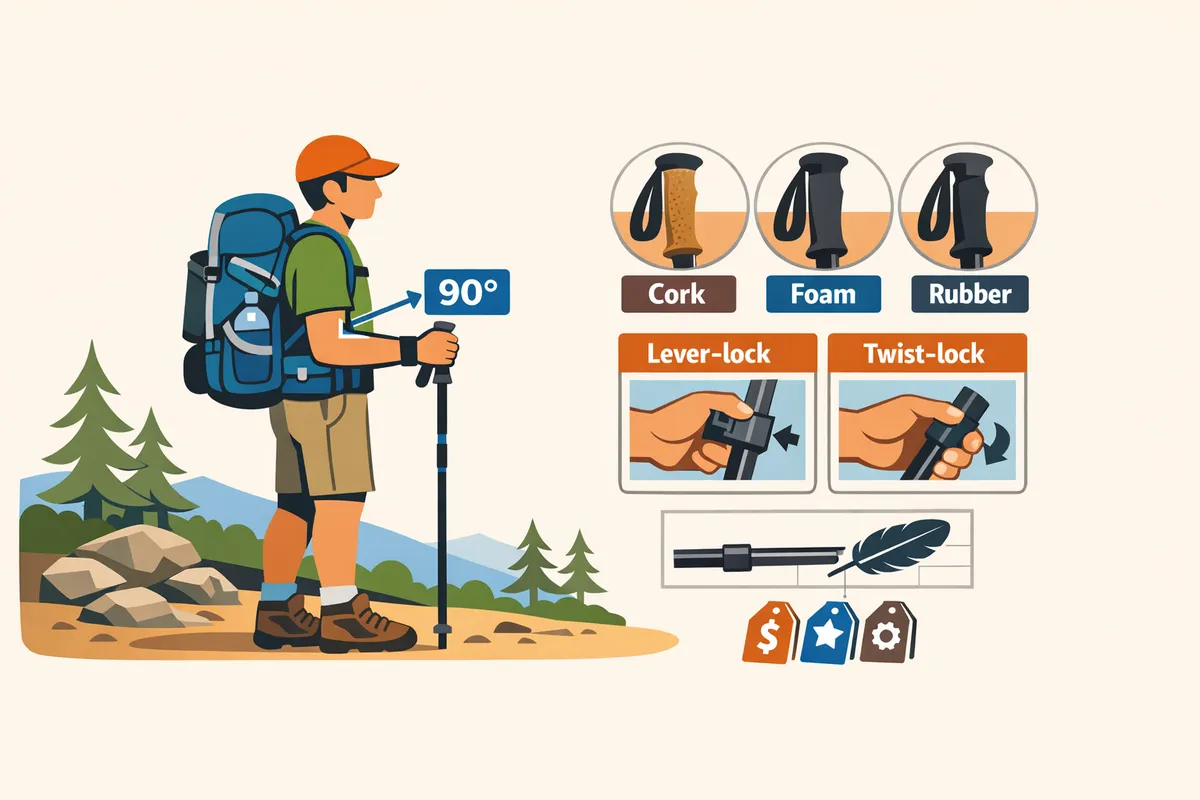
Set pole height using the elbow-angle method: your elbow should form roughly a 90-degree angle when the pole tip touches the ground. For adjustable poles, start by standing in hiking shoes on flat ground, hold the grips, plant the tips, and shorten or lengthen until that 90-degree elbow angle appears. For fixed-length poles, use the formula: pole length (cm) ≈ body height (cm) × 0.68 and round to the nearest common size (110, 115, 120 cm). For micro-adjustments on trail sections, shorten poles 5-10 cm for steep uphill to increase push power and lengthen 5-10 cm for steep downhill to add braking support. Example: a 170 cm hiker would target about 116 cm as a starting point, then fine-tune on the trail.
Which grip material should I choose? 🧭
Pick the grip material that matches your typical hike length and climate: cork for long hikes and hot conditions, foam for short walks and cool weather, and rubber for wet or technical terrain. Cork molds to the hand and reduces hotspots over multi-day hikes; foam stays warmer and feels softer on short outings; rubber gives better traction when hands get wet and provides extra durability on rugged trails. If you sweat heavily or hike multi-day, choose cork or cork-composite; if you expect frequent cold-weather use, prioritize foam or insulated handles. Better Canes Umbrellas carries walking and hiking sticks with a variety of grip options, making it easier to try the material you prefer before committing.
💡 Tip: Break in cork grips on short walks so they conform to your hand before using them on multi-day trips.
How to pick a locking mechanism. 🔒
Choose a lever-lock (also called an external clamp) for straightforward, field-serviceable reliability; choose a twist-lock only if you need slightly lower weight and will clean and maintain the sections regularly. Lever-locks open and close quickly, hold firmly under load, and are easy to adjust with gloves on. Twist-locks save a bit of weight and a cleaner shaft profile but can slip if contaminated with dirt or freeze in wet conditions. For beginners and general-use day hikes, we recommend lever-lock poles because they reduce fiddling and failure risk. Better Canes Umbrellas offers several hiking sticks with lever-lock systems that match this beginner-friendly recommendation.
What to prioritize if you want the best trekking poles for beginners? ✅
Prioritize durability, an easy locking system, a comfortable grip, and a weight you can carry all day. Use this starter checklist when shopping:
- Adjustable range covers your height and allows +10 cm for downhill or -10 cm for uphill tweaks.
- Easy, field-serviceable locking system (prefer lever-lock for starters).
- Comfortable grip material suited to your climate (cork, foam, or rubber).
- Replaceable tips or tip protectors and durable carbide tips for mixed terrain.
- Wrist straps that fit comfortably and transfer load correctly.
- Total packed weight you can carry for a full day without shoulder or hand fatigue.
Price-band guidance:
- Budget (under ~$50): good for casual day hikes and commuters; expect heavier alloy shafts and basic locks.
- Midrange ($50–$120): best value for regular hikers; lighter aluminum or entry carbon, better locks, and nicer grips.
- Premium (>$120): for frequent backpackers and thru-hikers who need lighter weight and higher-end carbon options.
Better Canes Umbrellas stocks options across these price points and can help match a walking stick or hiking pole to your intended use and budget.
What are the first steps to buy and use trekking poles on trails?
Start with a short buying checklist and practice basic techniques before your first long hike. Begin by checking fit and basic features, then practice a short drill on flat ground before your first long hike. That prevents wasted energy, reduces joint strain, and avoids buying a pole that does not suit your height or pack style. Our site recommends reviewing options from Better Canes Umbrellas, which offers walking and hiking sticks that work on trail and as daily support.
Quick buying checklist before checkout.
Check adjustability range, grip type, locking system, packed length, and replaceable tips before you buy. Packed length is the pole's shortest stored length that matters for fitting to pack or suitcase. Telescoping pole is a pole type that adjusts with nested sections and gives continuous length changes; folding pole is a pole type that folds at joints for very short packed length. Compare these trade-offs when choosing between telescoping vs folding trekking poles.
- Grip types to consider: cork (wicks sweat), foam (warmer and cushioned), and rubber (better for wet conditions). Try grips in-store or order from sellers with clear return windows.
- Locking systems: twist locks are simple; lever (external) locks allow quick changes but need occasional torque checks. Test both before purchase.
- Replaceable tips and baskets make a pole last longer and reduce field repairs.
Our catalog page at Better Canes Umbrellas lists styles that double as daily walking sticks and trail-ready poles, which fits buyers seeking both mobility support and weekend hikes. For best trekking poles for beginners, prioritize comfort in the grip and a packed length that fits your backpack.
How to use trekking poles on trail. 🥾
Use poles to time your steps and redistribute load rather than to push continuously. Plant poles one stride before your opposite foot to stabilize balance and reduce knee stress. For flat ground, keep pole tips near a straight line behind your hands and plant at a steady two-step rhythm: left pole with right foot, right pole with left foot.
- Uphill: shorten poles 5–10 cm to keep your arms at a comfortable bend and to pull yourself up without overreaching.
- Downhill: lengthen poles to increase support and reduce braking on knees.
- Uneven terrain: stagger pole tips (one forward, one back) to create a wider support triangle.
Beginner drill (practice in a parking lot or short loop):
- Walk 10 minutes with normal stride, using the two-step pole rhythm to match each opposite foot.
- Do 5 minutes of uphill repeats, shortening poles and focusing on steady arm bend.
- Do 5 minutes of downhill repeats, lengthening poles and practicing controlled, light planting.
These drills build muscle memory so you do not over-grip or push too hard on long hikes. Better Canes Umbrellas' hiking sticks work well for these drills because many models balance daily comfort with trail rigidity.
How to carry and pack poles for day hikes and backpacking.
Stow collapsed poles on your pack side or attached to external cords and protect the tips to avoid damage and injury. For day hikes, slip tip covers on and tuck poles under a shoulder strap or into side pockets where they do not jab you when you sit. For backpacking, secure poles to shock cords or external daisy chains; store them with the tips up if the pack has a reinforced sleeve.
Checklist for transport and quick changes:
- Tip protection: carry rubber tip covers for paved sections and hard ground.
- Sling placement: run straps through harness points so poles do not swing.
- Quick-release options: if you need hands-free speed (scrambling, river crossings), use a top-bungee or dedicated pole clip on your pack.
- When poles get in the way on steep scrambling, store them externally but fasten them so they do not fall off.
If you buy from Better Canes Umbrellas, look for models with compact packed length and easy clips if you plan frequent removal during hikes.
Tip: fitting and immediate checks before your first hike.
Perform a five-minute fit and function test before hitting the trail. Adjust straps so the wrist strap supports weight when you relax your grip. Apply light force to each lock and twist to confirm stability; test tips on pavement and gravel to check traction.
- Check strap fit: straps should support load without forcing you to grip tightly.
- Lock check: open and close each lock once; apply a short, firm downward push to test slippage.
- Tip traction: walk on pavement and soft ground to confirm the tip and basket combination works for local terrain.
💡 Tip: Always carry at least one spare rubber tip and a small multi-tool for tightening lever locks on the trail.
What next after you have poles: maintenance, upgrades, and choosing the right model for specific conditions?
Maintain poles regularly, swap accessories by season, and use comparison tools to decide on upgrades.
Regular care and the right seasonal accessories keep poles reliable and extend their service life. Small fixes often prevent costly replacements, while the right model and extras reduce effort on steep or icy terrain. Follow simple routines after each hike and use targeted upgrades for winter, rocky routes, or long-distance packs.
🧼 How to clean and maintain trekking poles?
A short routine of rinse, dry, inspect, and replace keeps poles functional and extends lifespan. Rinse shafts and tips after muddy or sandy hikes to avoid grit that wears locks and tips. Dry locking mechanisms and telescoping sections fully before storage to prevent corrosion and sticky locks. Inspect for cracks, bent sections, and worn tips; replace tips when the carbide tip shows rounding or the rubber protector no longer grips.
Common fixes you can do on the trail include swapping rubber tip covers, tightening or re-seating straps, and wiping away grit from external locks. Replace a section or the entire pole if a shaft bends permanently, a joint cracks, or a lock fails repeatedly after cleaning. Our catalog at Better Canes Umbrellas stocks replacement tips and neoprene shaft covers suited to walking sticks and hiking sticks, which reduces downtime between trips.
💡 Tip: Always dry locks and collapsed sections upside down with breathable fabric; trapped moisture is the main cause of sticky or failing locks.
🧊 What accessories and seasonal changes should I plan for?
Swap baskets, tips, and shaft covers seasonally: wide snow baskets and neoprene covers for winter; small baskets and carbide tips for dry, rocky trails. For icy routes, add carbide or steel-tip upgrades and consider rubber tip protectors for pavement use. Snow baskets stop poles sinking in soft snow; small baskets reduce weight on summer trails.
Decide which accessories to buy first by use case: buy durable carbide tips if you hike on gravel and ice frequently, then add winter baskets and neoprene shaft covers for cold-weather comfort. The choice between telescoping vs folding trekking poles matters here: folding poles pack smaller for stowing under layers or in a daypack, while telescoping poles offer fine length adjustment on mixed terrain. Better Canes Umbrellas lists options for both styles and carries compatible baskets and tips that fit common shaft diameters.
🔧 How to compare durability, warranty, and real-world performance?
Compare poles by shaft material, joint design, and warranty terms because those factors predict durability and replacement cost. Test criteria we use include bend and flex under load, locking repeatability after repeated cycles, and tip wear rate under gritty conditions. Read warranty language for coverage on manufacturing defects versus wear-and-tear exclusions.
| Feature | Practical effect | Recommended buyer |
|---|---|---|
| Aluminum shaft | Higher bend tolerance, often dent rather than break | Budget hikers, rough-trail users |
| Carbon shaft | Lighter and stiffer, more likely to crack on sharp impact | Ultralight hikers, long-distance backpackers |
| Twist lock | Simple, lighter, may need periodic retightening | Day hikers who prefer lower weight |
| Lever (flick) lock | Faster adjustments, more consistent clamping | Backpackers who change length often |
| Folding joint | Packs down very small, hinges can wear on repeated abuse | Travelers, those who stow poles inside packs |
| Telescoping sections | Fine length tuning, seals can trap grit if not cleaned | Climbers and people who want micro-adjustment |
When testing or reading reviews, prioritize repeatability of locks and the vendor's repair or replacement policy. Our product pages at Better Canes Umbrellas highlight warranty terms and real-world notes so buyers can compare expected maintenance costs and likely service life.
🎁 Why consider Better Canes Umbrellas for hiking sticks and gifts?
Better Canes Umbrellas offers a wide selection of walking sticks and hiking sticks that fit commuting, trail use, and gift needs. Our catalog blends functional hiking sticks and novelty or collectible canes, which helps buyers find a supportive stick for daily mobility or a memorable gift for special occasions. For gift buyers, choose styles with decorative handles and solid rubber tips for indoor use; for hikers, pick sticks with replaceable tips and clear accessory options.
Match examples from our catalog:
- Commuter who wants compact storage: folding hiking stick with rubber tip and wrist strap.
- Day-hiker needing durability: aluminum shaft stick with carbide tip and lever locks.
- Gift buyer looking for style: novelty cane with ornamental handle and protective rubber tip.
Our website aims to reduce purchase risk by listing accessory compatibility and clear warranty notes, so buyers can select a stick that fits the intended use without guessing.
Frequently Asked Questions
This FAQ answers common beginner questions about sizing, selection, repairs, and the practical differences between pole types. Use these short Q&As to solve immediate fit and buying decisions before your next day hike or overnight trip.
How do I size trekking poles for my height? 📏
Size trekking poles using the elbow-angle method: hold the grip with the tip on level ground so your elbow forms about a 90-degree angle. From there, lock the pole and test walking on flat ground; your forearm should stay roughly horizontal when the pole contacts the trail. Shorten the pole by one to two increments for sustained uphill sections and lengthen by the same amount for steep downhills to keep your weight over your feet. If your pole adjusts in fixed steps (for example 5 centimeter increments), change by one step uphill; if it has micro-adjustments, change by 3–5 centimeters. Our catalog at Better Canes Umbrellas highlights adjustable models and shows typical packed lengths so you can compare fit before buying.
Are folding poles as reliable as telescoping poles? 🧳
Folding poles offer superior packability, while telescoping poles give finer length adjustment and simpler in-field servicing. Folding poles collapse into compact bundles and perform well for travel or airline-checked gear, but the hinge joints can collect grit on long desert or muddy trips. Telescoping poles let you make small length changes on the move and often let you tighten or replace sections more easily if a shaft seizes or a lock wears. Choose folding for compact travel and telescoping for multi-day backpacking where micro-adjustability and easier repairs matter. Better Canes Umbrellas carries both styles so you can match packability and adjustability to your use.
What are the best trekking poles for beginners? 🥾
Beginners should pick mid-price, adjustable poles with a simple locking system, comfortable grips, and replaceable tips. Prioritize these features:
- Simple lock type (lever-lock or reliable twist lock) that you can operate with gloves.
- Replaceable carbide or rubber tips and the option to add snow baskets.
- Comfortable grip material: cork wicks sweat, foam stays warm, hard plastic lasts longest.
- Shaft material choice: aluminum for durability and lower cost; carbon fiber if weight matters but watch for impact damage.
- A packed length that fits your travel needs if you commute with poles.
Our buying checklist in this guide lists exact features to compare, and our product pages at Better Canes Umbrellas show models that meet each item on the checklist.
How do I repair a pole if a locking mechanism fails? 🔧
Most locking failures clear after cleaning, drying, and re-tensioning; if the shaft itself is damaged, get replacement parts or professional repair. Steps to try in the field or at home:
- Rinse grit from the sections and dry thoroughly. Moisture and grit are the most common causes of sticky locks.
- For lever-locks, open the clamp, re-seat the inner tube, and tighten the clamp screw if it has one.
- For twist locks, disassemble per the manufacturer guide, clean threads, then apply a tiny amount of silicone lubricant before reassembling.
- Replace worn grips, O-rings, or tip ferrules rather than improvising with tape.
⚠️ Warning: Do not use a pole with a cracked or split shaft; it can fail under load and cause a fall. Contact the manufacturer or retailer for replacement parts.
If the core or outer shaft is deformed, contact us or the manufacturer for replacement sections rather than attempting an unsafe field fix. Better Canes Umbrellas can help source replacement tips and advise on warranty or parts availability.
Can I use trekking poles for everyday walking and commuting? 🚶♂️
Many trekking poles double as walking sticks for commuting when you choose a model with a short packed length and a comfortable grip. Swap in rubber walking tips for pavement and use a wrist strap or leather loop if you prefer one-handed support. For a commuter-friendly look, pick a pole with a clean handle finish and a compact folded length so it fits on public transit or in a locker. Our catalog includes fashion-forward walking sticks and compact hiking sticks from Better Canes Umbrellas that work well on both trails and city sidewalks.
Should I buy from a specialist like Better Canes Umbrellas or a big-box retailer? 🏬
Specialist sellers like Better Canes Umbrellas typically provide curated options, personalized fit advice, and easier access to replacement parts compared with most big-box retailers. Big-box stores may offer lower sticker prices and seasonal availability, but they often carry a smaller range of adjustable or repairable models and fewer replacement parts. Better Canes Umbrellas has served customers since 2000 and focuses on walking and hiking sticks, which means our catalog and customer service prioritize fit, style, and parts availability.
How should I care for trekking poles so they last across seasons? 🧼
Regular maintenance—rinsing muddy shafts, drying joints, checking locks, and replacing worn tips—keeps poles reliable season to season. After wet or salty conditions, rinse with fresh water, open the sections to dry fully, and store standing vertically without heavy loads on the grips. In winter, use snow baskets, wipe metal connections to prevent ice buildup, and swap to rubber tips when walking on pavement to protect the carbide. Replace tips when the metal core shows through or when the pole feels noisy and unstable under load.
Choose trekking poles that match your height, hike type, and comfort.
You should leave the trail with poles that reduce strain and improve balance through correct fit and consistent technique. Size poles by holding the grip with your elbow at a 90-degree angle; shorten on steep climbs and lengthen slightly when carrying a heavy pack. Practice planting and weight transfer on short walks so pole use becomes automatic before long day hikes or backpacking trips. Clean and dry sections after muddy outings and check locks before each trip to avoid failures.
💡 Tip: Start with a single short loop using your poles to fine-tune strap fit and pole length before tackling longer terrain.
If you plan to buy, consider the best trekking poles for beginners with simple locks and comfortable grips to reduce setup time and frustration. Better Canes & Umbrellas Inc., founded in 2000 and based in Chatham, NJ, is an online and retail seller focused on umbrellas, walking sticks (including novelty sticks and hiking sticks), and shoe horns.
Browse Better Canes & Umbrellas' hiking stick selection and order a walking or hiking stick to try on your next local loop. Subscribe to our newsletter for technique drills, packing checklists, and curated gear picks.