
Travel Umbrellas 2026: Complete Guide to Compact, UPF 50+, Ultra‑Mini, Jumbo Compact, and Eco Designs (Carry‑On Fit Checker + Wind Test Data)
Travel Umbrellas 2026: Complete Guide to Compact, UPF 50+, Ultra‑Mini, Jumbo Compact, and Eco Designs (Carry‑On Fit Checker + Wind Test Data)
A blown-out umbrella can add 30 minutes to a commuter's morning and derail a business trip. This travel umbrellas guide 2026 compares compact, UPF 50+, ultra-mini, jumbo compact, and eco designs while testing carry-on fit and wind resistance. Travel umbrellas guide 2026 is a beginner's buyer guide that explains simple test methods, carry-on fit checks, and selection criteria for 2026 trips. Our Better Canes & Umbrellas catalog, from Better Canes & Umbrellas Inc., founded in 2000 in Chatham, NJ, offers commuter compacts, fashion umbrellas, novelty canes, and shoe horns so shoppers can match weather protection with style or gifting. Beginners may feel overwhelmed; this article starts from zero and ends with side-by-side wind and carry-on test results that show which models pack small but stand up to gusts.
What are the key travel umbrella fundamentals every buyer must know?
Packed size, weight, wind resistance, open canopy diameter, UPF rating, and durability are the fundamentals that determine an umbrella's fit for a trip. These specs trade off against one another: smaller packed size and lower weight usually reduce wind resistance and canopy area. Our website shows how those trade-offs map to short commutes, long-haul travel, and sun-heavy destinations so you can pick a model that minimizes baggage friction and weather risk.
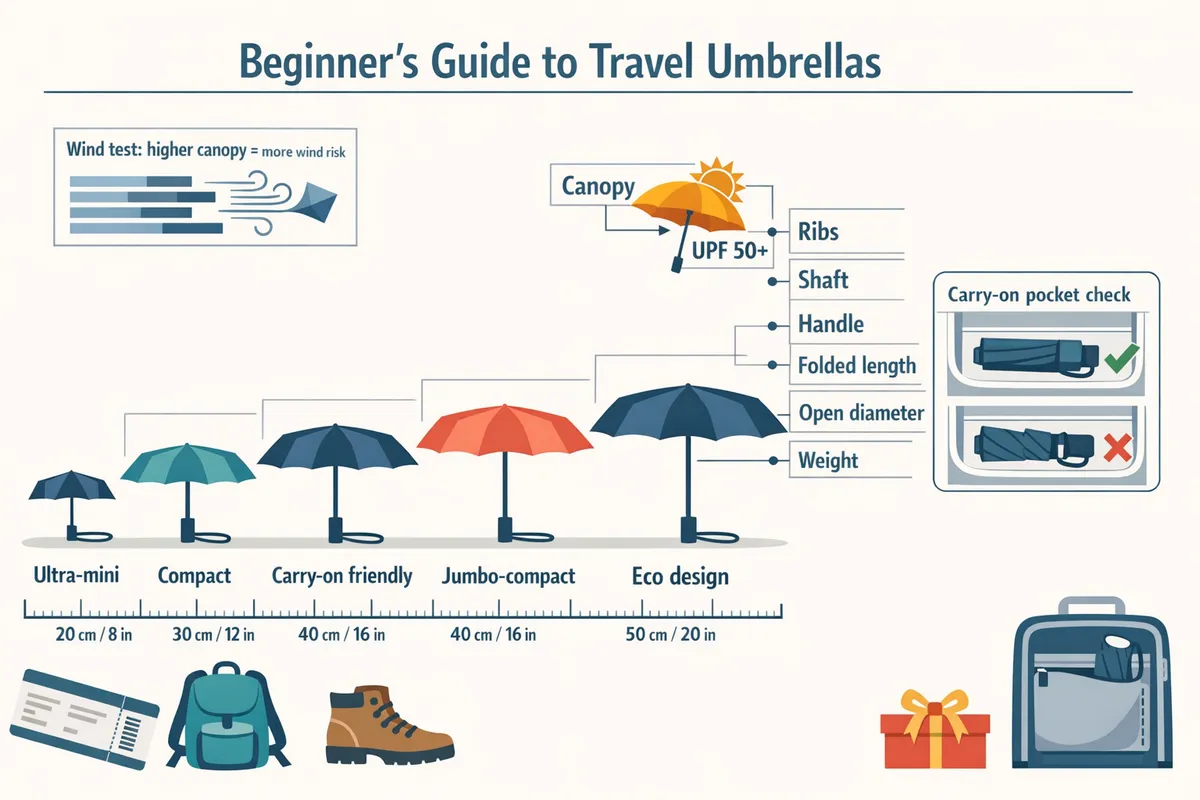
What is a travel umbrella and how do travel categories differ? ☂️
A travel umbrella is a portable umbrella category that balances protection and compactness for luggage and everyday carry. Ultra-mini models are designed to tuck into a coat pocket or the smallest purse; they often pack to about 7 to 9 inches and typically weigh 4 to 8 ounces. Compact folding umbrellas extend that packed length to roughly 9 to 12 inches and trade a bit more weight for fuller canopy area and sturdier ribs.
Jumbo-compact umbrellas fold but open to large canopies (40 inches or more) and suit rainy cities where coverage matters more than minimal weight. Vented or windproof travel umbrellas use dual-layer canopies or vented panels to shed gusts and reduce inversion risk at the cost of slightly greater packed length. UPF or sun umbrellas use denser fabrics or reflective coatings to block UV while keeping size and weight close to compact models.
Our website's Better Canes Umbrellas collection tags each listing with packed length, weight, and a short-use recommendation so you can match a category to the trip you plan.
💡 Tip: Measure the external pocket on your largest carry-on before buying. If the packed length exceeds that pocket, you will carry the umbrella inside your luggage.
What is UPF and why UPF 50+ matters for sun protection? 🌞
UPF is a fabric rating that measures how much ultraviolet radiation a canopy blocks. UPF stands for ultraviolet protection factor and UPF 50+ indicates the fabric blocks at least 98% of UV radiation, which matters for long beach days, high-altitude hikes, and prolonged city exposure. Fabrics achieve UPF through tight weaves, darker dyes, reflective coatings, or a second lining; a single-layer light-colored fabric will usually perform worse than a lined or coated canopy.
If you need a UPF 50+ compact travel umbrella for sun-heavy trips, prefer double-layer canopies or models that explicitly list a UPF value on our website. Better Canes Umbrellas highlights UPF ratings on sun models and calls out construction details, such as reflective backing or polyester weave, so you can compare protection without guessing.
How is wind resistance assessed and what realistic performance can you expect? 🌬️
Wind resistance describes how well umbrella ribs and canopy geometry survive gusts without flipping or breaking. Test labs measure sustained gust speeds and rib flex using calibrated fans and mechanical bending tests; those metrics show when an umbrella will invert or fail. Many travel umbrellas list a qualitative wind rating such as low, moderate, or high; treat vendor claims with caution and look for user videos or independent tests.
Realistically, ultra-mini and lightweight compacts offer the least wind tolerance and tend to invert under strong coastal gusts. Vented or reinforced-rib travel models shed wind better and recover from gusts more reliably, though they add grams and packed length. For routine city use, a compact vented model balances carry convenience and gust resistance. For consistently windy destinations, choose a jumbo-compact or a vented windproof model and check the model's reported rib material and hinge design on our Better Canes Umbrellas pages.
⚠️ Warning: Vendor "gust speed" claims often come from short bursts in controlled conditions and may not reflect sustained crosswinds experienced near shorelines.
Packed size, weight, wind rating, canopy diameter, and UPF comparison 📊
The table compares packed size, weight, wind resistance, canopy diameter, UPF, carry-on fit notes, and suggested trip types for common travel umbrella categories.
| Category | Packed length (typical) | Weight (typical) | Wind rating (typical) | Canopy diameter (open) | UPF (typical) | Carry-on fit notes | Suggested trip types |
|---|---|---|---|---|---|---|---|
| Ultra-mini | ~7–9 in | 4–8 oz | Low | 36–40 in | Low to moderate | Fits small purses, not most exterior pockets | Short commutes, nights out |
| Compact | ~9–12 in | 6–12 oz | Moderate | 38–44 in | Low to moderate | Fits most carry-on exterior pockets | Daily commute, business travel |
| Jumbo-compact | ~11–14 in | 10–18 oz | Moderate–High | 43–50 in | Low to moderate | Usually fits inside carry-on main compartment | Rainy city travel, heavy coverage needs |
| Vented / Windproof | ~10–13 in | 10–16 oz | High | 40–48 in | Low to moderate | May not fit tight exterior pockets | Coastal travel, windy climates |
| UPF / Sun | ~9–12 in | 8–14 oz | Low–Moderate | 36–44 in | UPF 40–50+ | Fits most carry-ons; check coating care | Beach, high-altitude, long outdoor exposure |
Our website's Better Canes Umbrellas product pages display packed length, weight, canopy diameter, and any listed wind or UPF ratings so you can filter by what matters most for your trip. Use those filters to narrow choices quickly rather than inspecting specs one-by-one.
Which travel umbrella should you pick first (practical starter recommendations)?
Pick the umbrella that matches your trip's primary trade-off: portability, wind resistance, or sun protection. Different trips force different compromises, so start by deciding which of those three matters most for your itinerary. Below are starter recommendations for four common trip types and a step-by-step Carry-On Fit Checker to confirm a model will stow where you need it.
Commuter recommendations 🚇
Commuters should prioritize short packed length, fast-drying fabric, and an easy-open mechanism. Choose an auto-open compact with a sleeve that slides into your briefcase or commuter backpack without catching on zippers.
Starter picks (three practical options):
- A 10–12 inch compact auto-open with polyester that sheds water quickly. Trade-off: very small packed size often means narrower canopy. Better Canes Umbrellas lists multiple commuter compacts that balance this trade-off.
- A slightly larger compact (12–14 inches) with stronger ribs. Trade-off: carries slightly more weight but resists gusts better on crowded streets. Better Canes Umbrellas recommends this for riders who cross exposed bridges.
- A folding umbrella with quick-dry nanocoating and a vented canopy. Trade-off: vents add bulk; they reduce inside-out damage during gusts. Better Canes Umbrellas curates vented commuter models for those who bike or walk to work.
Business and international travel ✈️
International travelers should choose a model that balances packed length with proven wind resistance and easy stow in a carry-on. Aim for a compact that fits under a carry-on bag or inside a suit carrier without crushing the frame.
Starter picks (three practical options):
- A compact with reinforced fiberglass ribs and a slip cover to prevent wetting garments. Trade-off: reinforced ribs add weight but avoid mid-trip replacement. Better Canes Umbrellas highlights reinforced options for frequent flyers.
- A jumbo compact travel umbrella for carry-on when you need a larger canopy and still want foldable convenience. Trade-off: larger canopy increases packed length slightly; test against your bag before flying. Better Canes Umbrellas stocks jumbo compact models that fit most international suitcases.
- A mid-size umbrella with a telescoping shaft and double-lock collar for durability. Trade-off: non-zero chance of shaft wobble over years; buy a curated model with good return policy from Better Canes Umbrellas.
Beachgoer picks 🏖️
Beachgoers should pick a UPF 50+ compact travel umbrella with corrosion-resistant shaft and sand-stable base options. UPF is ultraviolet protection factor that measures fabric's ability to block UV rays; UPF 50+ means the fabric blocks the vast majority of direct UV exposure.
Starter picks (three practical options):
- A UPF 50+ compact travel umbrella with anodized aluminum shaft and sealed joints for salt air. Trade-off: corrosion protection adds cost but prevents pitting. Better Canes Umbrellas lists beach-ready models with treated metal.
- A vented canopy with a wider open diameter for shade when sitting. Trade-off: wider canopy equals larger packed size; pick one that still fits your beach tote. Better Canes Umbrellas recommends wide-canopy compact models for family shade.
- A compact umbrella designed to accept a sand stake or detachable sand anchor. Trade-off: added accessories raise price but cut time spent chasing umbrellas in gusts. Better Canes Umbrellas offers kits that include anchors for sandy conditions.
Backpacking and day-hiking 🎒
Backpackers should choose the lightest possible umbrella that still passes basic wind tests for exposed ridgelines. Weight matters more than canopy size on multi-mile hikes, but ribs must resist at least moderate gusts.
Starter picks (three practical options):
- An ultra-mini umbrella under 8 ounces for uphill mileage savings. Trade-off: canopy will be small and less stable in crosswinds. Better Canes Umbrellas carries ultra-mini options aimed at fastpackers.
- A lightweight vented trekking umbrella with carbon or fiberglass ribs rated for trail gusts. Trade-off: extra material adds ounces but prevents frame failure on exposed trails. Better Canes Umbrellas recommends these for day hikes where weather is unpredictable.
- A trekking-specific umbrella with an adjustable handle that clips to a pack strap. Trade-off: added attachment hardware can snag; choose a model with a low-profile clip. Better Canes Umbrellas curates models that clip cleanly to hiking packs.
How to use a Carry-On Fit Checker and what measurements matter 📏
Carry-On Fit Checker is a measurement routine that confirms whether the umbrella's packed length and girth will stow in your chosen luggage space. Measure the interior depth and width of the compartment where you plan to store the umbrella and compare those to the umbrella's packed length and folded diameter.
Follow these steps before you buy or before boarding:
- Measure the interior depth of the bag or under-seat space in inches or centimeters.
- Measure the umbrella's packed length and folded diameter as listed or by using a tape.
- Mimic real packing: put the umbrella in its sleeve and slide it into the bag slot you plan to use. If the sleeve catches or you must force the bag closed, the umbrella will likely cause problems at the gate.
- If you need a larger canopy but must fit in a bag, consider a jumbo compact travel umbrella for carry-on; test it folded, not just its product spec, because canopy size affects fold geometry.
💡 Tip: Always slide the umbrella into the bag sleeve the same way you will on the trip; folded angles change how much space it needs.
Budget vs premium: expected lifespan, repair cost, and time saved by buying curated selections
Premium umbrellas typically cost more upfront but lower total cost of ownership through longer lifespan and fewer failures. For example, a commuter who replaces a basic $20 umbrella three times in a year faces repeated downtime for drying, returns, and buying replacements; a single curated premium model from Better Canes Umbrellas reduces that churn by offering stronger ribs and better fabrics.
Practical cost points to weigh:
- Time cost: estimate minutes lost per replacement for drying, repairs, and shopping. Multiply by staff or family members to reveal business or household hours lost.
- Direct cost: cheap models require more frequent replacement; premium models have higher repairability and sturdier parts.
- Operational risk: repeated returns or failures during travel create missed connections or wet luggage. Better Canes Umbrellas curates models to minimize these risks and highlights trade-offs so buyers match price to expected use.
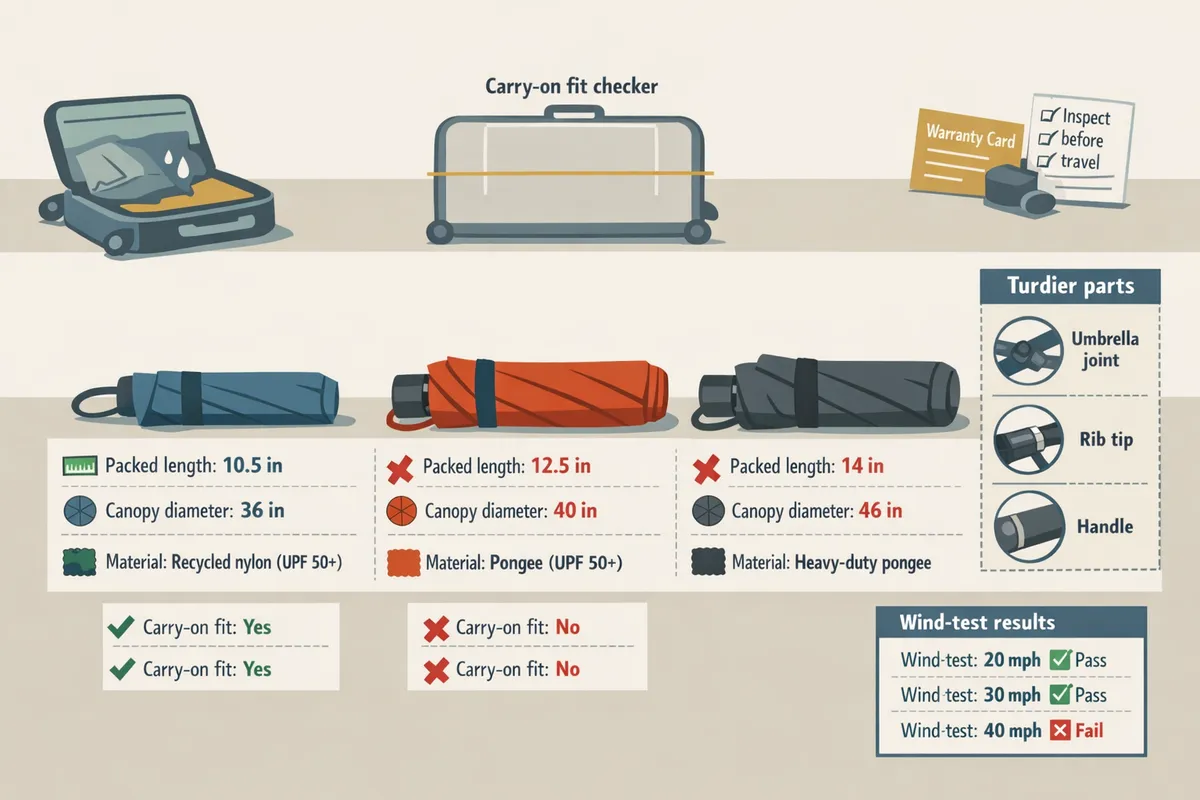
How do you validate performance and care for a travel umbrella long-term?
Validate a travel umbrella by checking independent wind-test results, UPF certification, carry-on dimensions, and warranty terms before buying, then follow targeted care steps to extend canopy life. Our approach reduces the chance of buying a model that fails in your most common conditions and shows what to inspect on arrival.
How we test umbrellas: wind tests, packed length, weight, and deployment speed 🔬
Our test protocol measures sustained wind speed before failure, packed length, weight, open diameter, and seconds-to-open. Wind test is a protocol that measures the sustained wind speed at which ribs or the canopy deform or invert; we report the last stable wind speed and the failure mode. UPF rating is a measure that indicates how much UV radiation a fabric blocks; we confirm labelled UPF values against the manufacturer spec where possible.
We record the following fields on a single test sheet and publish them when available.
| Metric | What we measure | Example result format |
|---|---|---|
| Sustained wind before failure | Wind speed in mph and failure mode | 30 mph, rib bend |
| Packed length | Total length with handle in cm and inches | 28 cm / 11 in |
| Weight | Total grams and ounces | 250 g / 8.8 oz |
| Open canopy diameter | Useful coverage in cm/in | 100 cm / 39 in |
| Seconds-to-open | Measured from button press to fully deployed | 2.2 s |
Different travelers care about different metrics. City commuters value packed length and seconds-to-open because short packed size and fast deployment save time. Coastal and monsoon travelers prioritize wind speed results and sturdy rib design to avoid mid-trip failure. Sun-focused travelers need the UPF 50+ compact travel umbrella label and canopy fabric info.
💡 Tip: For accurate carry-on checks, measure packed length including the handle; many airline rules reference total length rather than the folded cloth section.
Better Canes Umbrellas publishes carry-on fit specs and test fields on our product pages so shoppers can compare models without guessing.
Trip-based decision tree: choose the right umbrella for city commuting, multi-destination travel, or sun-heavy trips 🌍
Match trip attributes—dominant weather, luggage constraints, and trip duration—to the umbrella category that best fits your trip. Use this numbered flow to pick a category and feature set.
- Identify dominant weather. If wind dominates, go to step 2. If sun dominates, go to step 4. If mixed or uncertain, go to step 3.
- For wind-dominant trips, choose a travel umbrella with high sustained-wind test results and reinforced ribs. Coastal or autumn ferry commutes need stronger ribs; for monsoon regions pair that with quick-drying fabrics.
- For multi-destination trips where luggage space matters, pick a model with minimal packed length and low weight. If you must balance canopy size with compactness, choose a jumbo compact travel umbrella for carry-on so you keep a larger canopy without violating airline length limits.
- For sun-heavy travel, select a UPF 50+ compact travel umbrella with a tightly woven canopy and reflective underside to reduce heat. Small canopy models trade UV coverage for portability, so prefer compact models only when you accept reduced shade.
- For short daily commutes, prioritize seconds-to-open and a durable handle. For weeklong trips, prioritize canopy durability and a warranty that covers replacement.
Region-specific notes:
- Monsoon: prefer ventilated canopies plus high wind ratings and quick-dry polyester. Dry fully between uses to avoid mildew.
- Coastal: rinse salt spray after exposure and check for corrosion-prone parts. Better Canes Umbrellas lists materials used for ribs and tips on each product page.
- Alpine: wind gusts and snow loading require larger canopies with strong ribs; check reported failure modes for bending versus clean breakage.
Better Canes Umbrellas groups models by these trip profiles on our site to speed selection.
Care, warranty, and returns checklist: what to do on arrival and long-term maintenance 🧰
Inspect the umbrella on arrival, perform simple mechanical checks, follow maintenance steps like rinsing saltwater and drying fully, and confirm warranty and returns terms with the seller. These steps help spot defects early and preserve canopy and rib life.
On-arrival checklist (step-by-step):
- Open and close the umbrella five times. Smooth, consistent action indicates correct assembly.
- Check for rib play by gently flexing each rib near the joint; excessive wobble can indicate loose fittings.
- Inspect seams for skipped stitches and the canopy for pinholes or uneven coating.
- Confirm the packed length and weight match the listing if carry-on fit matters for your trip.
Routine care actions:
- Rinse saltwater with fresh water after coastal exposure and dry fully open to prevent corrosion and mildew.
- Always open fully to dry before storage to avoid fabric rot and canopy creases.
- Store in a cool, dry place away from prolonged direct sunlight to reduce UV degradation.
- If slider stiffness appears, wipe metal shafts with a dry cloth and a small amount of silicone-based lubricant sparingly.
Warranty and returns steps with Better Canes Umbrellas:
- Check the product page on our site for warranty duration and coverage details immediately after purchase. 2. Register your purchase on our site if registration is required for warranty activation. 3. If you find a defect, email our customer service with your order number, photos of the issue, and the test notes you performed on arrival.
⚠️ Warning: Do not store a wet umbrella in a closed sleeve; mildew damages fabric and may void some warranty terms.
Frequently Asked Questions
This FAQ answers the most common shopper questions about carry-on fit, UPF labeling, wind resistance, cleaning after salt exposure, and expected lifespan for travel umbrellas. Use these quick, actionable answers when comparing models in our travel umbrellas guide 2026 and when checking Better Canes Umbrellas product pages for exact specifications.
How compact should a travel umbrella be to fit in a carry-on? 🎒
Choose a packed length at least 2 cm shorter than the pocket or compartment where you will store the umbrella. Packed length is the umbrella's closed length that determines whether it fits inside a bag pocket. Measure the interior depth of the compartment with the bag packed as you normally would, including any lining or baseboard, then pick an umbrella with a shorter packed length. For example, if your bag pocket measures 23 cm, choose an umbrella with a packed length of 21 cm or less to allow for zipper and seam tolerances. Better Canes Umbrellas lists packed length and packed weight on each product page so you can compare models before buying.
💡 Tip: Measure with the bag's zipper closed and any organizer inserts in place so you buy an umbrella that fits your actual packed setup.
What does UPF 50+ compact travel umbrella actually mean for sun protection? ☀️
UPF 50+ means the canopy fabric blocks at least 98% of UV radiation. UPF (ultraviolet protection factor) is a fabric rating that indicates how much UV the material prevents from reaching skin. Confirm the claim by checking the product label or specification for an actual UPF rating and look for construction notes such as tight weave, reflective treatment, or multiple fabric layers. For beach or high-altitude travel, prefer canopies explicitly marked UPF 50+; Better Canes Umbrellas includes UPF ratings and fabric construction details on many compact models so you can match sun protection to your destination.
Can a jumbo compact travel umbrella be allowed in carry-on luggage? 🧳
Most airlines allow umbrellas in carry-on bags so long as the umbrella fits within the carry-on bag dimensions you plan to bring through the gate. Packed length and how you stow the umbrella determine acceptability more than the category name. If the umbrella exceeds your bag size it may need to be checked or carried separately, which creates a risk at boarding. Check the airline's published maximum bag dimensions, measure your bag with typical contents, and compare to the umbrella's packed length. Better Canes Umbrellas shows packed dimensions for jumbo compact models so you can verify whether a specific umbrella will fit your carry-on or personal item.
How windproof are travel umbrellas compared with full-size models? 🌬️
Travel umbrellas generally resist lower sustained winds than full-size models because shorter ribs and smaller canopies create higher bending stress under the same gusts. Vented design is a canopy construction that allows wind to pass through layered panels to reduce inversion pressure. Choose a vented canopy or reinforced ribs (fiberglass or hybrid metal) when you expect frequent gusts; these features delay inversion and lower the chance of breakage. For example, a compact rib at 50 cm bends more under lateral load than a 70 cm full-size rib, so reinforced ribs or a larger canopy increase structural margin. Better Canes Umbrellas labels wind-resistant features and, where available, includes field-test notes so you can match a model to typical conditions.
How should I clean and dry a travel umbrella after exposure to saltwater? 🧼
Rinse thoroughly with fresh water, open the canopy fully to dry in a ventilated place, and lightly lubricate moving parts if the umbrella contacted saltwater. Step-by-step: rinse with a gentle fresh-water flow to remove salt crystals; shake and open the canopy inverted to drain trapped water; allow the umbrella to dry fully away from direct sunlight to protect coating and fabric; then apply a small amount of corrosion-inhibiting lubricant to hinge joints if metal parts were exposed. Better Canes Umbrellas includes care instructions on product pages and recommends rinsing salt off as soon as possible to prevent corrosion.
⚠️ Warning: Never store a salt-soaked umbrella folded. Salt left in joints and on ribs accelerates corrosion and often causes irreversible damage.
How long will a travel umbrella last with regular use? ⏳
Lifespan varies with build quality and care; a durable, well-maintained travel umbrella can last several seasons, while basic budget models frequently fail within a year under daily use. Key factors: frequency of use, exposure to wind and salt, whether the umbrella is auto-open versus manual, and whether replacement parts are available. Routine checks—inspecting ribs, testing the locking mechanism, and drying the canopy—prevent small issues from becoming failures. Better Canes Umbrellas displays warranty terms and replacement-part availability on many listings so you can factor lifecycle cost into your purchase decision.
Next steps for choosing the right travel umbrella
Use size, UPF rating, wind performance, and carry-on fit as your decision checklist. You can now compare compact, UPF, ultra-mini, jumbo compact, and eco models using the test methods from this guide.
This travel umbrellas guide 2026 showed how to match umbrella types to trip profiles and how to interpret wind-test and carry-on fit data, so you can make a purchase that avoids returns and packing headaches. For beach trips, prioritize UV protection; for frequent flyers, confirm dimensions and hinge strength before buying.
If UV protection is your priority, choose an UPF 50+ compact travel umbrella and verify canopy material and coating during a hands-on check. For carry-on focused shoppers, measure your suitcase gusset and test fold size against airline rules before committing.
Better Canes & Umbrellas Inc., founded in 2000 and based in Chatham, NJ, is an online and retail seller focused on umbrellas, walking sticks (including novelty sticks and hiking sticks), and shoe horns. Schedule a consultation with Better Canes & Umbrellas Inc. to get personalized fit advice, carry-on compatibility checks, and recommendations based on the travel types you use most.
You started with the basics and are ready for one practical next step: book that consultation to make sure your next umbrella performs for 2026 trips.