
Quad Cane vs Quad Tip (QuadPod) vs Tripod: 2026 Stability, Weight Rating, and Stair Safety—How to Choose
Quad Cane vs Quad Tip (QuadPod) vs Tripod: 2026 Stability, Weight Rating, and Stair Safety—How to Choose
One in four older adults falls each year, and an unstable cane base raises stair risk for commuters and seniors. Quad cane vs quad tip compares quad cane, quadpod (quad tip), and tripod bases to measure stability, weight capacity, and stair safety. This comparison-post in our Walking Canes Guide gives a concise, evidence-oriented evaluation to help you choose the right base for daily mobility or gifting. Better Canes Umbrellas, operating since 2000 from Chatham, NJ, is our online and retail shop focused on umbrellas, walking sticks, novelty canes, and shoe horns that blend fashion and function. We break down stair performance, load limits, and usability so you avoid lost time, returns, and safety surprises. Which base keeps you steady on stairs while matching your style?
Which base type provides the most stability: quad cane, quad tip (quadpod), or tripod?
Large-base quad canes provide the most lateral stability overall, followed by quad tips (quadpods), with tripods offering a compromise between stability and maneuverability. Wider footprints and more contact points increase resistance to tipping; for example, a platform-style quad base resists lateral forces better than a compact four-prong tip. Our catalog at Better Canes Umbrellas includes both narrow-base and large-base quad cane options so shoppers can match footprint to use case.
What is a quad cane? 🦯
A quad cane is a cane with a four-point base that increases lateral stability compared with a single-point cane. Quad canes come in two common formats: a platform-style base (larger, flat footprint) and a pronged four-prong base (smaller footprint but still four contact points). Narrow-base vs large-base quad cane matters because a narrow-base quad cane trades some lateral resistance for easier indoor maneuvering, while a large-base quad cane gives stronger side-to-side support but can be bulkier and catch on thresholds.
Quad canes suit users who need steady lateral support during transfers, short walks, or recovery after surgery. Our Better Canes Umbrellas selection highlights which models are narrow-base versus large-base and lists recommended use cases on each product page.
Pros and cons of quad canes:
- Pros: strongest lateral stability, good for standing transfers, broader weight distribution.
- Cons: heavier, larger footprint can snag on stairs or tight spaces.
What is a quad tip (quadpod)? 🛟
A quad tip, or quadpod, is a compact four-prong rubber attachment that converts a single-shaft cane into a four-point support. Quad tips attach to an existing cane shaft and typically weigh less and pack smaller than a full quad-base cane. Footprint sizes vary: some quad tips approximate a narrow-base quad cane, while others offer a wider stance that approaches platform performance.
Quad tips appeal when you want occasional extra stability without buying a full quad cane. They work well for commuters who need a compact option that still improves balance on level ground. Our product notes at Better Canes Umbrellas specify which cane models accept quad tips and which tip profiles we recommend for indoor use versus outdoor walking.
Pros and cons of quad tips:
- Pros: lightweight, inexpensive upgrade, easy to install.
- Cons: stability depends on tip footprint; smaller tips give less lateral resistance and can shift on uneven surfaces.
What is a tripod cane? ⚖️
A tripod cane has three contact points that balance stability and a smaller footprint, offering more maneuverability than many quad-base options. The triangular contact pattern resists forward and backward wobble while keeping the base compact, so tripod canes generally handle narrow hallways and crowded sidewalks better than large platform quad canes.
Tripods suit users who need occasional balance help and frequently navigate stairs or tight spaces. They do not provide as much lateral resistance as a large-base quad cane, so they fit users who prioritize maneuverability over maximal side-to-side support. Our Better Canes Umbrellas tripod models list recommended terrain and indoor use to help buyers choose appropriately.
Pros and cons of tripod canes:
- Pros: compact footprint, better stair and doorway clearance, lighter feel.
- Cons: less lateral stability than large quad bases, may feel less reassuring during transfers.
Terminology and common confusions 🔤
Quad tip, quadpod, quad base, four-prong, platform base, and quad cane are terms often used interchangeably, but they describe different fittings and footprints. Use consistent labels when comparing products: "quad cane (large-base)," "quad cane (narrow-base)," "quad tip (quadpod)," and "tripod cane." This reduces buyer confusion and helps match product specs to needs.
A simple decision rule helps: choose a large-base quad cane when you need maximal lateral support; choose a quad tip when you want a lightweight, budget-friendly upgrade to an existing cane; choose a tripod when maneuverability and stair clearance are priorities. Our product pages at Better Canes Umbrellas indicate which term applies to each model and recommend applications for home, commuting, or post-op recovery.
⚠️ Warning: Large platform quad bases can catch on stair edges and curbs; test a model on a single step in a controlled setting before relying on it for stair descent.
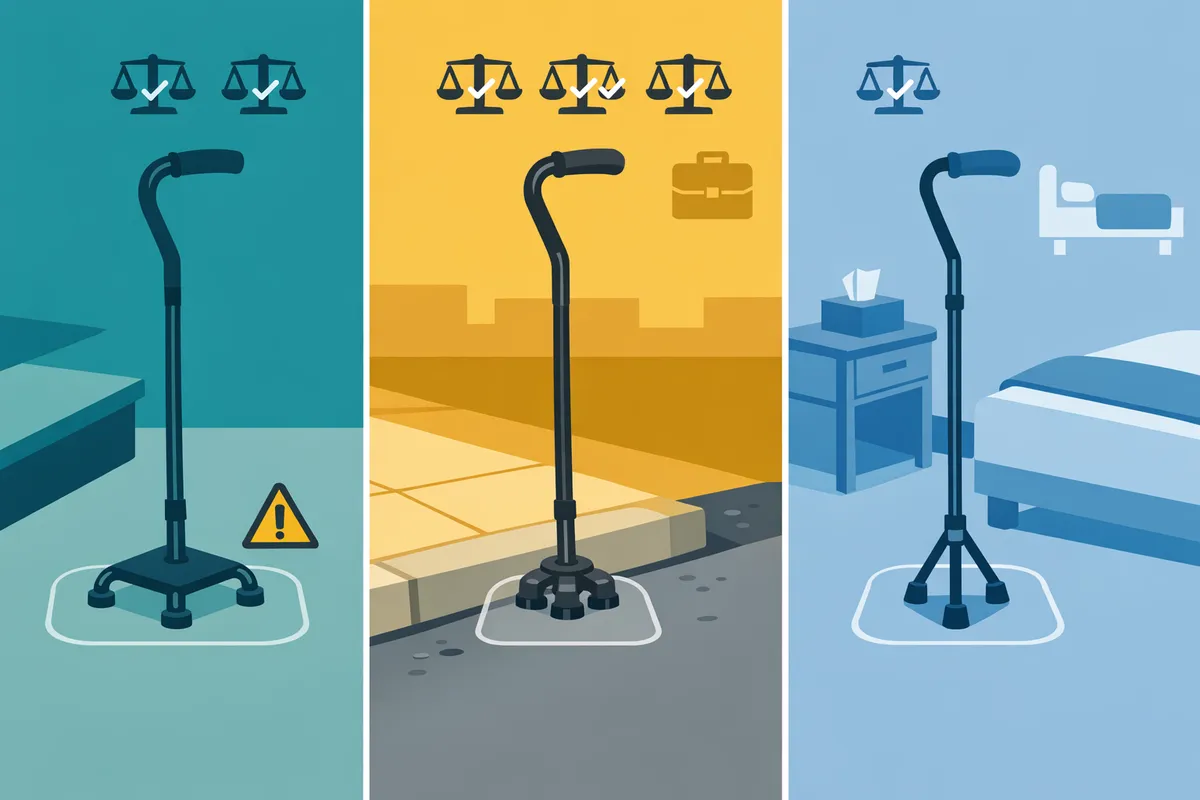
How do quad cane, quad tip, and tripod compare across stability, weight rating, footprint, and stair safety?
Quad cane, quad tip (quadpod), and tripod differ mainly in lateral stability, base footprint, stair behavior, and typical weight capacity. Choosing the right base reduces fall risk, avoids wasted purchases, and shortens the time you spend adapting to a new cane. The table and checklist below let you match specs to the situations you actually face, such as tight apartments, frequent stairs, or heavy body weight.
What comparison criteria should you use? 📋
Use stability (lateral and forward), footprint size, weight rating, stair safety, indoor maneuverability, and tip replacement cost to evaluate bases. These criteria prioritize real-world concerns: whether the cane will resist sideways tipping, fit down hallways, survive your weight, and whether parts are cheap and easy to swap.
- Stability. Measure lateral stability by footprint width and forward stability by base depth. For example, wide four-point bases resist side sway better on tiled floors.
- Footprint size. Note the base width and depth in inches; large quad bases often exceed 5 by 5 inches and can hinder tight turns.
- Weight rating. Check the maximum safe load on product labels and aim for a safety margin above your weight (see next subsection).
- Stair safety. Determine if the base catches on risers or pivots on edges; our product descriptions at Better Canes Umbrellas call out stair compatibility when manufacturers provide it.
- Indoor maneuverability. Test whether the base swivels in place or requires a wider turning radius; tripods typically win here.
- Tip replacement cost. Record the typical price and availability of replacement tips or bases to estimate long-term cost.
Feature matrix — quick comparison table 🧾
The table below compares narrow-base quad cane, large-base quad cane, quad tip (quadpod), and tripod across stability, weight rating, footprint, stair compatibility, and maintenance.
| Base type | Stability (lateral/forward) | Typical weight capacity (lbs) | Typical base footprint (in) | Stair compatibility | Maintenance (replace items/cost) |
|---|---|---|---|---|---|
| Narrow-base quad cane | 4/3 | 200–300 | 3.5 x 3.5 | Moderate. Smaller quad less likely to catch but gives less lateral spread | Tip replacement $6–12; base modular on some models |
| Large-base quad cane | 5/4 | 250–350 | 5 x 5 or larger | Poor to Moderate. Stable on flat surfaces but can snag on risers | Replace quad base $20–45 if modular; full-unit replacement if not |
| Quad tip (quadpod) | 3/3 | 200–300 | 2.5 x 2.5 (flexible) | Moderate. Can pivot at edge; better clearance than large quad | Tip replacement $6–12; many tips sold individually |
| Tripod cane | 2/3 | 200–300 | 3 x 2.5 | Good. Narrow profile clears edges but less lateral support | Tip replacement $5–10; fewer parts to replace |
The scores reflect typical models found in retail and our catalog at Better Canes Umbrellas and represent practical trade-offs buyers report in product reviews.
How to interpret weight ratings and real-world capacity? ⚖️
Weight ratings state the maximum safe load; choose a cane rated at least 20% above your body weight for a safety margin. Manufacturers usually test ratings by applying static load and then dynamic stress cycles; this appears in some spec sheets and is summarized on our product pages at Better Canes Umbrellas.
For example, a person who weighs 180 pounds should consider canes rated 215 to 220+ pounds. If you plan to carry bags or use the cane for extended leaning, add another 10% margin. Also verify whether the listed rating applies to a specific variant (narrow-base vs large-base quad cane) because the same shaft can carry different loads with different bases.
Stair safety tested: how each base behaves on steps? 🪜
Stair performance depends on base footprint shape and flexibility; large quad bases provide broad contact but can catch on a stair lip while tripods clear risers more easily. Large four-point bases give steady contact on landings and wide treads. However, they can wedge against a stair nosing and trip the user when pivoting.
Quad tips (quadpods) use smaller flexible pads that tend to pivot; this gives quicker clearance but can slip if the tread is wet. Tripods have the narrowest footprint and usually slide over a riser without catching, but they offer less sideways support while you step. Our product descriptions at Better Canes Umbrellas flag models that perform better on stairs and note whether a base is low-profile for stair use.
⚠️ Warning: Avoid using a visibly worn or hardened tip on stairs; loss of traction increases slip risk.
Practical stair guidance:
- Test the cane on a single step at home before relying on it in public stairways. Note whether the base snags or pivots.
- If stairs are frequent, favor a low-profile quad tip or a tripod that clears nosings.
- Practice one-handed rail use combined with the cane on the lower foot to reduce load on the cane when ascending or descending.
Replacement and maintenance (replace quad cane base and tips) 🔧
Replace worn rubber tips and damaged bases promptly to preserve stability and follow manufacturer compatibility to avoid mismatch. Inspect tips monthly for flat spots, hardening, or exposed metal, and swap them at the first sign of wear.
How to proceed:
- Measure the inside diameter of the cane ferrule and the outer diameter of the replacement tip to confirm fit. Our product pages list tip sizes and compatible parts on Better Canes Umbrellas to simplify ordering.
- Decide between modular bases (replaceable feet) and one-piece bases. Modular quad bases cost more up front but let you replace only the worn part; nonmodular units often require full-base replacement.
- Keep a spare tip in your bag. Tip replacement costs typically range from $5 to $15 depending on material and design.
💡 Tip: Order one replacement tip of the same material (standard rubber or all-terrain) with your cane so you have a known-compatible spare.

Which option should you choose for your situation and how do you pick the right model?
Match your primary use case, body weight, home layout, and grip preference to the base type for the safest, most comfortable cane choice. Making the wrong pick costs time and raises fall risk; this section gives a step-by-step decision tree, scenario-based recommendations, measuring and grip guidance, and buying checks.
Decision tree: four quick yes/no questions 🧭
Answering four yes/no questions about stairs, indoor space, outdoor terrain, and recovery needs points you to the best base type.
- Do you use stairs or crowded transit often? If yes, choose a tripod or compact quad tip to reduce catching on steps and speed up foot placement. Better Canes Umbrellas carries compact tripod and quad tip options designed for commuter use.
- Is most use inside a small-home or condo with narrow hallways? If yes, favor a narrow-base quad cane or a tripod for tighter turning radius. Narrow-base vs large-base quad cane matters here because large-base quad canes can obstruct small spaces.
- Do you walk often on uneven ground, gravel, or trails? If yes, pick a large-base quad cane or an all-terrain quad tip for broader footprint and better lateral support. Better Canes Umbrellas stocks rugged tips compatible with several stick styles.
- Are you recovering from surgery and need maximum lateral stability standing and sitting? If yes, choose a large-base quad cane with a wide platform and a comfortable ergonomic grip. Better Canes Umbrellas offers supportive grips that pair with larger bases.
Define terms used in these steps so choices stay clear. Quad tip is an interchangeable cane tip that creates a compact four-point footprint for extra lateral support. Quad cane is a cane that has an integrated multi-point base (narrow-base or large-base) that provides more stability than a single-point cane. Tripod is a three-prong cane base that balances stability with easier step-to-step placement.
Top picks by use case 🎯
Match base types to use cases: large-base quad canes for broad-floor stability at home, quad tips for mixed indoor/outdoor use, and tripods for stairs and narrow spaces.
- Home (small rooms, carpeted floors). Recommended: large-base quad cane for standing transfers and steady gait. Reasons: wider footprint reduces lateral sway; stable while loading a gallon of laundry; fewer regrips when moving from chair to standing. Better Canes Umbrellas carries home-friendly quad canes with cushioned handles.
- Stairs and public transit. Recommended: tripod or compact quad tip. Reasons: smaller footprint less likely to catch on stair edges; quicker placement during step transitions; easier to pivot in crowds. Choose a compact model from Better Canes Umbrellas labeled for commuter use.
- Outdoors and uneven terrain. Recommended: large-base quad cane or reinforced quad tip. Reasons: larger contact area disperses load on gravel; better lateral support when stepping on roots or curbs; removable tips available for cleaning. Better Canes Umbrellas lists all-terrain tips that clip on standard shafts.
- Post-op recovery and high-fall-risk patients. Recommended: large-base quad cane with ergonomic grip. Reasons: maximal lateral stability when standing or pivoting; room for wider stance at bedside; pairs well with slip-resistant rubber replacement pads. Better Canes Umbrellas sells replacement pads and reinforced bases for recovery needs.
- Fashion, novelty, or gift. Recommended: novelty shaft with optional quad tip or tripod adapter. Reasons: maintains style while adding basic support; adapters let recipients test stability without committing to a bulky base. Better Canes Umbrellas offers collectible sticks where quad tips and adapters are sold separately.
How to measure cane height and choose the right grip 🧰
Correct cane height puts your elbow at roughly 20 to 30 degrees when standing with the cane tip about 6 inches from your foot.
- Stand in your usual shoes. Hold the cane upright 6 inches lateral to your foot. Measure to the crease of your wrist; that measurement gives the recommended cane length.
- Test the angle: with the cane tip on the floor and your arm relaxed, your elbow should bend about 20 to 30 degrees. If the bend is much larger or smaller, change shaft length.
- Grip selection: choose a grip that spreads pressure across the palm if you have arthritis, and a slimmer grip if you need finer control. Replaceable gel or ergonomic grips reduce hand fatigue during longer walks. Better Canes Umbrellas lists grips by hand size and offers gel and foam options.
💡 Tip: Test cane height and grip while carrying a typical load (purse or briefcase) to ensure comfort under real conditions.
Maintenance checklist and when to replace the base or tips 🔧
Inspect rubber wear, wobble, and cracked plastic monthly and replace bases or tips when the contact area reduces or the cane wobbles.
- Monthly checks: press the rubber tip—if it flattens beyond 30% of original thickness or loses tread, replace it.
- Wobble test: stand with the cane and shift weight; any side-to-side play at the base means parts or the shaft ferrule need replacement.
- Visual signs: hairline cracks in plastic bases, exposed metal, or missing rivets mean immediate replacement.
- Replacement actions: replace quad cane base and tips as a pair when wear becomes uneven; use factory or recommended aftermarket parts for fit and safety. Better Canes Umbrellas offers replacement tips, bases, and fitting guidance for each cane family.
Buying checklist and return considerations 🛒
Confirm weight rating, base footprint, return policy, and available replacement parts before purchase to avoid returns or unsafe fits.
- Check weight rating: choose a cane rated at least 25% above your body weight as a safety margin.
- Verify footprint: compare narrow-base vs large-base quad cane measurements to ensure the base fits doorways and hallways in your home.
- Replacement parts: confirm availability of replacement tips, bases, and grips from the seller so you can maintain the cane long-term. Better Canes Umbrellas lists replacement parts alongside product pages.
- Return policy and trial: pick a retailer with a clear return window and support for exchanges; try the cane on stairs if that is a primary use.
- Final fit check: test the cane while wearing everyday shoes, carrying usual items, and on the surface where you walk most.
Frequently Asked Questions
This FAQ gives short, actionable answers to the most common buyer questions on stability, stair safety, sizing, parts replacement, and insurance for quad and tripod canes. Read the single-sentence answers for quick guidance, then use the supporting details to choose a model or next step.
Are quad canes more stable than quad tips? ⚖️
Quad canes with an integrated four-point base generally provide greater lateral stability than screw-on quad tips. Integrated quad bases combine shaft geometry and a wider, fixed footprint so they resist side-to-side wobble better than many screw-on adapters. A quad tip is a four-contact adapter that fits onto a single-point cane and can add stability at lower cost. Better Canes Umbrellas stocks both integrated quad canes and quad tip adapters, which makes it easy to compare feel in-store or by ordering both styles for a short home trial.
Can I safely use a quad tip on stairs? 🪜
You can use some quad tips on stairs, but many compact quad tips will pivot at step edges or catch on risers, so practice and a spotter are advisable. Test the tip on a single step while standing close to a rail; if the adapter shifts or tumbles, switch to an integrated quad base or a tripod with a smaller, controlled footprint. For frequent stair users choose a model designed for edge stability and check replacement tip diameters at Better Canes Umbrellas before buying.
⚠️ Warning: Avoid compact quad tips on steep, uneven, or narrow stairs without a spotter. A pivoting tip increases fall risk.
How do I replace quad cane bases and tips? 🔧
Replacement depends on the product design: many quad tips screw on or slide on, while some integrated quad bases use replaceable rubber pads that a retailer or technician can swap. Follow these steps when replacing parts:
- Confirm the model number stamped on the shaft or under the base.
- Inspect attachment type: threaded, push-fit, or modular pad.
- Order the matching part from the cane maker or a retailer such as Better Canes Umbrellas.
- For threaded or push-fit parts, remove the old piece, clean the shaft end, and install the new one; check fit and tightness before use. If the base shows structural cracks or the cane wobbles after replacement, seek a professional fitting rather than continuing to use the cane.
What does narrow-base vs large-base quad cane mean for daily use? 📏
Narrow-base quad canes trade some peak lateral support for improved indoor and tight-space maneuverability, while large-base quad canes increase lateral stability at the cost of bulk. A narrow-base model fits tighter hallways and turns, which helps commuters and apartment dwellers. A large-base model covers more surface area, which helps users who need strong side-to-side support on uneven ground. Better Canes Umbrellas lists footprint and base width on product pages so you can match the cane to your home layout or travel needs.
How do I choose between a tripod cane and a quad cane? 🧭
Choose a tripod cane when you want a smaller footprint with moderate lateral support; choose a quad cane when side-to-side stability is the priority. Tripod canes balance stability and maneuverability for users who navigate both indoor spaces and curbs. Quad canes suit users who need stronger lateral bracing, such as after vestibular injury or for uneven terrain. Try representative models from Better Canes Umbrellas while standing and walking the path you expect to use most; that practical test usually reveals the best compromise.
Will my insurance cover a quad cane or quad tip? 💳
Insurance coverage varies by plan and typically requires documentation of medical necessity to qualify the device as durable medical equipment. Check your plan's DME rules, request a clinician's note that names the specific cane type and functional limitation, and retain the product receipt and model number from Better Canes Umbrellas. If your plan requires prior authorization, submit the clinician note and the supplier invoice before purchase to avoid denied claims.
💡 Tip: Save the original receipt, product model number, and clinician documentation together; that packet speeds any reimbursement or FSA/HSA claim.
Choose the cane base that matches your balance needs and stair plans.
Select the base that gives predictable standing support and safe stair clearance for your daily routines. For many users the quad cane offers broader standing area while the quad tip (QuadPod) and tripod options change how the cane handles weight and stair edges. Quad cane vs quad tip decisions should focus on footprint, center-of-gravity, and where you use the cane most (indoors, curbs, or stairs).
Think about narrow-base vs large-base quad cane based on how often you need tight turns versus maximum standing stability. A narrow-base quad cane eases walking in narrow hallways. A large-base quad cane improves stationary support on flat ground but adds bulk when navigating steps.
Better Canes & Umbrellas Inc., founded in 2000 and based in Chatham, NJ, is an online and retail seller focused on umbrellas, walking sticks (including novelty sticks and hiking sticks), and shoe horns. The company expanded its assortment in 2005 to include a wide range of walking and novelty sticks and later added shoe horns in unique styles and designs. The site positions itself as a source for reliable, fashionable, and collectible items that serve both practical daily needs and gift occasions.
💡 Tip: Try your preferred base on a short stair flight while supported by a railing to check toe clearance and balance.
Schedule a consultation with Better Canes & Umbrellas through our website to get a personalized recommendation and fitting. For wider context, see the Walking Canes Guide for comparisons and sizing advice.