
Offset vs. Quad Canes: Which Is Safer for Heavy Users? 2026 Comparison by Stability, Weight Capacity, and Everyday Use
Offset vs. Quad Canes: Which Is Safer for Heavy Users? 2026 Comparison by Stability, Weight Capacity, and Everyday Use
A single slip with an under-supported cane can force heavy users out of daily routines for weeks. offset vs quad cane is the central choice heavy users face when weighing stability, weight capacity, and everyday handling. An offset cane is a walking aid that places the shaft behind the handle to center load under the wrist, and a quad cane is a walking aid with a four-point base that increases surface contact for standing stability. On our site this 2026 comparison from Better Canes & Umbrellas Inc., a Chatham, NJ seller since 2000 that pairs commuter practicality with collectible style, examines recommended models and real-world trade-offs, so which design best balances load-bearing support, daily comfort, and personal style within the Walking Canes range?
Offset cane is a cane design that places the shaft behind the handle to improve hand alignment. Quad cane is a cane type that uses a four-point base to increase standing stability. How do offset and quad canes differ for heavy users?
Offset and quad canes solve different problems for heavy users: offset designs reduce wrist bending and improve forward clearance, while quad bases enlarge the support footprint for standing stability. Heavy users must weigh wrist comfort and gait fluidity against static support, maneuverability, and weight. Better Canes Umbrellas carries examples of both styles so buyers can compare fit, feel, and day-to-day performance before buying.
Offset handle mechanics and who benefits 🖐️
Offset cane is a cane design that shifts the grip behind the shaft to reduce wrist torque and keep the wrist straighter during use. The offset geometry places the load line nearer the forearm, which lowers bending at the wrist; clinicians often recommend this for people with wrist osteoarthritis or chronic radial deviation. Typical scenarios: commuters who walk longer distances, users with mild balance impairment who need gait smoothing, and people who find standard straight-handled canes cause wrist fatigue. Better Canes Umbrellas offers offset-handle models in adjustable heights and several handle shapes so shoppers can match grip size and style to their daily routines.
💡 Tip: Set cane height so the wrist crease falls at the top of the handle while standing with your arm relaxed; this improves leverage and reduces shoulder compensation.
Quad base support and clinical scenarios 🦶
Quad cane is a cane type that increases the contact footprint with four points to provide greater static standing stability. The wider base resists tipping when a user pauses, turns slowly, or stands for long periods; physical therapists often prefer quad bases after lower-limb surgery or for patients with very slow, shuffling gait. Trade-offs include heavier weight, reduced foot clearance when taking short steps, and more snag risk on rugs or uneven thresholds. Better Canes Umbrellas stocks quad-base options intended for home use and caregiver-assisted transfers, letting buyers test the extra support against the practical limits of their living spaces.
Single-point cane portability and when it stays appropriate 🎒
Single-point cane is a cane with one tip that favors portability and quick stepping over a large support footprint. For active users, commuters, or anyone who needs fast step-to-step movement and good foot clearance, single-point models let you move more naturally and weigh less in a bag. For questions framed as quad cane vs single-point cane for stability, single-point offers less static support but wins on agility; choose single-point when mobility and weight matter more than standing balance. Better Canes Umbrellas carries lightweight single-point canes and folding options for users who need a compact stabilizer for errands and travel.
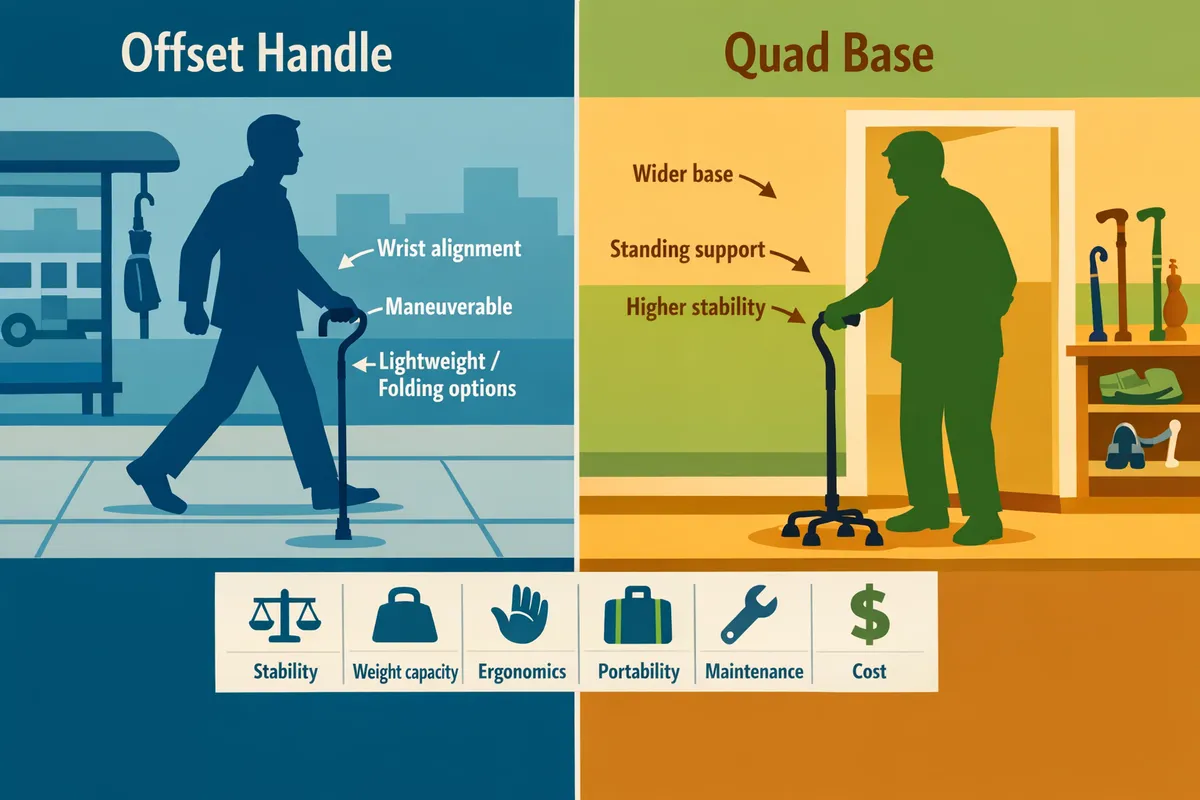
Quad canes generally provide a wider, more stable base while offset canes offer better wrist alignment and maneuverability. How do offset and quad canes compare across stability, weight capacity, ergonomics, portability, maintenance, and cost?
Quad canes, offset canes, and single-point canes trade stability, comfort, and convenience in different ways, so picking the right style reduces fall risk and unnecessary strain. This section lays out objective factors you can measure (footprint area, shaft construction, handle geometry) and practical scenarios (standing from a chair, slow ambulation, pivoting) to rank priorities quickly.
Stability and real-world tasks 🧭
Quad canes offer the highest static stability because their four-point base increases footprint area and lateral support. The larger base spreads load across multiple contact points, which helps when standing from a chair or pausing on uneven floors. Footprint area, tip design, and how the base meets the floor are the three objective stability factors to check: larger footprint area reduces tipping risk; broader ferrules maintain traction on carpet and tile; and a low-profile quad base reduces awkward catches on thresholds. For caregivers assisting transfers, Better Canes Umbrellas' quad models provide clear visual differences in base size so you can match a model to the user’s standing tasks. Example: a user who frequently pauses to adjust shoes will benefit more from a quad base than from an offset cane.
Side-by-side comparison table 📋
This table summarizes stability, weight capacity, ergonomics, portability, cost, caregiver use, and indoor suitability for offset, quad, and single-point canes.
| Cane Type | Stability | Weight Capacity | Ergonomics (wrist/hand strain) | Portability | Cost | Caregiver use | Indoor suitability |
|---|---|---|---|---|---|---|---|
| Offset cane | Moderate. Better than single-point for sway control | Typical range matches standard canes; bariatric options available | Lowers wrist deviation by placing shaft behind handle | Good. Many folding offset models exist | Moderate | Easier handoff than quad for quick assistance | Good in narrow spaces and on stairs |
| Quad cane | High. Four-point footprint gives best static stability | Often available in higher-rated models; bariatric quad variants exist | Can increase wrist pronation depending on handle type | Poorer. Larger base complicates stairs and tight turns | Higher average cost | Requires caregiver familiarity for transfers and pivoting | Excellent for standing tasks and slow walking on even floors |
| Single-point cane | Low. Small footprint gives least static stability | Similar to offset unless reinforced for bariatric use | Can increase wrist strain with prolonged use | Best. Light and compact, many foldable options | Lowest | Simple to hand between people but offers least support | Best for quick steps and ambulatory users on clear paths |
Better Canes Umbrellas carries offset, quad, and single-point models in several price bands so caregivers can choose the trade-off set that matches the user’s daily environment.
Weight capacity and bariatric options 🏋️
Weight capacity depends on shaft material, joint reinforcement, and ferrule design, and bariatric canes add reinforcement and larger tips to raise safe load limits. Indicators of bariatric models include thicker shaft diameters, welded or reinforced joints at the handle and height collars, and wider ferrules or multi-point base construction. If a user approaches or exceeds a cane’s rated capacity, choose a bariatric model rather than oversized use of a standard cane; Better Canes Umbrellas’ heavy-duty selection lists construction details for each model so you can confirm shaft diameter and recommended load. Example: a user who needs consistent two-handed support during brief transfers should pick a bariatric quad or reinforced offset rated for the user’s weight rather than a standard single-point cane.
⚠️ Warning: Never use a cane if the user’s weight exceeds the model’s rated capacity; doing so raises fall and equipment-failure risk.
Ergonomics and wrist/hand strain 🤲
Offset cane is a cane type that places the shaft behind the handle to improve hand alignment and reduce wrist deviation. Offset designs move the vertical load behind the hand, which reduces bending at the wrist and lowers grip force during stance. Handle type matters: anatomical or palm-grip handles distribute pressure over a larger surface and reduce hotspot pain compared with narrow crook handles. Quad bases can increase wrist pronation if paired with a straight handle, so match handle geometry to the user’s grip strength and any arthritis. Better Canes Umbrellas lists handle materials and recommended grip types for users with rheumatoid or osteoarthritis so caregivers can pick models that minimize hand pain during daily tasks like carrying a bag or opening doors.
Portability and everyday use 🚶
Single-point canes and many offset canes beat quad canes on portability because they weigh less and have smaller bases that clear stairs and narrow hallways easily. If the user commutes, climbs stairs, or needs to tuck the cane under a seat, a folding offset or a lightweight single-point cane saves time and reduces fatigue. Quad canes increase difficulty on stairs and in tight turns; a caregiver transferring a user on stairs will often swap a quad for a helper’s grab or use both hands. Better Canes Umbrellas stocks folding offset and compact single-point models with weight listings and folded dimensions to help caregivers compare practical carry trade-offs. Example: a commuter who uses public transit and needs quick folding will prefer a folding offset over a quad base.
Maintenance, tip replacement, and durability 🧰
Quad cane bases require more tip maintenance because each contact point wears at different rates, while offset and single-point canes mainly need ferrule replacement and shaft inspections. Check ferrules monthly for visible grooves or a hard inner core showing through; replace when the tread depth falls below 1.5 mm or when slippage increases. Materials matter: aluminum shafts resist corrosion and steel shafts resist bending under high load but may require more frequent inspections for joint wear. Better Canes Umbrellas offers replacement ferrules and care guidelines per model so caregivers can schedule periodic checks and avoid surprise failures.
💡 Tip: Rotate a quad cane base 90 degrees every 6 months to even out ferrule wear when the user’s gait is consistent.
Cost, caregiver handling, and indoor suitability 💲
Quad canes typically cost more because of their larger bases and additional materials, while offset and single-point canes usually cost less and are easier to store indoors. For caregivers, quad canes provide better hands-free standing support during dressing or bathroom transfers, but they require practice to avoid catching the base on rugs and thresholds. Offset canes are better for users who need wrist relief and who live in apartments or houses with narrow corridors. Better Canes Umbrellas groups models by use case (commuter, indoor support, heavy-duty) so caregivers can compare price against the practical benefits they will actually use. Example pricing pattern: expect a higher entry price for a stable quad with an ergonomic handle versus a low-cost single-point cane intended for short-term use.
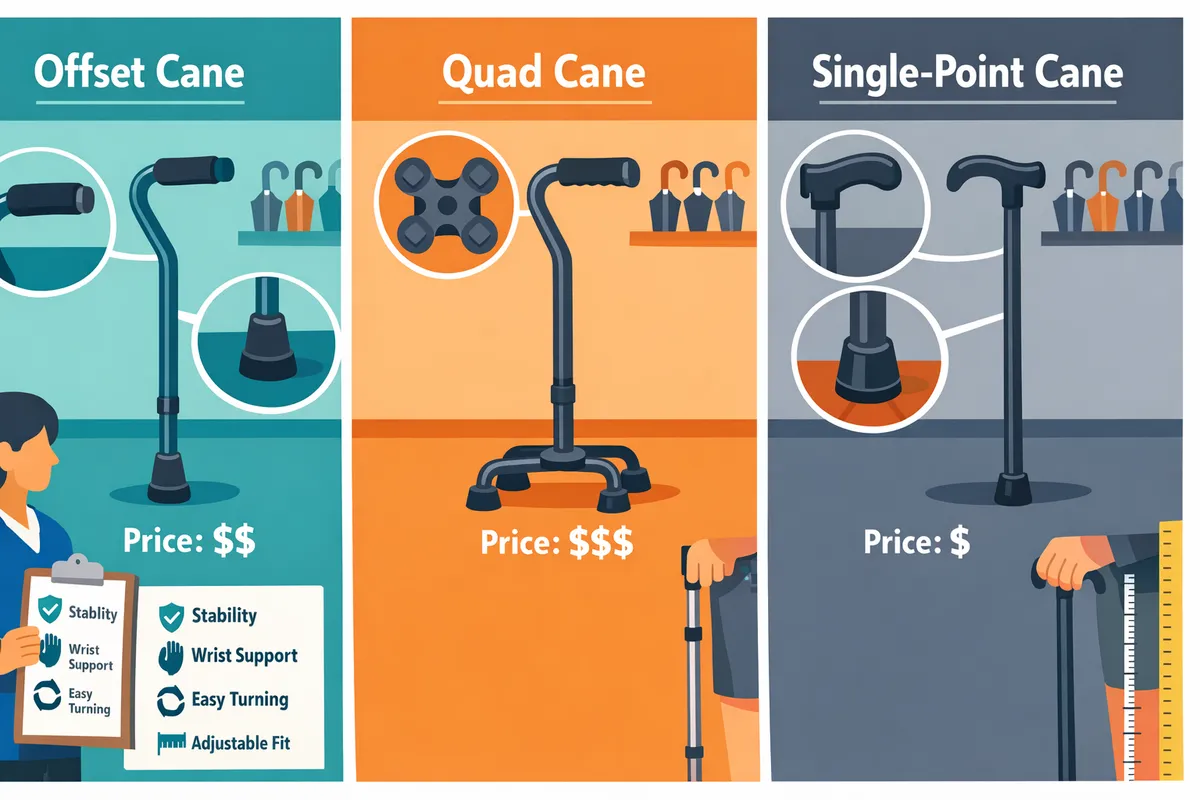
For heavy users, quad canes often deliver the safer standing platform while offset canes reduce wrist pain and improve maneuverability in tight spaces. Which cane should heavy users choose and how should they size and fit it?
Quad canes typically answer the need for maximum standing stability while offset canes address wrist alignment and room maneuvering. Choosing the right cane requires matching balance severity, typical walking conditions, caregiver involvement, and weight capacity. Below are a clinical-style decision framework, a step-by-step sizing and fit checklist, targeted maintenance and safety advice, and practical buying guidance from Better Canes Umbrellas.
Decision framework: match condition and environment to cane type 🗺️
Use a simple decision tree that prioritizes balance deficits, walking speed, home hazards, and caregiver needs to recommend either a quad or offset cane. Start by asking four questions in order: balance severity, typical walking speed, primary environment, and whether a caregiver performs transfers.
- Balance severity. If the user has frequent unsteadiness, fall history, Parkinsonian gait, or needs to stand unsupported for transfers, recommend a quad cane for its wider base and greater static stability. Give the user a quad with a low center-of-gravity base and wide ferrule. Better Canes Umbrellas' staff recommends our quad cane collection for these cases.
- Walking speed and gait. If the user walks at a normal or brisk pace with occasional wobble, an offset cane often provides better forward clearance and reduces wrist deviation. Choose offset-handle canes for users who need smoother swing-through steps in corridors and stores.
- Environment and obstacles. If the home has narrow hallways or frequent stair negotiation, prefer an offset cane for maneuverability; if surfaces are uneven or the bathroom is used without caregiver help, prefer a quad for standing tasks.
- Caregiver-assisted transfers. If caregivers frequently steady or pivot the user, a quad cane with a rigid base and heavy-duty stem provides safer hand placement and loading.
Examples:
- Post-op with preserved balance and short-term use: offset cane for room mobility and wrist comfort.
- Osteoarthritis with preserved balance but painful wrist: offset-handle cane with ergonomic grip.
- Chronic balance loss and slow gait: quad cane with large base and non-slip ferrule.
- Frequent caregiver transfers: quad cane rated for higher loads and with a secure handle.
Sizing and fit checklist for heavy users 📏
Correct height and fit reduce fall risk and wrist pain by ensuring neutral posture and predictable cane geometry. Follow this step-by-step fitting process while wearing the shoes the user normally wears.
- Stand upright with shoes on and feet shoulder-width apart. Hold the cane at the side opposite the weaker leg.
- Bend the elbow slightly and aim for an elbow angle of 20 to 30 degrees when the cane tip is placed one step ahead of the foot. Measure the distance from the wrist crease to the floor as a cross-check. Use the smaller measurement if methods conflict.
- Use the height table below to pick an initial cane length, then fine-tune with the elbow-angle check.
| User height (feet/inches) | Suggested cane length (inches) |
|---|---|
| Up to 4'10" | 34" |
| 4'11"–5'4" | 36" |
| 5'5"–5'10" | 38" |
| 5'11"–6'2" | 40" |
| Over 6'2" | 42" |
- Ferrule selection. Ferrule is the rubber tip that provides traction and a visual wear indicator. Pick a wide-diameter ferrule for heavy users to increase contact area and reduce slipping. Consider spiked ferrules only for consistent outdoor use on ice; do not use spikes indoors.
- Cane angle and hand placement. The cane shaft should angle slightly outward (about 10 to 15 degrees) when in use. Hold the cane opposite the weaker leg to create a stable tripod with the feet.
- Confirm weight capacity. Always choose a cane rated above the user’s body weight. For users needing higher support, select a bariatric walking cane 500 lb capacity model from our heavy-duty/bariatric canes.
⚠️ Warning: A cane that is too short forces the user to lean and increases fall risk; a cane that is too long causes shoulder elevation and instability. Verify height while the user is standing and moving, not seated.
Maintenance and safety checks 🧰
Regular inspection and timely replacement of wear items prevent sudden failure and slippage for heavy users. Inspect hardware, ferrule, shaft straightness, and handle attachment before first use and then monthly for heavy daily use.
- Ferrule wear. Replace the ferrule when treads smooth or when rubber shows cracks. Heavy users may need ferrule swaps every 3 months depending on activity. Keep a spare ferrule on hand for same-day replacement.
- Stem and handle. Check for bent shafts, loose collars, or play where the handle meets the shaft. Do not use a cane with visible bending; unsafe deflection increases tip load on the ferrule.
- Fasteners and adjustability. For adjustable canes, confirm push-button or pin locks engage fully and do not slip under load. Test the cane at the user’s weight before leaving the store.
- Cleaning and storage. Wipe down handles and shafts after outdoor use to prevent grit from accelerating wear. Store canes upright in low-humidity areas to avoid rubber degradation.
💡 Tip: Replace ferrules before they show full wear; a spare ferrule in a pocket or bag avoids using a compromised cane during errands.
Vendor guidance: why buy from Better Canes Umbrellas 🛒
Buying from Better Canes Umbrellas reduces selection risk because we match user goals to cane features, offer in-store fitting, and provide customer service that handles exchanges or adjustments. According to Better Canes Umbrellas, matching user goals to cane features saves time and lowers return rates.
What we offer that speeds the right choice:
- Product breadth. Browse our quad cane collection, offset-handle canes, and heavy-duty/bariatric canes to compare base geometry, handle style, and load rating without jumping between retailers.
- In-store and remote fitting. Visit our Chatham, NJ location for hands-on fitting or use our customer service to walk through the sizing checklist by video.
- Practical support. We provide spare ferrules, replacement handles, and clear guidance on choosing a bariatric walking cane 500 lb capacity when needed. Our customer representatives will suggest heavier-gauge stems and wider ferrules for heavy users.
- Returns and warranty. We offer sensible return windows and inspection guidance so you avoid keeping a poorly fitted cane.
Use the decision framework and sizing checklist above when selecting from our product pages to reduce time spent testing models and lower the chance of returns or safety issues.
Quad and offset canes raise common buyer questions about stability, capacity, sizing, and clinical guidance. Frequently Asked Questions about offset vs quad cane
This FAQ answers the precise buyer questions heavy users and caregivers ask about stability, weight capacity, sizing, and when to get clinical input. Each answer points to practical verification steps and product choices you can find through Better Canes Umbrellas.
Which is more stable: offset, quad, or single-point cane? 🤔
Quad canes provide the greatest static stability, followed by offset canes, then single-point canes. Quad bases give four contact points that widen the standing platform; offset canes widen hand alignment and improve dynamic balance while moving; single-point canes work best for minimal support and quick turns.
| Cane type | Best stability use | Maneuverability | Typical user profile |
|---|---|---|---|
| Quad cane | Highest static standing support (transfers, long stands) | Lower maneuverability in tight spaces | Users with frequent balance loss or high fall risk |
| Offset cane | Good dynamic support while walking; reduces wrist torque | Better for narrow spaces and stairs | Users with wrist pain or moderate balance issues |
| Single-point cane | Minimal standing support; best for gait cueing | Easiest indoors and on stairs | Users with minor balance deficits |
Rule of thumb: choose a quad for high fall-risk, an offset for moderate risk with wrist concerns, and a single-point for low-risk mobility. Better Canes Umbrellas stocks reduced-footprint quad models and multiple offset styles to match these needs.
Can a bariatric walking cane support 500 lb? 🏋️
Some bariatric walking canes are rated to support 500 lb, but you must confirm the cane's published weight rating on the product page before purchase. Look for explicit "bariatric" or "heavy-duty" labels, reinforced shafts, and wide-base tips on the Better Canes Umbrellas product listing; contact customer service if the rating is not visible.
How to verify quickly:
- Check the product specification for a maximum user weight. 2. Confirm materials (reinforced steel or aircraft-grade aluminum). 3. Verify the tip type and diameter; wider tips increase load distribution. 4. Ask about warranty and return options if you need higher capacity.
Do not assume standard adjustable canes meet high-capacity needs. Select a listed bariatric model to avoid structural failure, premature wear, or voided warranties.
Are quad canes harder to use indoors? 🏠
Quad canes can feel bulkier near furniture and narrow doorways, but choosing a reduced-base quad and the right tip largely removes the problem. Many users switch to a compact quad base or a low-profile rubber tip to pass through tight areas without losing the extra stability.
Practical workarounds:
- Choose a reduced-base quad model from Better Canes Umbrellas for tighter footprints.
- Use a high-traction, low-profile tip to avoid catching on rugs.
- Practice the step-turn technique: pause, pivot the body toward the direction, then advance the cane to avoid scraping furniture.
💡 Tip: Measure the narrowest doorway and the clearance beside favorite chairs before buying a quad cane to ensure the base will fit during everyday use.
Can offset canes reduce wrist pain? ✋
Offset canes often reduce lateral wrist strain by moving the shaft behind the handle so the forearm and wrist stay aligned under load. Users with ulnar deviation, mild to moderate arthritis, or prior wrist discomfort commonly report reduced pain when switching to an offset handle.
When offset helps and when to get a checkup:
- Offset handles help when pain is localized to the wrist and caused by leverage or hand position.
- See a clinician if pain radiates into the elbow or shoulder, or if pain persists despite an offset handle; the source may be gait mechanics or a joint condition that a cane alone will not fix. Better Canes Umbrellas carries several offset handle shapes to test comfort before committing.
How do I size a cane for a heavy user? 📏
Proper cane height is measured with the user standing relaxed and the cane tip positioned about 6 inches lateral to the foot while the handle aligns with the crease of the wrist. This position keeps the elbow slightly bent (about 15 degrees) and prevents shoulder elevation or leaning.
Quick sizing checklist:
- Wear the shoes you use daily.
- Stand upright and hold the cane at your side; adjust so the handle sits at the wrist crease.
- Confirm a slight elbow bend when the cane tip is 6 inches lateral to the foot.
- For heavy users, choose a model rated above the user's weight and consider a wider tip for stability.
⚠️ Warning: Using a cane that is too short forces shoulder elevation and increases fall risk; test height with everyday footwear or schedule a fitting at our Chatham, NJ retail location.
When should I consult a clinician before choosing a cane? 🩺
Consult a clinician before choosing a cane if the user has recurrent falls, unexplained dizziness, severe weight-bearing pain, or recent lower-limb surgery. These red flags indicate underlying balance, neurological, or orthopedic issues that change the recommended cane type or require a formal mobility assessment.
What the clinician will evaluate and how Better Canes Umbrellas helps:
- Clinicians assess gait, strength, and transfer safety and may recommend quad, offset, or a specialist device.
- If a clinician prescribes a specific handle height, base type, or bariatric rating, use Better Canes Umbrellas' product filters to match those specs quickly.
Quad canes usually provide greater base stability and higher weight capacity, while offset canes offer lighter weight and easier maneuvering.
For heavy users who prioritize steady support and reduced tip risk, a quad cane is the safer choice. Quad models spread load across four feet and suit longer standing periods or slower gait. Offset canes work when you need a lower-profile stick for short walks, stairs, or tighter indoor spaces. This is the core trade-off to weigh when comparing offset vs quad cane options for daily use.
Better Canes & Umbrellas Inc., founded in 2000 and based in Chatham, NJ, is an online and retail seller focused on umbrellas, walking sticks (including novelty sticks and hiking sticks), and shoe horns. The company expanded its assortment in 2005 to include a wide range of walking and novelty sticks and later added shoe horns in unique styles and designs. The site positions itself as a source for reliable, fashionable, and collectible items that serve both practical daily needs and gift occasions.
💡 Tip: Test a cane while wearing the shoes you use most and try the surfaces you encounter daily.
Schedule a consultation with Better Canes & Umbrellas to get a personalized fit and weight-capacity recommendation.