
Cane Tip Replacement: Sizes, Options, and How to Replace
Cane Tip Replacement: Sizes, Options, and How to Replace
A worn cane tip can turn a routine walk into a sudden slip that causes a fall. Cane tip replacement is a maintenance procedure that measures cane shafts, selects the correct walking cane tip and walking cane base, and installs a new rubber or polymer tip to restore traction and stability. This how-to guide gives step-by-step instructions to measure cane shafts, pick the correct walking cane tips and walking cane bases, replace a worn tip, and maintain cane stability. At Better Canes Umbrellas we recommend checking shaft diameter, taper, and heel style before you buy to avoid wasted time and poor fits. Later we'll compare tip materials so you know which holds up best on wet pavement.
How do I identify the right cane tip size and type?
Measure the cane shaft diameter and note the shaft shape to choose a tip that fits snugly and matches the cane's end profile. Accurate sizing prevents a loose fit that shortens tip life and increases slip risk. Below are step-by-step measuring instructions, a definitive sizing chart, compatibility tables for common shaft shapes, wear indicators with replacement timelines, and options for non-standard or damaged shafts.
Measure shaft diameter and shape 📏
Measure the outside diameter for round shafts and take both narrow and wide measurements for oval shafts using a caliper or a ruler. Measure at the very end of the cane where the tip sits; coverings and grips often add 1–2 mm. For round metal or wooden shafts, record the single OD (for example 3/4" ≈ 19.05 mm). For oval shafts, record the short and long axis (for example 16 mm × 20 mm) so you can choose tapered or flexible tips.
Use these practical checks while measuring:
- Remove any worn tip or sleeve before measuring. Better Canes Umbrellas recommends measuring twice to avoid ordering the wrong size.
- If you only have a ruler, measure across the widest part and convert inches to millimeters (1 inch = 25.4 mm).
- Acceptable press-fit tolerance: 0–1.0 mm for bare shafts; add 1.0–2.0 mm to the tip inner diameter if the shaft has a rubber sleeve or decorative covering.
💡 Tip: If the cane end is slightly frayed or the sleeve compresses, round up to the larger size in the tolerance range rather than down.
Sizing chart and quick-fit table 🔢
Use the chart below to match common shaft sizes to the recommended tip inner diameter so you can pick the correct replacement at a glance. The table shows inch sizes, mm equivalents, recommended tip inner diameter ranges, and a short note for sleeves or grips.
| Shaft size (inch) | Shaft OD (mm) | Recommended tip inner diameter (mm) | Notes (sleeve/grip) |
|---|---|---|---|
| 5/8" | 15.9 mm (16 mm) | 16.0–17.0 mm | For thin rubber sleeves add +1 mm |
| 3/4" | 19.05 mm (19 mm) | 19.0–20.0 mm | Standard press-fit for most rubber tips |
| 7/8" | 22.23 mm (22 mm) | 22.0–23.0 mm | Common for heavier canes and some quad bases |
| 1" | 25.4 mm (25 mm) | 25.0–26.0 mm | Use heavy-duty tips for large-diameter shafts |
Example: a commuter cane with a 3/4" metal shaft and a thin EVA sleeve usually needs a 19–20 mm inner-diameter tip; if the sleeve is thick, order the next size up. Better Canes Umbrellas stocks replacement tips that list inner diameters clearly so you can match quickly.
Cross-compatibility chart (table) 🗂️
Not every tip style fits every shaft shape; check this table to see which tip types normally work with common cane ends before you buy a rubber tip or walking cane base.
| Tip style | Standard round shafts | Oval / tapered shafts | Decorative / fluted shafts | Quad-style shafts |
|---|---|---|---|---|
| Rubber slip-on tip | Direct fit (press-fit) when sized correctly | Fits if flexible; choose slightly larger ID | May need light sanding or an adapter | Usually incompatible without adapter |
| Quad base (four-prong) | Requires quad-specific shaft or adapter | Often requires adapter or collar | Decorative ends often need reshaping | Direct fit when base matches quad stem size |
| Self-standing base | Direct fit if shaft diameter matches base stem | Works if base has flexible bore | Decorative shafts may sit loosely | Requires quad-specific self-standing design |
| Heavy-duty / hiking tip | Direct fit for larger-diameter shafts | Fits tapered shafts with clamp-on option | Decorative shafts may need custom adapter | Use quad-to-round adapter or quad-specific option |
Example: a decorative fluted cane often needs an adapter sleeve to accept a standard rubber tip; forcing a press-fit tip risks splitting the decorative finish. Better Canes Umbrellas lists which tips include adapters and which require a quad-specific base.
Identify wear and when to replace ⚠️
Replace a cane tip when you see tread loss, exposed metal or wood, cracks, wobble, or audible squeaks under load. These visual and functional signs correlate directly with increased slip and fall risk.
Typical replacement frequency examples:
- Light daily use (short walks, indoor): replace every 12–18 months.
- Moderate urban use (sidewalks, grocery trips): replace every 6–12 months.
- Heavy use or abrasive surfaces (daily long walks on concrete): replace every 3–6 months.
Check monthly if you weigh over 220 lbs or regularly walk on rough terrain; heavier loads accelerate rubber compression and cracking. Test a tip by pressing down and twisting gently; any lateral play or a metal-on-ground feel means replace immediately. Better Canes Umbrellas recommends keeping a spare tip in your bag for quick swaps.
⚠️ Warning: Do not use a cane if you can see the metal or wood core of the shaft at the tip; that exposed edge increases the chance of a sudden slip.
Non-standard and damaged shafts — options 🔧
For bent, split, or irregular cane ends, use a universal adapter, clamp-on ferrule, or get a professional repair rather than forcing a press-fit tip. Forcing a wrong-size tip can worsen splits and create a safety hazard.
Practical options and expected outcomes:
- Build-up tape or adhesive shim. Wrap to increase diameter by 1–2 mm as a temporary fix. Expected outcome: short-term snug fit for 1–3 months; check frequently.
- Clamp-on ferrule or collar. Clamps mechanically secure the tip to odd-shaped ends. Expected outcome: reliable for irregular or tapered shafts without reshaping.
- Universal adapter with epoxy-lined bore. Inserts into damaged hollow shafts and provides a solid stem for standard tips. Expected outcome: semi-permanent repair if shaft is not structurally compromised.
- Professional repair or replacement. If the shaft is split, bent more than a small angle, or the core is exposed, a repair shop or replacing the cane is the safer option.
If you are unsure, bring photos and measurements to a retailer or contact Better Canes Umbrellas for advice on adapters and quad bases designed for non-standard shafts.
How do I replace a cane tip step by step?
Follow a five-step workflow to remove a worn cane tip, choose a matching replacement, and install the new tip so the cane is stable on multiple surfaces. This short process limits time spent troubleshooting and reduces the risk of loose fits or premature wear. Use the numbered steps below; each step includes expected outcomes and recovery options if something goes wrong.
Step 1: Gather tools and a matching replacement 🧰
Have a new tip that matches your measured inner diameter, plus a rubber mallet and a cleaning cloth. Buy a replacement sized to the cane shaft inner diameter you measured earlier (common sizes include 5/8", 3/4", and 1"). Consider 2-pack or 4-pack walking cane tips to keep a spare on hand and reduce repeat trips to the store. Better Canes Umbrellas stocks multiple sizes and formats, which saves time versus hunting different retailers for the correct fit.
What to buy now:
- Correct-size rubber tip or walking cane base (match inner diameter).
- Rubber mallet or wooden block for gentle seating.
- Soft cloth, rubbing alcohol, and penetrating oil if tip is stuck.
Expected outcome: You have the right size tip and basic tools; you avoid a loose or overly tight fit that shortens tip life.
Step 2: Remove the worn tip safely 🗜️
Pull the worn tip straight off while stabilizing the cane shaft to avoid bending or splitting the end. Stand the cane tip-down on the floor, hold the shaft just above the tip, and pull firmly and evenly; if the tip resists, apply a few drops of penetrating oil around the rim, let it soak 5–10 minutes, then try again. If the tip still will not budge, tap the stuck tip gently with a rubber mallet while pulling; do not twist the tip or cut into the shaft end because that can deform the shaft and prevent a secure fit.
When to stop and get help: If tapping and oiling fail after a few attempts or the shaft shows visible cracking, stop and consult a local repair shop or cane fitter to avoid further damage.
⚠️ Warning: Do not use a metal hammer or pry the tip with pliers. Those actions can compress the shaft, creating a loose fit or a fracture.
Expected outcome: The old tip comes off intact or with minimal force; you can inspect the shaft for damage before installing the new tip.
Step 3: Clean and inspect the shaft end 🧼
Clean the exposed shaft end and inspect it for cracks, compression, or uneven wear before installing the new tip. Wipe the shaft end with alcohol and a cloth to remove dirt and old rubber residue; use fine sandpaper only to remove small burrs and then clean again. Check for radial cracks, compression where the shaft looks flattened, or a loose ferrule sleeve; any of those conditions means the shaft may need a sleeve, filler, or professional repair before you install a new tip.
What to do if you find damage:
- Small surface burrs: sand lightly and clean.
- Compression or split wood/metal: fit a shaft sleeve or consult a repair service.
- Unknown damage: bring the cane and the new tip to a local store that sells walking cane bases for an on-site check.
Expected outcome: The shaft end is clean and structurally sound, ready to receive the replacement tip without creating wobble or uneven wear.
Step 4: Install the new tip and test fit 🔩
Align the new tip straight with the shaft and push it on until it seats; use a rubber mallet to finish seating if needed. Place the cane on a flat surface, press the tip onto the shaft while applying even downward force, then give a few light taps with the mallet to seat the tip fully. The correct fit feels snug with no lateral wiggle; if the tip is slightly long and interferes with gait, trim the rubber tip top by 2–3 mm or choose a thinner model. After installation, walk slowly for several steps and check for wobble. If the tip loosens after a day of use, re-seat it with another gentle mallet tap.
What tight is tight enough: The tip should not move when you push side-to-side with your thumb. If it does, remove and inspect for debris or replace with the next larger inner-diameter size.
Expected outcome: A secure, wobble-free tip that sits flush and gives predictable contact on flat and slightly uneven surfaces. Better Canes Umbrellas' walking cane tips are sized and labeled to simplify this step.
Step 5: Verify stability and record replacement date ✅
Check balance on carpet, tile, and pavement, then log the replacement date to track wear. Walk short distances on at least two surface types (indoor tile/carpet and outdoor pavement) while paying attention to slipping, rocking, or unusual noise. Note the replacement date on a small maintenance log or set a calendar reminder for three to six months depending on use; frequent outdoor use or higher user weight shortens replacement intervals.
Maintenance tips:
- Inspect the tip weekly for flat spots or cracking.
- Swap to a heavy-duty rubber or quad cane base if you notice rapid wear.
💡 Tip: Keep a spare tip from Better Canes Umbrellas in your bag and mark the replacement date on the box so you can compare wear after typical use.
Expected outcome: Confirmed stable performance across surfaces and a recorded date that helps predict the next replacement window.
Comparison table: tip formats and materials 📊
This table compares common walking cane tips and formats by grip, wear life, user-weight suitability, and surface best use. The rows list formats often sold by retailers like Better Canes Umbrellas to help you choose the right option for commuting, indoor use, or outdoor walking.
| Format / Material | Grip (how well it resists slipping) | Typical wear life (relative) | User-weight suitability | Surface best use |
|---|---|---|---|---|
| Standard rubber tip | Good on dry indoor surfaces; moderate on wet floors | Moderate | Light to medium users | Indoor tile, carpet, dry pavement |
| Heavy-duty rubber | Better grip on uneven or wet ground | Longer | Medium to heavier users | Outdoor pavement, trails, wet surfaces |
| Quad cane base (4-point) | Excellent stability and broader contact area | Long (even wear) | Medium to heavy users, balance issues | Indoor/outdoor, standing tasks, long waits |
| Self-standing tip | Good grip with vertical stability; helps cane stand upright | Moderate | Light to medium users | Indoor use, kitchen, office |
| Decorative rubber tip | Varies by design; often lower technical performance | Variable (depends on compound) | Light users or occasional use | Short indoor/outdoor use, fashion-forward canes |
How to use the table: Pick heavy-duty rubber or a quad cane base for frequent outdoor commuting. Choose a self-standing tip for convenience in shops or offices. Better Canes Umbrellas lists these formats so you can match fit and style at purchase.
Visual aids to include (photo/video) 🎥
Film a short 30–60 second clip for each step and capture 3–5 stills so caregivers and users can follow the sequence quickly. Recommended shots and captions:
- Measuring shot: close-up of caliper or tape on the cane shaft with caption "Measure inner diameter where tip sits."
- Removal shot: hands pulling the tip straight off with caption "Pull straight; add penetrating oil if stuck."
- Cleaning shot: cloth and alcohol wiping the shaft end with caption "Clean and inspect for cracks or compression."
- Installation shot: pressing new tip on and tapping with mallet with caption "Seat straight; check for wobble."
- Testing shot: user walking on tile and pavement with caption "Test on multiple surfaces and log date."
Suggested image to include in the article:
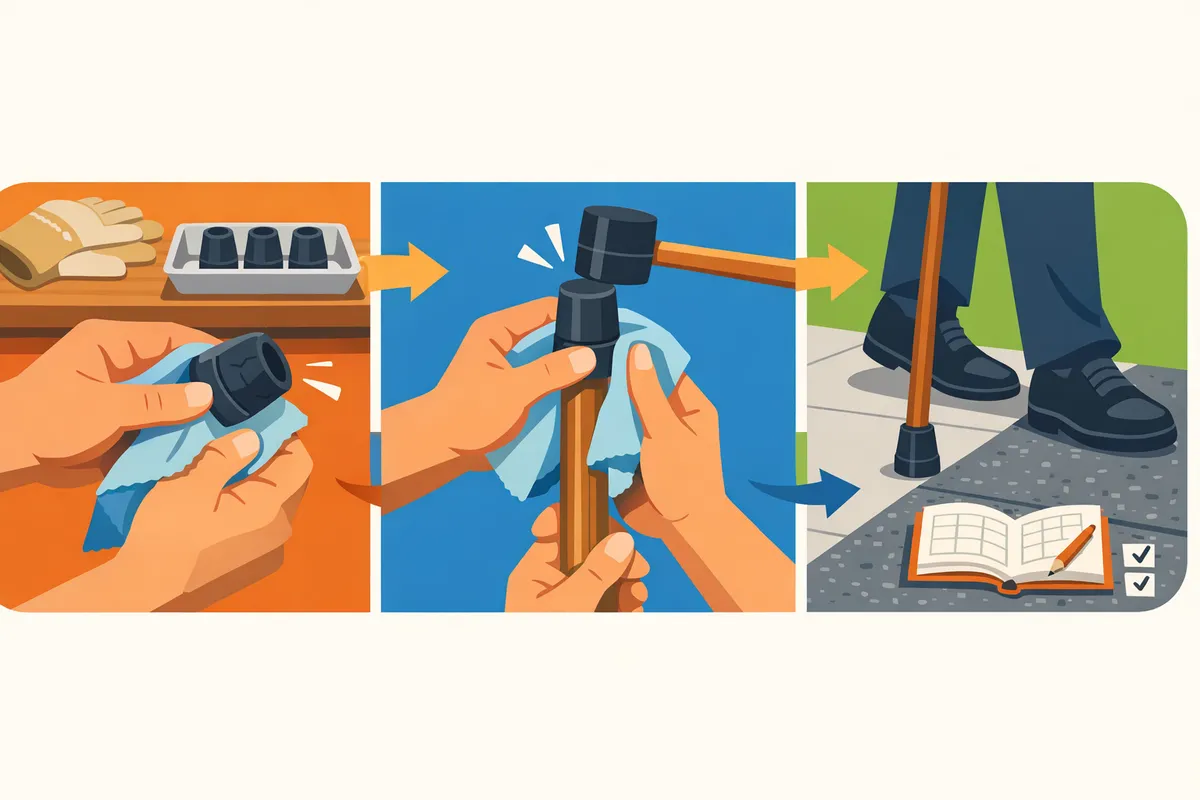
Expected outcome: Visuals make the five-step process reproducible for caregivers and users, reduce trial-and-error, and highlight the correct fit options available from Better Canes Umbrellas.
How do I maintain cane tips and handle common problems?
Regular inspection and timely replacement keep cane tips safe and reduce fall risk. Inspect monthly and replace sooner for heavy daily use or frequent outdoor walking; small fixes now prevent bigger stability problems later.
Routine maintenance schedule 🗓️
Inspect cane tips monthly and replace them sooner if you walk on rough surfaces or use the cane daily. Check for tread depth, hairline cracks at the lip, and uneven compression where one side sits lower than the other. Sample replacement intervals by use and surface:
- Infrequent indoor use (carpeted floors): inspect every 3 months; expect replacement every 9–12 months.
- Daily commuting or mixed indoor/outdoor use: inspect monthly; expect replacement every 3–6 months.
- Heavy outdoor or rough-surface use (gravel, concrete): inspect every 2–4 weeks; expect replacement every 1–3 months. Better Canes Umbrellas sells bundled walking cane tips so caregivers and commuters can keep spares on hand and avoid downtime.
Troubleshooting fit issues 🛠️
A loose or rattling tip usually means the tip inner diameter does not match the shaft outer diameter or the shaft end is deformed. Measure the shaft at the very end with a caliper or tape and compare to the tip inner diameter printed on the package. Quick fixes: try a tip one size smaller, add a thin rubber sleeve or a single wrap of electrical tape to the shaft for a firmer press-fit, or replace the worn ferrule if the shaft end is crushed. Test the repair by standing, applying full weight, and twisting gently; a secure fit should show no lateral play and no scraping sound. Better Canes Umbrellas offers matched sizes and thin fitting sleeves that save trial-and-error time.
Common mistakes to avoid ⚠️
Forcing a wrong-size tip, ignoring hairline cracks, and skipping routine checks all increase fall and repair risk. Top 7 caregiver mistakes and consequences:
- Forcing too-large tips — causes rapid split and instability.
- Using glued repairs — adhesive can create hard spots and uneven wear.
- Ignoring hairline cracks — cracks grow under load and suddenly fail.
- Skipping monthly checks — small wear becomes unsafe between visits.
- Buying cheapest single-tip replacements for heavy outdoor use — they wear faster and cost more over time.
- Assuming all tips fit all shafts — tapered and decorative shafts need different inner diameters.
- Not carrying a spare — leaves users stranded or tempted to use an unsafe cane.
⚠️ Warning: Do not force a tip onto a shaft or use hard adhesives to fill gaps; both create uneven load and higher fall risk.
When to choose a walking cane base or quad tip 🦯
Choose a quad base for extra surface contact and steadier balance; keep a single-point rubber tip for light indoor use and easier portability. Comparison of typical options:
| Option | Best for | Pros | When to replace |
|---|---|---|---|
| Single-point rubber tip | Indoor floors, short trips | Lightweight, compact, easy swap | When tread is smooth or cracks appear |
| Quad base (4-point) | Standing tasks, longer balance support | Greater contact area, more stable on flat surfaces | When feet of base show uneven wear or wobble |
| Heavy-duty base | Outdoor, uneven terrain | Wider footprint, reinforced material | When base deforms or rubber thins |
| For many users, Better Canes Umbrellas' quad bases and heavy-duty walking cane bases provide clear-fit size options and replacement feet to match common shaft diameters. Choose a quad if you need stable stopping and standing support; choose single-point tips when weight and portability matter. |
Why choose Better Canes Umbrellas' replacement tips 👍
Better Canes Umbrellas offers matched sizes, multi-pack options, and rubber compounds chosen for wear resistance and grip, which reduces the time spent testing fits. For caregivers stocking gear, a 4-pack of the most common inner diameters cuts repeated orders and lowers the risk of running out. Example scenario: a home aide who replaces tips monthly for three clients will save several trips by keeping a small set of matched sizes on the cart. Better Canes Umbrellas lists inner diameters on each product page, so you can quickly pick the correct walking cane tips or walking cane bases by your shaft measurement.
Local availability and quick replacement options near me 📍
Many pharmacies, medical supply stores, and hardware sections stock common cane tip sizes and can provide same-day replacements. What to bring to the store: the old tip, a short shaft measurement (in inches or millimeters), and a note of shaft shape (round, tapered, or decorative). Helpful search phrases for same-day results: "cane tip replacement near me," "walking cane tips 5/8 inch near me," or "quad cane base replacement near me." If local stock is limited, Better Canes Umbrellas ships replacement tips and bases and offers bundled packs for faster restocking.
Frequently Asked Questions
Quick answers to the questions we see most about cane tip replacement so you can get the right fit and keep the cane stable. These responses cover sizing, trimming, replacement timing, tip styles, common fit problems, and where to buy replacements.
How do I know which cane tip size I need? 🤔
Measure the outside diameter of the cane shaft and match that number to a tip whose inner diameter includes the measurement. Measure across the widest part of a round shaft. For oval or decorative shafts, measure both width and thickness and choose a tip with a tolerance range or use a sleeve adapter. For example, common sizes include 5/8 inch (16mm), 3/4 inch (19mm), and 7/8 inch (22mm); check the product description to confirm exact inner-diameter ranges. Better Canes Umbrellas lists inner-diameter specs on each walking cane tips product page and provides a sizing chart to make matching easier.
Can I trim a cane tip to make it fit? ✂️
You can only trim certain tips to shorten length; trimming will not increase a tip's inner diameter. Only trim small amounts off the tread of rubber tips to restore clearance or to correct slight unevenness. After any trim, test the cane on hard and soft surfaces for wobble and even contact for at least five steps. Better Canes Umbrellas recommends replacing a tip or using a sleeve when the tip is too tight, rather than forcing a trim to expand the opening.
⚠️ Warning: Cutting rubber can change traction and stability. Wear gloves, trim small increments, and always retest balance immediately.
How often should walking cane tips be replaced? ⏱️
Replace a cane tip when the tread depth is gone, visible cracking appears, or the cane starts to feel unstable during normal use. For moderate daily use expect replacement roughly every 6 to 12 months; heavier users, frequent outdoor walking, or abrasive surfaces can shorten that interval to a few months. Check tips monthly and after any trip, slip, or drop that could deform the shaft end. Better Canes Umbrellas offers multi-pack walking cane tips so users can keep a spare on hand and replace worn tips without delay.
💡 Tip: Keep a spare tip in a bag or the car; swapping a worn tip immediately prevents risky slips and lost time searching for a match.
Are quad cane bases better than single-point tips? 🟰
Quad cane bases increase static contact area and help users who need extra balance, while single-point rubber tips are lighter and easier to use on stairs. Quad bases spread weight across four small feet and work well for standing transfers or long periods of standing; they add bulk and can snag in tight spaces. Single-point tips stay nimble for walking, fit most standard shafts, and are better on stairs and narrow pathways. Better Canes Umbrellas carries both walking cane bases and single-point tips so you can choose based on typical surfaces and mobility needs.
What if a replacement tip keeps falling off? 🧩
A tip that keeps falling off usually means the diameter is wrong, the shaft is deformed, or the tip style is incompatible with that cane end. Re-measure the shaft diameter at the worn end, inspect for dents or bends, and try a sleeve adapter or a different tip shape designed for decorative or quad shafts. If the shaft is damaged, a repair shop can re-fit or replace the shaft end; repeated loose fits risk sudden loss of support. Better Canes Umbrellas stocks sleeves and fitting guides to help correct common fit problems before you need professional repair.
Can I buy replacement tips from Better Canes Umbrellas? 🛒
Yes. Better Canes Umbrellas offers matched tip sizes, multi-packs, quad bases, and specialty tips for decorative and novelty canes. Browse our walking tips collection to compare inner-diameter specs, material choices, and package sizes so you can buy the right type the first time. If you are unsure, measure the shaft and choose a tip with a slightly tighter inner diameter for a snug fit, or select a sleeve adapter available on our quad bases and tips pages.
Finish cane tip replacement with a secure fit and clear next steps.
You should now have the measurements, the right size tip, and the replacement steps to restore cane stability. Proper cane tip replacement prevents wobble, reduces slip risk, and prolongs the cane shaft. For example, matching shaft diameter to the new tip keeps the cane steady on tile and pavement.
💡 Tip: After installing a new tip, test the cane on hard and soft surfaces and check the fit again after one day of use.
For a practical next step, visit Better Canes Umbrellas to browse compatible walking cane tips and order the part that matches your shaft diameter. Choose the tip style you prefer, confirm the size, and replace the worn piece so your cane feels secure during daily use.
Subscribe to our newsletter for upkeep advice and Cane Fit & Stability updates. Return to Better Canes Umbrellas to pick your replacement tip and complete the repair this week.