
Cane Height Chart By Height
Cane Height Chart By Height
A mismatched cane length raises fall risk and adds daily strain for cane users. This cane height chart by height offers a copyable table for people 5'2"-6'4", step-by-step checks, and buying guidance pointing to Better Canes Umbrellas' adjustable options. A cane height chart by height is a reference tool matching standing height to recommended cane length for posture and balance. Our FAQ lists quick measuring steps, five verification checks, and how to choose commuter, hiking, or novelty canes from our Walking Canes collection. Better Canes & Umbrellas Inc., founded in 2000 in Chatham, NJ, sells umbrellas, walking sticks, and shoe horns in practical and collectible styles and carries adjustable canes for daily mobility. Which measurements give the most comfortable daily fit and which adjustable models suit your routine?
What cane length matches a person’s height?
A good starting cane length equals half the user's height in inches plus about 1/2 inch. This method gives a near-correct length for most adults and pairs with a wrist-crease check to confirm comfort and posture. Better Canes Umbrellas' adjustable walking sticks remove much of the guesswork by letting customers fine-tune the final setting without buying a custom fixed shaft.
💡 Tip: Measure while wearing the shoes you normally walk in and add about 1/2 inch if those shoes have thick heels.
What is the quick cane height chart for 5'2"-6'4"? 📏
Use this chart as an immediate reference: recommended cane length equals half the person’s height plus 1/2 inch, shown here as final inch values. The table lists common full-inch heights and the matching cane length to copy into product filters or packing lists.
| Person height | Recommended cane length |
|---|---|
| 5'2" (62") | 31.5 in |
| 5'3" (63") | 32.0 in |
| 5'4" (64") | 32.5 in |
| 5'5" (65") | 33.0 in |
| 5'6" (66") | 33.5 in |
| 5'7" (67") | 34.0 in |
| 5'8" (68") | 34.5 in |
| 5'9" (69") | 35.0 in |
| 5'10" (70") | 35.5 in |
| 5'11" (71") | 36.0 in |
| 6'0" (72") | 36.5 in |
| 6'1" (73") | 37.0 in |
| 6'2" (74") | 37.5 in |
| 6'3" (75") | 38.0 in |
| 6'4" (76") | 38.5 in |
Better Canes Umbrellas lists adjustable models that cover these lengths so buyers rarely need exact-inch fixed options.
How do I use the half-height rule to size a cane? 🧮
Use half the person’s height in inches plus one half-inch as the starting cane length. First, measure the person standing in normal shoes and convert height to total inches. Second, divide that number by two and add 0.5 inches. Third, round to the nearest half-inch if your cane adjusts in 0.5-inch steps.
After you calculate this starting length, perform a wrist-crease verification: stand upright with arms relaxed at the sides, hold the cane tip on the ground about 6 inches lateral to the outside foot, and check that the top of the cane reaches the wrist crease. If the wrist crease sits higher or lower than the cane handle when the elbow is slightly bent (about 15 degrees), adjust in 0.5-inch increments.
Better Canes Umbrellas' adjustable models let you set and lock that half-inch increment so you avoid multiple returns or replacement purchases.
What size cane should a 5'10" man use, and what cane height for 6'2"? 🤔
A 5'10" man typically starts with a cane around 35.5 inches; a 6'2" person typically starts with a cane around 37.5 inches. These values come from the half-height plus 1/2 inch formula: 70 inches divided by 2 plus 0.5 gives 35.5 inches; 74 inches divided by 2 plus 0.5 gives 37.5 inches.
Use those starting points when filtering product listings. Then verify with the wrist-crease test while wearing usual shoes and carrying any everyday items (purse, small backpack) that change posture. If shoulder or wrist pain exists, err toward an adjustable option so a trained fitter or clinician can fine-tune the handle height without forcing a return.
If you searched for what size cane for a 5'10 man or for cane height for 6'2, Better Canes Umbrellas offers adjustable canes that match those start points and simplify the final fit.
How do adjustable canes compare to fixed-length canes? 📊
Adjustable canes reduce fit risk by covering a range of lengths, while fixed-length canes require a precise match to the user's height. Adjustable models let one cane serve multiple users or adapt to footwear changes; fixed canes typically feel lighter and may offer slightly cleaner aesthetics when the length is correct.
| Feature | Fixed-length cane | Adjustable cane | Role of Better Canes Umbrellas |
|---|---|---|---|
| Fit precision needed | High. Must select correct inch. | Low to medium. Set within a range. | Product pages show ranges and suggested starting inches to simplify selection. |
| Ease of swapping users | Poor. Each user needs own size. | Good. Single cane can suit different heights. | Adjustable models in our catalog fit common household needs. |
| Durability and weight | Often lighter for a given material. | Slightly heavier at locking points. | We list locking styles so buyers match durability to use case (daily commute vs occasional use). |
| Best use case | Long-term single-user, matched to height. | Travel, shared use, growth (teens), footwear variation. | Use our adjustable sticks for commuters and gift buyers who want low-risk sizing. |
Choose adjustable canes from Better Canes Umbrellas if you want fewer returns, easier gifting, and quick in-store or at-home fit adjustments.
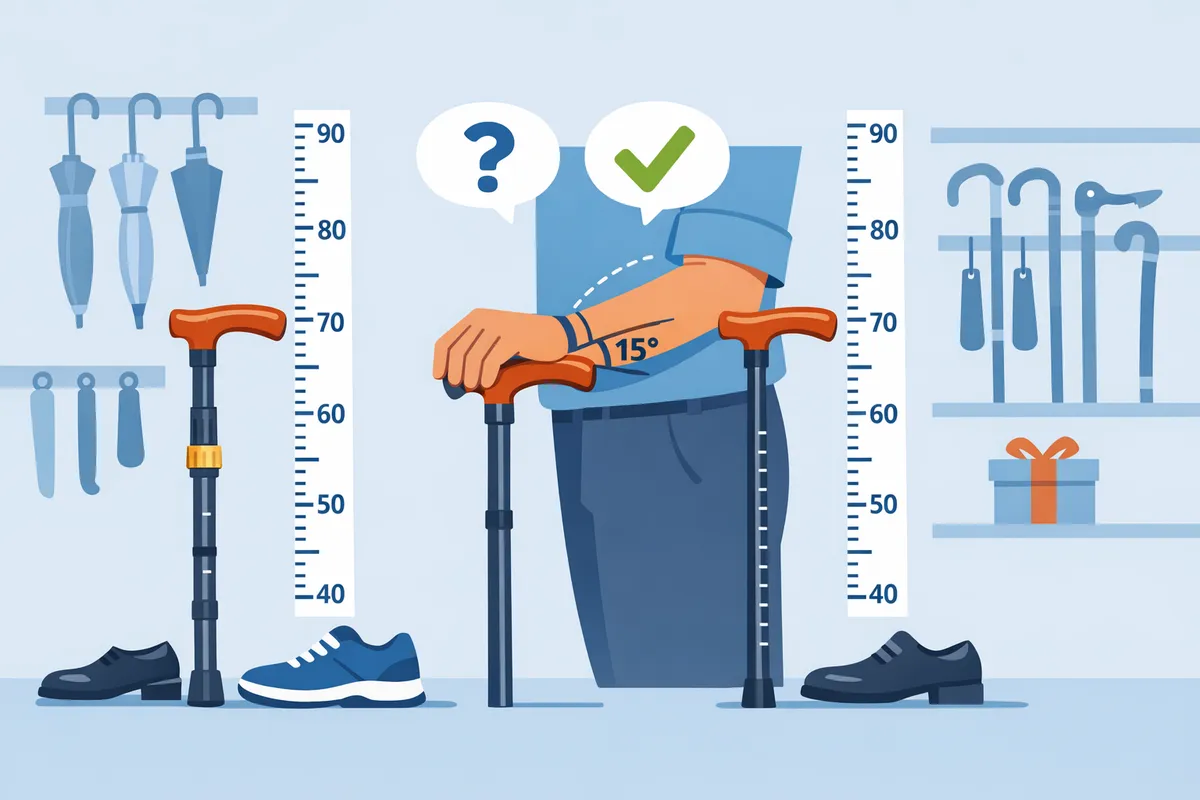
How do I verify cane height with wrist-crease, posture, and footwear?
Verify cane height by checking wrist-crease alignment, confirming a relaxed 15-degree elbow angle, and measuring while wearing the shoes you use most. This three-part check reduces leaning, arm overreach, and shoulder hunch during everyday use. Our Better Canes Umbrellas adjustable models make small corrections simple when tests show the handle sits too high or low.
Wrist-crease method step-by-step 🖐️
The wrist-crease method sets cane height so the handle aligns with the crease of your wrist while your elbow bends about 15 degrees. Follow these steps exactly.
- Stand upright in the shoes you wear for walks or errands. Keep posture natural; do not exaggerate standing taller or slouching.
- Let your arms hang relaxed at your sides and place the cane tip on the floor next to the side of your foot. The cane should sit close to your body, not forward.
- Check where the top of the handle meets your wrist. The handle should line up with the crease where your hand meets your wrist.
- Confirm the elbow angle is about 15 degrees. If the elbow is straight or bent more than 20 degrees, the cane is too short or too long.
- Mark the floor-to-handle distance and compare to your cane. Adjust in 0.5-inch steps until you match.
For example, if someone asks what size cane for a 5'10" man, use half the height plus 0.5 inch: 70 inches / 2 + 0.5 = 35.5 inches. Better Canes Umbrellas adjustable canes let you fine-tune to that measure without guessing.
Adjustments for footwear and posture 👞
Measure cane length while wearing the shoes you walk in most and add 0.5 to 1 inch for thick-soled footwear. Thick soles, platform shoes, and winter boots change the floor-to-handle distance and can make a correctly measured cane feel short.
If you habitually walk with a forward-leaning posture or rounded shoulders, choose an adjustable cane rather than a fixed-length model so you can test small increases. Our Better Canes Umbrellas adjustable canes make 0.5-inch changes practical, avoiding repeated returns and wasted time.
💡 Tip: Measure in the exact shoes you use outdoors. Do not measure in slippers or bare feet unless those are your primary walking footwear.
Seated checks and functional testing 🚶
A properly sized cane keeps your gait balanced, reduces shoulder hunch, and lets you sit and stand without overreaching. After the wrist-crease check, validate the fit with short functional tests.
- Walk 20 to 30 steps on level ground and note whether your torso tilts away from the cane or if you compensate with the opposite leg. Symmetrical steps and level shoulders indicate a good fit.
- Sit in your usual chair and pick the cane up from the side. The correct height lets you reach the handle without bending the torso forward or twisting the hips.
- Try a quick stair or curb descent at slow speed. The cane should support balance without forcing you to lean forward or pull yourself up with the arm.
If tests show leaning or overreach, change the cane height by 0.5-inch increments and retest. Better Canes Umbrellas models simplify these checks because you can fine-tune on the spot.
⚠️ Warning: Using a cane that is clearly too short or too long increases fall risk; stop using the cane for independent ambulation until you correct the length.
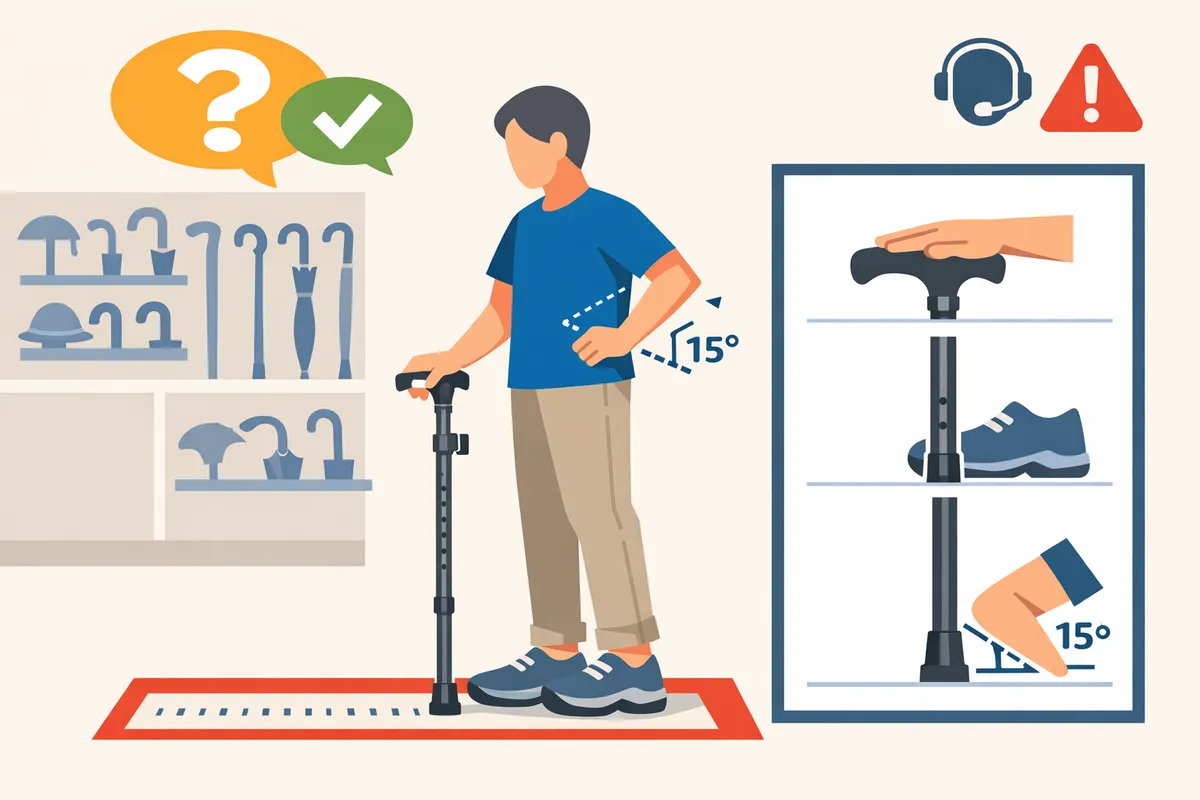
How should I choose and buy the right cane from Better Canes Umbrellas?
Choose an adjustable cane when you are unsure about exact sizing, match the cane type to your main activity, and verify fit with a wrist-crease check while wearing your usual shoes. Better Canes Umbrellas offers adjustable canes, commuter folding sticks, hiking sticks, novelty canes, and shoe-horns so you can match fit, activity, and style while cutting return risk.
Why do adjustable canes reduce sizing risk? 🔧
Adjustable canes reduce sizing risk by providing a length range that covers measurement error and seasonal footwear differences. Adjustable shafts commonly span several inches, so a single cane can fit users who make a half-inch measuring error or who switch between sneakers and heavier shoes. For example, a person 6'2" typically needs a cane around 37.5 inches; an adjustable model that covers 35–39 inches accommodates that measurement plus thicker winter boots. Adjustable mechanisms (spring-pin, twist-lock, or quick-pin) let you fine-tune height in steps as small as 1/2 inch. Better Canes Umbrellas lists adjustable models with clear range specs and locking styles so you can pick the adjustment method that feels secure for daily use. Choosing adjustable reduces the chance of returns, painful misfits, and the wasted hours of exchanging products.
Which cane type should I choose for commuting, hiking, or gifting? 🎁
Pick a cane type by your primary use: compact folding for transit, a stout hiking stick for trails, and a decorative or collectible cane for gifts. Use the table below to compare typical priorities and the Better Canes Umbrellas options that match them.
| Use case | Key features to prioritize | Better Canes Umbrellas options |
|---|---|---|
| Commuter | Compact fold, lightweight, quick open/close | Folding commuter canes with ferrule tips |
| Hiking | Stiff shaft, ergonomic grip, aggressive tip or carbide ferrule | Hiking sticks and telescoping trekking poles |
| Everyday support | Stable base, comfortable handle, single-point or quad tip | Adjustable support canes with derby or offset handles |
| Gift / Novelty | Decorative shaft, collectible finishes, lighter use | Novelty canes and collectible walking sticks |
For a tall user (cane height for 6'2"), choose an adjustable commuter or support cane that can set to ~37.5 inches and still fold or stow for travel.
What should I check when shopping on Better Canes Umbrellas? 🛒
Follow a short buying checklist: measure while wearing your usual shoes, confirm wrist-crease alignment, choose adjustable if you are unsure, select a handle style that fits your grip, and add a shoe-horn if you need dressing help.
- Measure. Stand straight in the shoes you wear most and measure from wrist crease to floor.
- Verify. Hold the cane at your side and confirm the handle lines up with your wrist crease and your elbow bends about 15 degrees.
- Choose adjustability. If your height falls near a boundary or you plan to change shoes, pick an adjustable range that covers at least 1.5 inches above and below your target.
- Pick handle style. Derby handles suit users who need wrist stability; offset and ergonomic handles work for longer walks.
- Add accessories. A shoe-horn from Better Canes Umbrellas reduces bending strain when dressing and pairs well with gift purchases.
💡 Tip: Measure with the shoes you actually walk in. A one-inch boot sole can change recommended cane height and comfort.
Frequently Asked Questions
This FAQ provides short, actionable answers to common cane-sizing and buying questions. Use these quick replies to check a cane height chart by height, verify fit, and decide whether an adjustable model from Better Canes Umbrellas will save you time and risk.
How accurate is the half-height rule for cane sizing? 🧭
The half-height rule gives a reliable starting estimate for most adults. Clinical guidance and practical fitting protocols show the rule places most users within about an inch of their optimal cane length. Our site recommends following the half-height formula, then performing a wrist-crease check and a relaxed 15-degree elbow-angle test to confirm comfort. For example, a person 5'6" (66") starts at ~33.5"; the wrist-crease check commonly adjusts that by 0.5–1 inch. Better Canes Umbrellas lists adjustable options so you can fine-tune fit without repeated returns.
What size cane for a 5'10" man? 📐
A person who is 5'10" typically starts with a cane around 35.5 inches using the half-height plus allowance. Half of 70 inches equals 35, then add roughly 0.5 inch for the starting length. Confirm while wearing the shoes you normally walk in and check that the wrist crease falls near the top of the handle with a relaxed 15-degree elbow angle. Our catalog at Better Canes Umbrellas includes adjustable walking sticks that allow half-inch adjustments so you can match the measurement precisely.
What cane height for 6'2"? 📏
A person who is 6'2" typically starts with a cane around 37.5 inches using the half-height plus allowance. Measure standing in your usual footwear, then perform the wrist-crease and elbow-angle checks to spot needed tweaks. If the wrist crease falls above or below the handle, adjust by 0.5–1 inch until the elbow rests near 15 degrees. Better Canes Umbrellas carries adjustable models that remove guesswork and let you test small changes at home.
Can I safely use a cane shorter or longer than recommended? ⚠️
Using a cane that is too short or too long increases fall risk and adds joint strain. A too-short cane forces forward lean and hip pain; a too-long cane causes shoulder hunch and uneven weight distribution. Choose an adjustable cane if you are unsure or expect footwear changes to avoid time lost on returns and the medical risks of poor fit. Our product pages highlight adjustable walking sticks for customers who want an easy way to dial in the correct length.
⚠️ Warning: Using the wrong cane length raises fall risk and joint pain. Test fit before relying on a cane for daily mobility.
How should I measure my height for the chart? 📏
Measure standing with your back flat against a wall while wearing the shoes you usually walk in; keep your head level and spine straight. Record the nearest full inch and use that number with the cane height chart by height to get a starting cane length. After picking the starting length, perform the wrist-crease test and a 15-degree elbow-angle check to confirm or adjust. Better Canes Umbrellas recommends measuring this way to reduce sizing errors and returns.
Should I buy an adjustable cane or a fixed-length dress cane? 🛍️
Choose an adjustable cane if you expect footwear or health changes or want a low-return-risk purchase; choose a fixed-length dress cane when style and a confirmed measurement are priorities. Adjustable models from Better Canes Umbrellas let you make small, reversible adjustments at home, cutting the hours and cost associated with exchanging ill-fitting sticks. Fixed-length dress canes give a cleaner look but require precise measurement up front, which can lead to reorders if measured incorrectly.
Quick, practical steps to choose the right cane height.
Use this simple cane height chart by height as a copyable starting point for people between 5'2" and 6'4". Follow the verification steps below to confirm fit before buying.
- 5'2" — 33 inches
- 5'4" — 34 inches
- 5'6" — 35 inches
- 5'8" — 36 inches
- 5'10" — 37 inches
- 6'0" — 38 inches
- 6'2" — 39 inches
- 6'4" — 40 inches
- Stand straight with shoes on and relax your arms. 2. Measure from floor to your wrist crease. 3. Test the cane so your elbow bends about 15 degrees while holding the handle. 4. Walk a few steps and adjust if the cane feels too long or short.
💡 Tip: Measure while wearing the shoes you use daily and confirm the wrist-crease check for the most reliable fit.
Better Canes & Umbrellas Inc., founded in 2000 and based in Chatham, NJ, is an online and retail seller focused on umbrellas, walking sticks (including novelty sticks and hiking sticks), and shoe horns. Shop Better Canes & Umbrellas for adjustable walking sticks and set the cane to the measurement above as your first step. Subscribe to the Better Canes & Umbrellas newsletter for sizing tips, fitting videos, and style recommendations.