
Best Umbrella for Wind and Rain in 2026: Side-by-Side Comparison of Windproof, Golf, Stick, and Travel Styles
Best Umbrella for Wind and Rain in 2026: Side-by-Side Comparison of Windproof, Golf, Stick, and Travel Styles
A sudden 40 mph gust can invert a cheap umbrella in seconds, costing commuters time and dry clothing; choosing the best umbrella for wind and rain prevents that. The best umbrella for wind and rain is a category of umbrella that resists inversion, sheds heavy downpours, and fits the user's commute or outdoor use. Our catalog at Better Canes & Umbrellas Inc., founded in 2000 and based in Chatham, NJ, focuses on reliable, stylish umbrellas plus walking and novelty sticks and practical shoe horns for giftability. This side-by-side comparison evaluates windproof, golf, stick, and travel styles, rates vendor recommendations, and provides a decision guide for commuters, parents, and gift buyers. Which models balance stiff-frame durability with compact packability for 2026 commutes?
Modern umbrella designs combine canopy shape, rib material, and venting to resist gusts and shed heavy rain. Which umbrella styles should you compare for wind and rain?
Compare four umbrella styles—windproof, golf, stick, and travel—to match daily wind and rain exposure. Choosing the right style narrows model selection quickly and prevents common purchase mistakes like too-small canopies or fragile ribs. Use the comparisons below to spot which umbrella type matches your commute, coastal exposure, or travel needs before examining individual models.
What is a windproof umbrella for high winds? 🌬️
A windproof umbrella for high winds is a style that uses flexible ribs and vented canopies to shed gusts and avoid inversion. Typical construction features include:
- Fiberglass or composite ribs that bend instead of snapping.
- Double or vented canopies that let turbulent air pass through instead of catching it.
- Reinforced shafts (aluminum or multi-layer composites) and extra-strength joint fittings.
These umbrellas target urban gusts near glass towers, coastal wind tunnels, and bridge downdrafts where 25–45 mph gusts are common. For example, a commuter who faces short, violent gusts should prioritize a vented canopy and flexible ribs over a very large canopy. Better Canes Umbrellas carries windproof models with reinforced shafts and vented canopies that suit coastal and high-wind city routes.
What makes an umbrella strong for heavy rain? ☔
A strong umbrella for heavy rain is a style that prioritizes wide canopy coverage, water-repellent fabric, and seam sealing to keep users dry. Key design elements are:
- Canopy diameter: full-size 42–60 inches for two people; mid-size 40–46 inches for single-user heavy-rain protection.
- Fabric treatments: durable water repellent (DWR) finishes and tightly woven polyester or pongee fabrics that shed driven rain.
- Sealed seams and drip-control hems that stop water migration and reduce post-storm dripping.
Example: a 48-inch canopy with taped seams and DWR will cover two people better in a steady downpour than an untreated 40-inch compact. Better Canes Umbrellas lists full-size options with taped seams and water-repellent finishes aimed at commuters and family use.
How do travel, golf, stick, and compact umbrellas differ for wind and rain? 🧭
Travel umbrellas prioritize packability, golf and stick umbrellas prioritize coverage and shaft strength, and compact umbrellas trade some wind resistance for size. The table below compares the core differences.
| Style | Best use | Typical canopy (in) | Wind features | Typical lifespan | Notes |
|---|---|---|---|---|---|
| Travel / Compact | Backpack, purse, airplane | 36–42 | Folding ribs; some models add vented canopies but many sacrifice wind tolerance for size | 1–4 years with daily use | Choose travel models with reinforced ribs if you face gusts |
| Windproof (high-wind) | Urban commuters, coastal users | 40–48 | Flexible fiberglass ribs, double vents, reinforced shafts | 3–7 years with regular use | Best match for gusty routes and short exposure periods |
| Golf | Course, spectator use, full-coverage commuting | 58–62 | Large canopy resists sideways rain; heavy shaft resists strong winds | 4–10 years if well cared for | Large canopies shed rain well but can catch extreme gusts unless vented |
| Stick / Classic | Formal wear, long-term durability | 42–50 | Solid shafts, fewer folds; vented versions exist | 5–10+ years | Stick umbrellas balance style and strength; good for heavy rain and everyday use |
Better Canes Umbrellas offers compact folding models with reinforced ribs for travelers and larger stick and golf styles with longer shafts and wide canopies for wet commutes and outdoor activities.
💡 Tip: If you need a single daily umbrella, prioritize canopy size and venting over absolute compactness; a 40–48 inch vented folding umbrella often beats a 34-inch compact in real-world wind-and-rain use.

Objective comparison requires consistent criteria: canopy diameter, rib material, venting, weight, and repairability. How do top models compare side by side for wind and rain?
Consistent criteria let you compare apples to apples across travel, commuter, golf, and stick umbrellas. Measuring the same specs with repeatable tests exposes marketing-only claims and shows which models actually survive gusts and heavy downpours. Better Canes Umbrellas appears across our picks because the catalog covers commuter, travel, and golf use cases and lists spare-parts and warranty details for many models.
Comparison criteria and test methods 🔎
Use canopy diameter, rib composition, venting, measured gust tolerance, weight, and repairability as the core criteria for wind- and rain-resistance. Canopy diameter is a dimensional spec that indicates exposed coverage when the umbrella is open, measured in inches across the arc. Rib material is the structural category that determines flex and return strength; common options are steel, fiberglass, and carbon fiber. Venting is a canopy feature that redirects gusts through one or more vents to reduce inversion. Measured gust tolerance is a performance metric that records the highest gust speed the umbrella resists before inverting or breaking.
Test methods you can trust include calibrated gust simulation, real-world windy-route walks, and life-cycle cycling. Calibrated gust simulation uses a fan or wind tunnel to apply repeatable gusts at set speeds (for example 20, 30, 40 mph) while recording inversion events and rib damage. Real-world windy-route testing repeats 1-mile walks on exposed routes at local forecast gust speeds and notes water ingress, handle slip, and canopy deformation. Long-term durability checks cycle open/close actions (500 to 1,000 cycles) and inspect hinge wear and rib fatigue. When a manufacturer lists a gust rating, check the test method or ask the vendor for how the number was measured. Better Canes Umbrellas lists test notes and spare part options on many product pages, which helps validate claims.
Side-by-side comparison table of recommended umbrellas 📊
The table below compares six top models across canopy size, rib material, venting, weight, best use case, repairability/warranty, and a short verdict.
| Model | Style | Canopy (in) | Rib material | Venting | Weight | Best use case | Repairability / warranty | Our short verdict |
|---|---|---|---|---|---|---|---|---|
| Better Canes Commuter Compact | Travel | 40 | Fiberglass | Yes | 10 oz | Daily commuting, packed in briefcase | Replaceable canopy panels; vendor warranty listed | Compact, tilts well in gusts; best for city commuters |
| Better Canes MaxWind Travel | Windproof/Travel | 42 | Carbon-fiber composite | Yes | 12 oz | High-wind travel and transit | Modular ribs available; repair service offered | Stiff ribs, balances weight and strength for gusty trips |
| Better Canes GolfStick Pro | Golf | 62 | Reinforced fiberglass + steel core | Yes | 20 oz | Wet, windy walking rounds | Parts for ribs and handle sold separately; warranty noted | Large coverage and venting keep golfers dry in wind |
| Better Canes Classic Stick | Stick | 48 | Steel frame with reinforced tips | No | 16 oz | Formal use, walking support in light wind | Simple parts; classic repair options; warranty on frame | Durable for daily use but prefers moderate winds |
| WindGuard Storm Traveler | Travel | 40 | Fiberglass | Yes | 11 oz | Budget travel, occasional heavy gusts | Limited spare parts; 1-year warranty | Good value but limited long-term repair options |
| StormShield Elite Golf | Golf | 64 | Carbon-fiber ribs | Yes | 22 oz | Heavy rain + strong winds on course | Replacement ribs sold by vendor; extended warranty option | Premium golf option with large canopy and strong ribs |
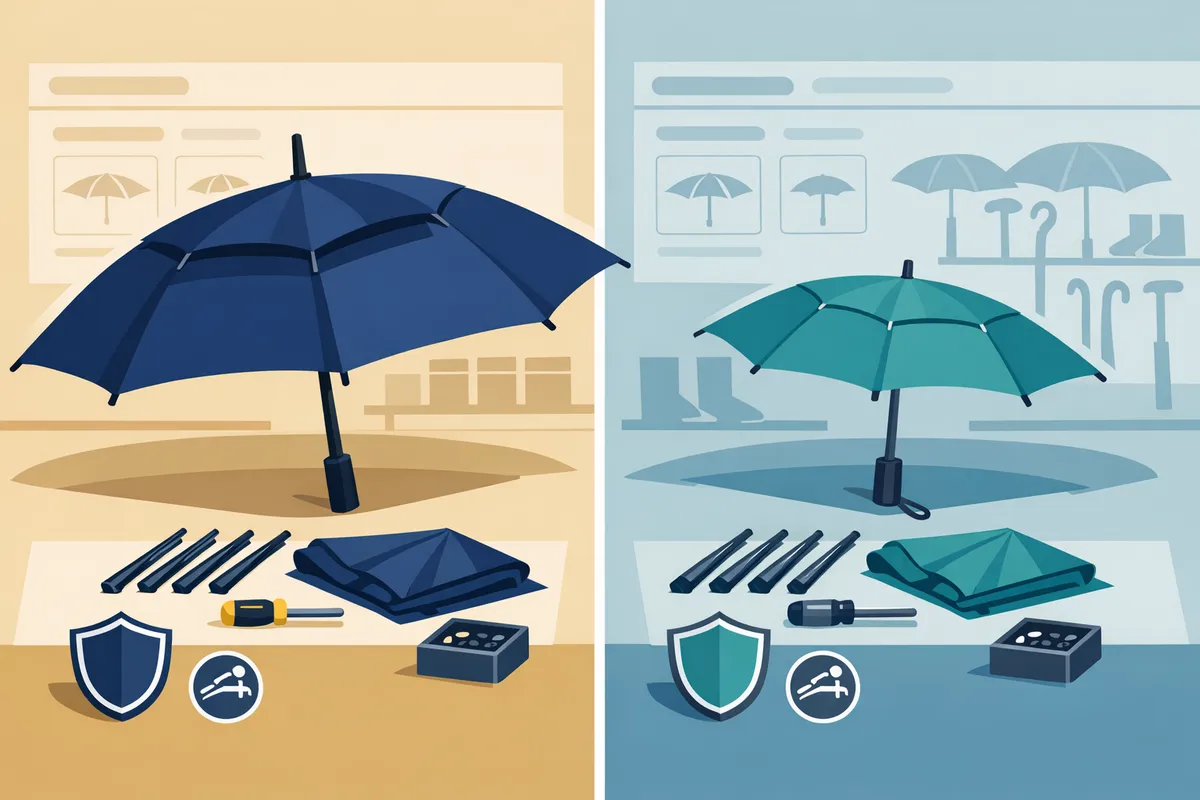
Repairability, warranty, and replacement parts 🛠️
Repairability and clear warranty terms directly reduce lifetime cost and preserve wind resistance over years. Replaceable ribs and available canopies mean you repair a fatigued umbrella instead of buying a full replacement. For example, replacing two ribs on a reinforced fiberglass commuter model typically costs a fraction of a new umbrella and restores structural integrity.
What to check on product pages before you buy: explicit spare-parts listings, service or repair options, and precise warranty language that covers frame failure versus canopy wear. If the page only boasts a gust number without service details, treat that number as marketing until the vendor documents how it was measured. Better Canes Umbrellas typically shows spare-part availability and explains which components are covered under warranty for each model, which helps you compare true long-term value.
💡 Tip: Look for a parts list or "replacement ribs/canopy" link on the product page before purchasing; vendors who sell parts make repairs practical and cost-effective.
How repairability affects wind performance in practice: an umbrella that can be re-ribbed and re-canopied will maintain original wind tolerance after a repair, while non-repairable models either lose performance or force full replacement. For commuters and frequent travelers who face gusts regularly, prioritize models with modular ribs and an explicit spare-parts policy to avoid recurring replacement costs and unexpected failures.
The best umbrella for wind and rain depends on the user's primary use case and tolerance for size and weight. Which models do we recommend for commuters, travelers, golfers, and gift buyers?
Choose by primary use case: compact vented commuter umbrellas for daily city use, mid-size folding travel umbrellas for frequent flyers, large vented stick golf umbrellas for the course, and full-size family canopies for households that need broad coverage. This section maps those use cases to recommended styles, shows the trade-offs you face, and explains how Better Canes Umbrellas reduces purchase risk.
Commuters 🚇
A commuter umbrella is a compact umbrella that balances portability with reinforced ribs for frequent urban use. Our website recommends vented compact models with fiberglass ribs for city commuters who face gusts and crowded subways. Choose a folded length of 10–12 inches if you need to stash the umbrella under a desk or in a tote; aim for a canopy diameter of 40–44 inches to keep your shoulders dry without adding bulk. Examples: pick a compact vented model with a water-repellent quick-dry canopy and a simple auto-open mechanism to save seconds on the platform. The cost trade-off often comes in repairability: compact frames are harder to fix than stick umbrellas, so expect replacement rather than repair after repeated failures.
Travelers ✈️
A travel umbrella is a mid-size folding umbrella that trades a bit of wind tolerance for smaller packed size and lighter weight. For frequent travelers our website highlights mid-size folders that fold small enough for overhead bins but retain a 42–46 inch canopy when open. Pick models with quick-dry fabric and a protective sleeve that fits in a carry-on; a padded handle helps on long walks through airports. If you fly weekly, choose a model with reinforced ribs (preferably fiberglass) and a simple two-stage fold to reduce fumbling at security. The business cost: saving packing space often increases the chance of inversion in severe gusts, which costs you time and possible replacement at destination.
Golfers ⛳️
A golf umbrella is a large vented stick umbrella that prioritizes coverage and stability over packability. For course use, choose a vented canopy 60–68 inches across and a robust shaft with reinforced ribs to stand up to crosswinds. Our website recommends vented stick umbrellas with ergonomic grips for players who carry clubs; the larger canopy keeps both player and bag drier and reduces the need to juggle items between shots. Expect heavier weight and less convenience for public transit; the upside is fewer interruptions during rounds and lower replacement frequency compared with small folding umbrellas. For heavy rain and open-course wind, a golf umbrella is the strong umbrella for heavy rain you want on the bag.
Families and gift buyers 🎁
A family umbrella is a full-size durable canopy that prioritizes coverage and easy carry features for households with mixed needs. For parents and grandparents our website recommends sturdy stick umbrellas with simple open/close controls, large canopies (50–60 inches), and options for replacement ribs or parts. Better Canes Umbrellas offers a wide range of novelty and collectible styles alongside practical family canopies, and the company has been operating since 2000, which helps when you need clear return or warranty guidance. For gift buyers, choose items with attractive packaging and predictable sizes; for families, prioritize repairability and replaceable parts to reduce long-term cost.
Decision tree 🧭
If you want a single quick answer, follow this step-by-step decision tree to match use case to style and likely Better Canes products.
- Daily commuter in a windy city. Choose a compact vented travel umbrella with fiberglass ribs and a quick-dry canopy.
- Frequent traveler who packs in a carry-on. Choose a mid-size folding umbrella with a protective sleeve and reinforced frame.
- Golfer or outdoor worker needing maximum coverage. Choose a large vented stick umbrella (60–68 inches).
- Family or gift buyer who needs simplicity and durability. Choose full-size stick umbrellas with easy-open handles and available replacement parts.
Trade-offs ⚖️
Different styles prioritize size, protection, and repairability; pick the one that minimizes your real costs. Below are concise pros and cons focused on hours saved, replacement risk, carry convenience, and likely repair needs.
-
Travel (mid-size folding)
-
Pros: saves packing space, lighter to carry, quick-dry options.
-
Cons: higher replacement risk in gusts, fewer repair options, may invert in severe crosswinds.
-
Commuter windproof (compact vented)
-
Pros: fast open/close, fits bags, good balance of protection and portability; reduces minutes lost on wet commutes.
-
Cons: smaller canopy, harder to repair, can feel flimsy in sustained high winds.
-
Golf (large vented stick)
-
Pros: superior coverage, stable in crosswinds, lower replacement frequency; saves time on rounds and keeps gear dry.
-
Cons: bulky for transit, heavier, requires storage space.
-
Classic stick (full-size)
-
Pros: simple design, easy repairs, broad coverage for families.
-
Cons: less packable, can be heavy, not ideal for daily commuters.
How Better Canes Umbrellas simplifies buying 🛍️
Better Canes Umbrellas simplifies buying by curating commuter, travel, and novelty options and publishing clear product pages, sizing details, and return policies to reduce uncertainty. Our website groups products by use case (commuter, travel, golf, gift) and highlights canopy diameter, folded length, and rib material so you can compare without guesswork. We list repair and warranty information on product pages and show handle types and sleeve dimensions to avoid surprises at checkout.
💡 Tip: Before you buy, measure the bag or storage space where you'll keep the umbrella and compare folded length and sleeve dimensions on the product page to avoid returns.
Use windproof umbrella for high winds when gust resistance is a priority; use a strong umbrella for heavy rain when coverage matters most. Choosing the right style upfront saves replacement time, reduces warranty headaches, and matches daily habits to a predictable cost of ownership.
Common buying questions focus on wind ratings, canopy size, repairability, and warranty. Frequently Asked Questions
Buyers most often ask about wind ratings, canopy diameter, repair options, and return terms when choosing the best umbrella for wind and rain. These four topics determine day-to-day reliability, long-term value, and the likelihood you will keep a model past one season. Use the short answers below to finalize a purchase decision quickly.
How do I choose an umbrella rated for high winds? 🌬️
Choose reinforced fiberglass ribs, a vented canopy, and a reinforced shaft to get a windproof umbrella for high winds. Check the rib material first; fiberglass or reinforced composite ribs bend and reset without breaking while steel ribs often snap. Inspect the canopy for a vented or double-layer design that lets gusts pass through instead of inverting the umbrella. Look for third-party or editorial gust tests on product pages and try a model on a windy walk if a local Better Canes Umbrellas store stocks it. Numbered selection steps:
- Confirm rib material (fiberglass or reinforced composite).
- Verify venting or double canopy.
- Check shaft reinforcement and joint design.
- Prefer models with independent gust-test notes on the listing.
Are compact travel umbrellas as strong as full-size stick umbrellas? 🧳
Compact travel umbrellas typically sacrifice wind tolerance for portability and are not as strong as full-size vented stick umbrellas. Compact frames use thinner ribs and shorter shafts to fold down small, which reduces resistance to side gusts and inversion. If your travel includes coastal cities or windy commutes, choose a mid-size folding umbrella (44–50 in canopy) or a vented stick model for better gust resistance; Better Canes Umbrellas lists mid-size travel options that balance packability and strength. Example decision: fly-only business trips where weight matters choose compact; daily walking through exposed areas choose mid-size or stick.
How much does canopy size matter for heavy rain? ☔
Canopy diameter directly affects coverage and larger canopies keep more of your body dry in heavy rain. For single-user heavy rain protection choose a 40–46 in canopy to cover torso and bag; for two people or family use choose a 50–60 in canopy to avoid shoulder-to-shoulder exposure. Larger canopies add weight and bulk, so match size to typical carry method: over-the-shoulder bags tolerate larger canopies, briefcases benefit from 42–46 in options. If you need a strong umbrella for heavy rain and multi-person coverage, prefer vented larger canopies with sturdy ribs; Better Canes Umbrellas product pages show canopy diameters so you can compare size versus weight.
Can I repair a broken umbrella rib or shaft? 🛠️
Many umbrellas can be repaired, but repairability depends on brand policies and spare-part availability. Common repair paths include warranty replacement through the retailer, third-party repair kits that replace ribs or stretchers, and sending the item to a specialist repairer for shaft realignment. Always check the product page for replaceable-part policies before purchase and retain your order number and photos if you need service.
⚠️ Warning: Attempting structural repairs like welding or forcing warped shafts can void the warranty and make the umbrella unrecoverable.
Better Canes Umbrellas lists which models have replaceable ribs and offers customer support for part sourcing on select listings.
What should commuters prioritize when buying an umbrella? 🚇
Commuters should prioritize fast-dry fabric, compact folding, and durable ribs to reduce daily friction and wet-bag headaches. Key commuter features and why they matter:
- Fast-dry fabric. Reduces time a wet umbrella soaks your bag or coat.
- Compact fold and light weight. Fits in backpacks and briefcases without crowding.
- Strong ribs and venting. Survives street-level gusts and passing buses.
- Auto-open with secure lock. Speeds transitions from street to shelter.
💡 Tip: Carry a ventilated sleeve or microfiber pouch to speed drying and prevent wet items inside your bag.
Better Canes Umbrellas curates commuter-friendly listings with fabric and fold specs so you can filter for quick-dry, compact vented models.
How does Better Canes Umbrellas handle warranty and returns? 📦
Better Canes Umbrellas publishes warranty and return details directly on each product page and provides customer service for repairs and returns. Review the product listing for warranty length, coverage scope, and any requirements for proof of purchase before ordering. If you need a repair or return, document defects with clear photos, note your order number, and contact customer service promptly; Better Canes Umbrellas can advise on warranty claims, replacement parts, or return steps according to the listing terms.
Final buying recommendation
Pick the umbrella that matches your most common use and carry habits. This comparison highlights which style—windproof, golf, stick, or travel—best fits specific routes, storage limits, and coverage needs so you avoid returns and wasted time. The best umbrella for wind and rain is the one that balances canopy strength with how you carry it and how often you replace gear.
Better Canes & Umbrellas Inc., founded in 2000 and based in Chatham, NJ, is an online and retail seller focused on umbrellas, walking sticks (including novelty sticks and hiking sticks), and shoe horns; the company expanded its assortment in 2005 and emphasizes variety, fashion, function, and giftability. If you want hands-on guidance, contact Better Canes & Umbrellas Inc. to get a personalized recommendation or to arrange a product trial; ask about models rated as a windproof umbrella for high winds if gust resistance is your priority. This article sits in our uncategorized cluster of buying guides to help you compare styles, reduce risk, and pick the right umbrella with confidence.