
ASTM F3681 Beach Umbrella Safety Standard
ASTM F3681 Beach Umbrella Safety Standard
A sudden gust can flip an unsecured beach umbrella in seconds, turning a beach day into a safety risk. ASTM F3681 beach umbrella safety standard is a testing specification that defines anchoring, wind-resistance, canopy strength, and labeling requirements for consumer beach umbrellas. This FAQ-style guide explains what ASTM F3681 requires and gives shoppers and retailers actionable verification, buying, and post-purchase steps to avoid product failures and compliance headaches. Better Canes & Umbrellas Inc., founded in 2000 in Chatham, NJ, lists commuter, travel, and beach umbrellas on our site and shows simple compliance checks to help customers choose safe, stylish options. Which inspection steps catch the most common failures?
What does ASTM F3681 cover for beach umbrellas?
ASTM F3681 beach umbrella safety standard specifies performance, labeling, and assembly requirements for complete umbrella systems, including the canopy, pole, anchor or base, and the instructions sold with the product. The standard tells shoppers which parts manufacturers must test and label so buyers can compare systems on real performance criteria instead of marketing claims.
What is ASTM F3681-24 and how does it define an umbrella system? 🏖️
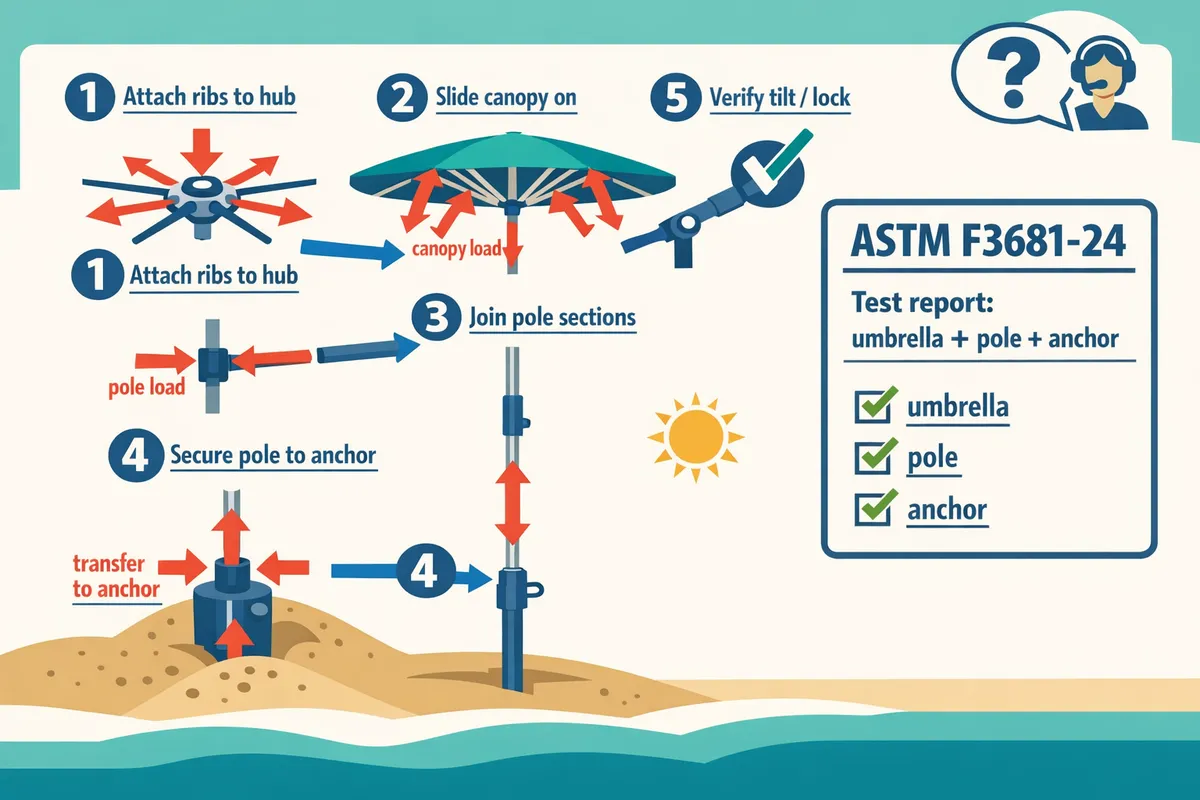
ASTM F3681-24 is a safety standard that sets passing criteria and labeling requirements for beach umbrella systems. The standard defines an umbrella system as the canopy plus the pole, any anchor or base sold with the umbrella, and the included assembly and use instructions. That means a product sold without an anchor or with an aftermarket anchor is not the same tested system. Shoppers should expect packaging or a technical sheet to name the anchor type and the exact assembly steps used during testing. Better Canes Umbrellas lists which items include an anchor and provides the assembly details customers need to verify that the sold combination matches the tested system.
Which tests in the standard matter most to shoppers? 🌬️
Anchor pullout and overturn tests matter most to shoppers because they reproduce the real failure modes that cause umbrellas to detach or flip in gusts and steady wind. The tests a buyer should ask about or look for on a product sheet include:
- Static lateral load test. Shows how much sideways force the anchor resists before the pole shifts.
- Dynamic gust simulation. Replicates sudden wind gusts to expose anchors that slip under impact.
- Pullout depth and force measurement. Confirms the anchor depth used in testing and the force required to remove it from sand.
- Overturn torque test. Measures the moment at which the umbrella will tip over with a given anchor.
Ask the retailer for pass/fail results plus the test conditions (sand type, anchor depth, and whether the base was sand-filled or weighted). Better Canes Umbrellas customer service can provide those details for models that were tested.
💡 Tip: Request the test report or a summary that lists the anchor model, sand density used, and the pass/fail outcomes before you buy.
How does ASTM F3681-24 differ from previous versions? 📝
ASTM F3681-24 raises some test thresholds and tightens labeling and documentation compared with earlier editions. Key buyer-visible changes include clearer requirements to state the standard version on packaging, explicit labeling of which anchor or base was used in testing, and stricter documentation of assembly steps (for example, required anchor depth and fill weights if applicable). Manufacturers now must tie any wind-performance claim to the exact system tested, so you should see statements like "Tested with X anchor at Y depth per ASTM F3681-24" on compliant products. If you own an older umbrella, its packaging may reference an earlier edition; that does not mean it is unsafe, but it does mean the original tests used different thresholds. Better Canes Umbrellas updates product listings to show the tested combination and the standard edition when applicable.
How can shoppers and retailers verify an umbrella claims ASTM F3681 compliance?
Check the label for an explicit "ASTM F3681-24" reference and verify a matching test report that lists the tested umbrella, pole, and anchor configuration. Verifying those two items cuts through vague marketing claims and shows whether the product was measured against the correct test modes. Below are practical steps, a printable five-step checklist you can use in-store, and a comparison table of common base and anchor types against the standard's test modes.
How do I read labels and marketing claims? 🏷️
A valid compliance claim names "ASTM F3681-24" and cites a test report or certificate number. Strong label phrases to look for include: "Tested to ASTM F3681-24," "Certified per ASTM F3681-24," or "Test report no. [ID] from [lab name]." Vague language such as "wind resistant," "storm tested," or "meets safety guidelines" without the standard name or a report ID does not verify compliance.
Look for the tested configuration on the label or packaging: it should state the pole diameter, pole length, canopy size, and the exact anchor or base type. At Better Canes Umbrellas we display compliance documents on product pages for models that passed testing; ask a sales associate to show the certificate when shopping in-store.
⚠️ Warning: If the label lists only internal testing or lacks a lab name and report ID, treat the claim as unverified.
What documentation should sellers provide? 📄
Sellers must provide a test report or lab certificate that references "ASTM F3681-24" and lists the exact umbrella, pole, and anchor configuration tested. A test report is a document that records laboratory procedures, measured forces, pass/fail results, and the specific sample configuration used in testing.
Key fields to check on a report: lab name and accreditation, report or certificate ID, test date, explicit reference to "ASTM F3681-24", description of the tested assembly (pole, canopy, anchor or base), and test mode results (lift-off, pull-out, tilt). Red flags include missing anchor details, tests run on a different pole length or canopy size than the sold product, or reports labeled "manufacturer testing" without an independent lab. Better Canes Umbrellas makes manufacturer test reports available on request for models that claim compliance; ask customer service for the report PDF and confirm the certificate ID before purchase.
What is a simple 5-step compliance checklist shoppers can use? ✅
Use this five-step checklist at point of sale: check the label for 'ASTM F3681-24', request the test report, confirm the tested anchor matches the sold kit, verify assembly instructions match the tested configuration, and record the seller's certificate ID. Carrying out these steps reduces the risk of buying a product that performs differently than advertised.
Printable checklist (copy or photograph this at the store):
- Label: Look for exact text "ASTM F3681-24" on the box or tag.
- Report: Request the test report or certificate and note the report ID and lab name.
- Configuration match: Confirm the report lists the same pole length, canopy size, and anchor/base as the product on the shelf.
- Instructions: Open the instruction sheet and verify installation steps match what the report describes (e.g., anchor depth, sand-fill weight, assembly order).
- Record keeping: Photograph the certificate ID, seller name, date, and any warranty or return information.
💡 Tip: If buying online from Better Canes Umbrellas, save the product page screenshot plus the certificate ID and email it to customer service so you have a purchase-time record.
How do common bases and anchors compare for wind performance? 🌊
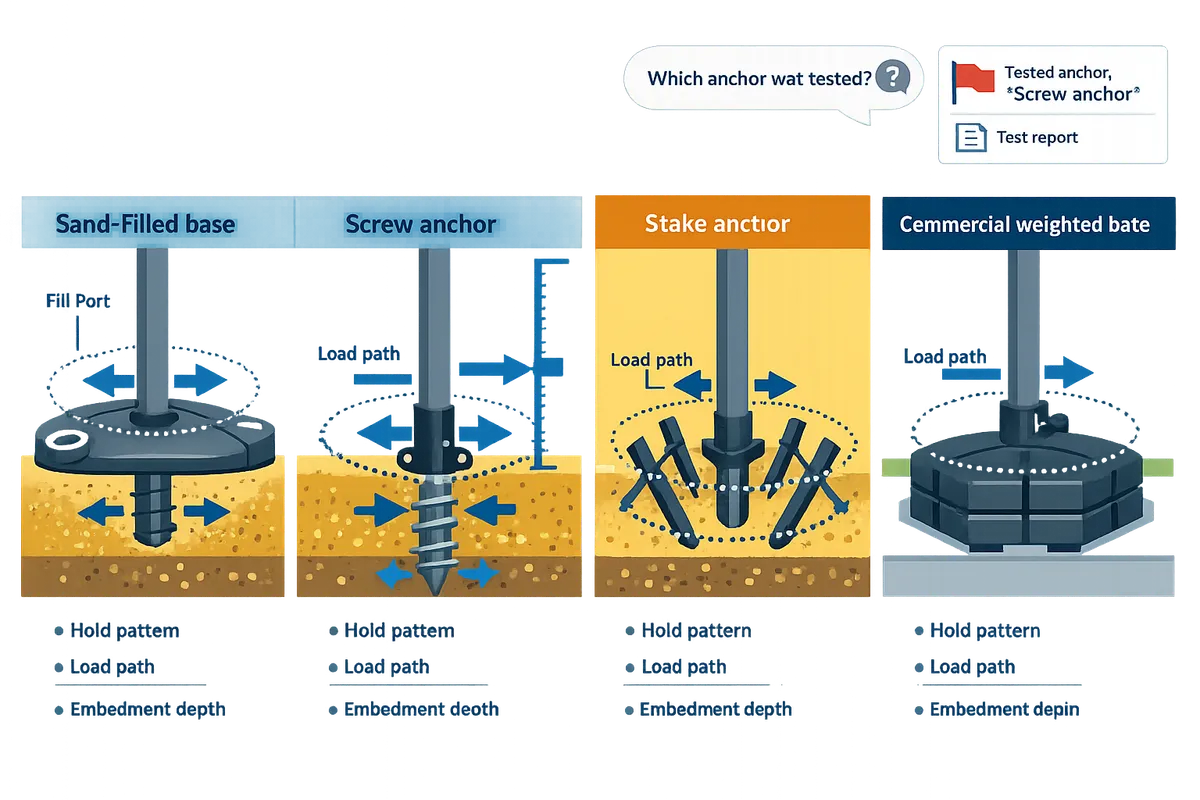
This table shows which base types most closely meet the "ASTM F3681-24" test modes and typical wind-claim ranges. Below the table we add practical buying notes tied to common failure points.
| Base / Anchor type | Weight / hold pattern | Typical wind-claim range (vendor claims) | Pros | Cons | ASTM F3681 test-mode performance |
|---|---|---|---|---|---|
| Sand-filled portable base | Variable; depends on fill amount (sand or water) | Vendors often claim equivalence to 15–75+ lb when filled | Portable, easy to ship, inexpensive empty | Performance varies with fill, user error in filling and compaction | Inconsistent. Passes when fill and compaction match tested condition; fails if underfilled or instructions differ |
| Screw (auger) anchor | Concentrated deep-hold in sand | Sellers typically claim 20–40 mph equivalence depending on design | Good vertical pull resistance, compact to carry | Requires correct installation depth and technique | Performs well in pull-out modes if installed to tested depth; poor if installed shallow or in soft sand |
| Stake anchor (rebar-style) | Surface-to-shallow embedment, lateral resistance | Often marketed for light winds, 15–30 mph | Low cost, quick setup | Limited lift resistance; susceptible to sand erosion | Generally fails higher-load tilt and pull tests unless used with additional ballast or tie-downs |
| Weighted commercial base (concrete or engineered slab) | High static weight, broad footprint | Vendors claim higher ranges; used in commercial rentals | Strong hold, consistent performance when heavy | Bulky, less portable, often needs handling equipment | Best performance in ASTM test modes when the base and attachment mirror the tested assembly |
Practical notes: reports that pass ASTM F3681-24 always list the anchor type and installation steps used in testing. A sand-filled base will only meet the standard if the report specifies fill weight and compaction method. Screw anchors require specified embedment depth. Better Canes Umbrellas flags the tested anchor type on product pages so you can compare the sold kit to the tested assembly.
What should buyers and retailers do after purchase to keep umbrellas compliant and safe?
Follow the label instructions, retain the test report, and use the exact anchor/base and installation method the umbrella was tested with. ASTM F3681-24 ties the safety claim to a specific umbrella, pole, and anchor configuration, so changing any one piece can void the tested performance.
How should retailers display compliance and label language? 🏷️
Retailers must show the ASTM F3681-24 reference and the test report identifier on shelf tags and in the online product description. Displaying both items reduces buyer confusion and supports traceability during returns or incidents. Practical shelf copy that cuts legal exposure and helps customers make the right choice includes the standard reference, test report ID, and the tested configuration.
Suggested shelf tag text (short):
- ASTM F3681-24 compliant. Test report ID: [report number]. Includes matched anchor kit.
Suggested online product-description block (concise):
- ASTM F3681-24. Test report ID: [report number]. Tested configuration: canopy size, pole diameter, anchor model. See packaging for installation steps. Contact customer service for the full test report.
Our product pages for Better Canes Umbrellas present this wording prominently above the fold and repeat the test report ID in the specification table. That practice reduces disputes and the number of returns caused by buyers substituting the wrong anchor.
What user instructions preserve tested performance? ⚠️
Users must install the anchor exactly as shown on the label and use only the anchor type and size listed in the test documentation. Common user errors include swapping to a lighter anchor, failing to insert the pole to the tested depth, and setting the canopy angle outside the tested range; each error changes the load path and reduces wind resistance.
Practical packaging and signage items to prevent user error:
- A single-panel installation diagram showing insertion depth markers and the allowed canopy angle (use a photo with a ruler or notch marker).
- A short checklist on the box: "Use included anchor, insert to marker, tighten collar, do not tilt beyond X degrees." Use plain-language markers like "insert to notch A."
- A QR code or short URL to the test report and an installation video.
⚠️ Warning: Replacing the tested anchor or inserting the pole less than the indicated depth voids the ASTM F3681-24 performance claim and increases failure risk.
Our customer service at Better Canes Umbrellas will email the tested installation steps on request and offers replacement anchor kits that match the original test configuration.
When should a model be removed from sale or recalled? 🔁
Remove a model from sale if the manufacturer withdraws the test certificate, if post-market incidents reveal a failure mode outside the original test report, or if required anchor components are no longer available as sold. These are objective trigger points that warrant immediate action by retailers to protect customers and limit liability.
Practical steps for retailers when a trigger occurs:
- Halt new sales and remove online listings.
- Quarantine existing inventory and tag it as "do not sell."
- Gather documentation: original test report, sales records for the model, incident reports, and any manufacturer notices.
- Notify customers who bought the model if a safety issue or recall applies; offer replacement, refund, or matching anchor kit as appropriate.
Record-retention recommendation: keep the model's test report and related sales/incident records for the model lifecycle plus two years after the last unit sale to support any post-market inquiries. Better Canes Umbrellas will delist a product immediately if the test certificate is withdrawn and will provide customers with next-step options.
How does Better Canes Umbrellas help buyers choose compliant beach umbrellas? 🛍️
Better Canes Umbrellas displays ASTM F3681-24 labeling, provides test report identifiers on product pages, and bundles the matching anchor kit with compliant umbrellas. According to Better Canes Umbrellas, clear labeling and matching anchors cut returns and customer confusion by making the tested configuration obvious before purchase.
What we do on the product page:
- Prominent ASTM F3681-24 callout with the test report ID in the specifications section.
- Clear note when an umbrella requires the included anchor kit to meet the listed wind performance.
- Customer service can provide the full test report or an installation video by email on request.
Our retail staff (online and in-store) explain the most common setup mistakes and recommend the bundled anchor kits for buyers who want the tested performance without guesswork. Our long operating history since 2000 makes providing test documentation and buyer guidance a standard part of order support.
Frequently Asked Questions About ASTM F3681
ASTM F3681-24 is a testing specification that defines performance, labeling, and assembly requirements for complete beach umbrella systems. This FAQ answers the short verification and buying questions shoppers and retailers type into search boxes and shows what to check before you buy or stock umbrellas.
Does "wind-resistant" on a box mean the umbrella meets ASTM F3681? 🌬️
No. "Wind-resistant" on packaging is a marketing claim unless the label explicitly cites ASTM F3681-24 and a matching lab test report. Ask the seller for the lab report number and confirm the tested anchor or base is the exact accessory included with the sale. If you shop with Better Canes Umbrellas, request the report before purchase and check the product page for the tested configuration and installation instructions.
💡 Tip: When a seller provides a test report, verify the lab name, report ID, report date, and the SKU or model number that was tested.
Can I test an umbrella at home to check ASTM F3681 compliance? 🧪
No. Consumers cannot reproduce ASTM F3681-24 lab conditions reliably at home. A beach-side pull or gust test can reveal obvious failures but cannot stand in for an accredited lab report tied to the exact umbrella, pole, and anchor configuration. Better Canes Umbrellas publishes QA details for models we stock; treat any at-home test as informal confirmation, not certification.
Does ASTM F3681 apply only to anchors or to entire umbrella assemblies? 🧰
ASTM F3681 applies to the complete umbrella assembly, including canopy, pole, anchor or base, and the instructions. The test certificate lists a specific configuration; using a different pole, base, or installation method voids the claim. Better Canes Umbrellas labels product pages to show which anchor or base was part of the tested assembly when relevant.
If a product lists ASTM F3681-24, what should I ask for next? 📄
Request the lab test report or certificate ID and confirm the tested anchor/base is included with the sale. Verify the report date and lab name, compare the tested SKU to the SKU you will receive, and confirm the installation steps in the user instructions match the test setup. Better Canes Umbrellas can supply the certificate ID for items we stock and explain what was included in the tested configuration.
Will older umbrellas meet ASTM F3681-24 if they were sold before the 2024 revision? 🕒
Not necessarily. Products tested to a prior edition may not meet the updated thresholds in ASTM F3681-24. Check whether the manufacturer re-tested the model or issued an addendum that covers the 2024 revisions before relying on older documentation. If you carry older inventory, Better Canes Umbrellas recommends flagging models that lack a current certificate and either re-testing or updating packaging and online listings.
How should I record compliance info for a retail audit? 🗂️
Keep a retrievable file for each SKU containing the test report PDF, the product page or packaging image showing "ASTM F3681-24", and any seller certificates. Store the report ID and lab name in your inventory notes, attach scanned copies to the SKU record, and note which anchor or base shipped with each batch. Better Canes Umbrellas advises linking the certificate ID to the SKU and retaining test reports for the life of the model.
Follow these steps to verify, buy, and maintain a beach umbrella that complies with ASTM F3681.
The ASTM F3681 beach umbrella safety standard specifies anchoring, wind-resistance, and labeling requirements so shoppers and retailers can confirm a model meets minimum safety tests. Check for a visible compliance statement, manufacturer test reports, and recommended anchoring depth before purchase.
- Inspect product labeling and request test documentation from the seller.
- Choose a model with clear anchoring guidance and a design suited to your typical beach conditions.
- After buying, set up and test anchoring in calm conditions and follow the label’s wind limits and maintenance steps.
💡 Tip: Test your umbrella’s anchoring in shallow sand at home and keep a tether or weight on hand for windy days.
Better Canes & Umbrellas Inc., founded in 2000 and based in Chatham, NJ, is an online and retail seller focused on umbrellas, walking sticks (including novelty sticks and hiking sticks), and shoe horns. Browse Better Canes & Umbrellas to compare travel umbrellas that meet ASTM F3681 and pick the right model for commuting or beach use. Subscribe to the Better Canes & Umbrellas newsletter for buying guides, care reminders, and safety updates.