
ASTM F3681-25 Changes: Beach Umbrella Safety 2026
ASTM F3681-25 Changes: Beach Umbrella Safety 2026
A poorly anchored beach umbrella can become a dangerous projectile on crowded shores. ASTM F3681-25 changes are updates to the ASTM safety standard that tighten umbrella stability, anchoring, and labeling requirements for 2026. This best-practices guide explains the specific changes in ASTM F3681-25, what they mean for manufacturers and retailers, and how retailers and consumers should respond; it is part of our UPF Umbrella Standards coverage. Better Canes Umbrellas, founded in 2000 and based in Chatham, NJ, is our online and retail store for commuter and compact umbrellas, walking and novelty sticks, and shoe horns, so these requirements will affect our product labeling and merchandising. Which canopy styles—from compact commuter models to beach-fashion designs—may need redesign or relabeling to meet the new rules?
What specific requirements does ASTM F3681-25 add or change for beach umbrellas?
ASTM F3681-25 tightens anchoring, wind-resistance tests, and labeling requirements for consumer beach umbrellas. These changes add explicit tests for common anchoring methods, raise clarity on wind thresholds, and require more specific on-product instructions. Retailers and manufacturers should use the delta below to prioritize retesting, relabeling, and updated product messaging for affected SKUs, including lines sold by Better Canes Umbrellas.
What is ASTM F3681-25 and how does it differ from prior editions? 📝
ASTM F3681-25 is a voluntary ASTM standard that updates performance test methods, anchoring criteria, and labeling for beach umbrellas. The edition narrows tolerances in anchoring pull-out and overturn tests and specifies calibration and apparatus details that F3681-24 left more flexible. Key high-level changes include: stricter validation of common anchoring methods (for example, screw augers and spiral anchors), clearer wind-resistance descriptors on labels, and a new requirement to document repeat-use durability for anchors and bases. For product teams at Better Canes Umbrellas, this means prioritizing models that claim "wind resistant" or ship with anchors for retesting first. For example, a large sunshade sold with a spiral-anchor kit must be tested under the new pull-out and lateral-load sequences rather than the older single-load check.
Which products and materials are explicitly affected by the new edition? 🌊
F3681-25 applies to consumer beach umbrellas, anchoring devices intended for outdoor sunshade use, and accessories marketed with wind performance claims. Affected SKUs include:
- Standard beach umbrellas (all canopy sizes).
- Anchors and augers sold separately or as kits.
- Umbrella-plus-base or umbrella-plus-anchoring-device bundles.
- Novelty or multi-use umbrellas that are marketed for outdoor beach use (these often escape retesting).
- Accessories that claim wind resistance, such as sandbags or tethering straps.
Materials commonly implicated in test failures are fiberglass ribs (breakage), thin-walled aluminum poles (bending), and lightweight anchor alloys (pull-through). Retail managers should flag every SKU that claims wind performance or ships with an anchor for lab testing and updated labels. Expect a voluntary adoption window; most retailers plan 6–12 months to retest inventory and update packaging.
💡 Tip: Prioritize novelty and multi-use umbrellas for retesting — they frequently lack recorded test data and can create customer-safety liabilities.
Delta table: F3681-24 vs F3681-25 (requirements, tests, labeling) 📊
The table below summarizes the main clause differences, practical impacts for retailers, and recommended actions for compliance.
| Clause | F3681-24 | F3681-25 | Practical Impact for Retailers | Action Needed |
|---|---|---|---|---|
| Scope | General performance guidance for beach umbrellas and fixtures. | Narrower scope that explicitly covers consumer beach umbrellas, anchoring devices, and accessories claiming wind performance. | More SKUs fall clearly under the standard, including some novelty and multi-use items. | Inventory audit to tag SKUs that now fall inside scope; retest tagged items. Mention Better Canes Umbrellas models flagged for attention. |
| Anchoring tests | Simple pull or lateral load tests; apparatus loosely defined. | Specific pull-out, lateral, and cyclic load sequences for common anchoring methods; requires documented test setups. | Anchors previously tested under basic loads may fail the new cyclic or lateral sequences. | Retest anchors, especially screw augers and spiral anchors, using the new sequences. Update product pages to state tested anchoring method per ASTM F3681-25. |
| Wind thresholds | Descriptive thresholds; some ranges recommended but inconsistent. | Defined wind-effect criteria with test speeds and failure definitions tied to overturn or uncontrolled flight. | Products with "wind resistant" claims must reference tested thresholds. | Remove vague wind claims until testing completes; add tested wind-speed guidance on labels. |
| Test apparatus | Broad apparatus descriptions; calibrations recommended. | Detailed apparatus dimensions, calibration steps, and specimen mounting instructions. | Third-party labs will require stricter setup; DIY or informal testing may be invalid. | Use accredited labs that follow the new apparatus specs. Keep lab reports on file for customer or regulatory queries. |
| Required labels | Basic instruction and caution fields suggested. | Mandatory label fields: tested anchoring method, maximum recommended wind speed, repeat-use advisory, and consumer-installation steps. | Packaging and online product pages must show specific fields rather than generic warnings. | Redesign labels and product pages to include required fields. Train customer service to explain anchor type and wind limits. |
| Consumer instructions | General anchoring guidance often suggested. | Prescriptive installation steps tied to tested anchoring method and a warning about conditions that exceed tested limits. | Poor or generic instructions will no longer match the standard's intent and could increase liability. | Update instruction sheets and quick-start cards. Offer clear video or photo guidance on installation for common sand types. |
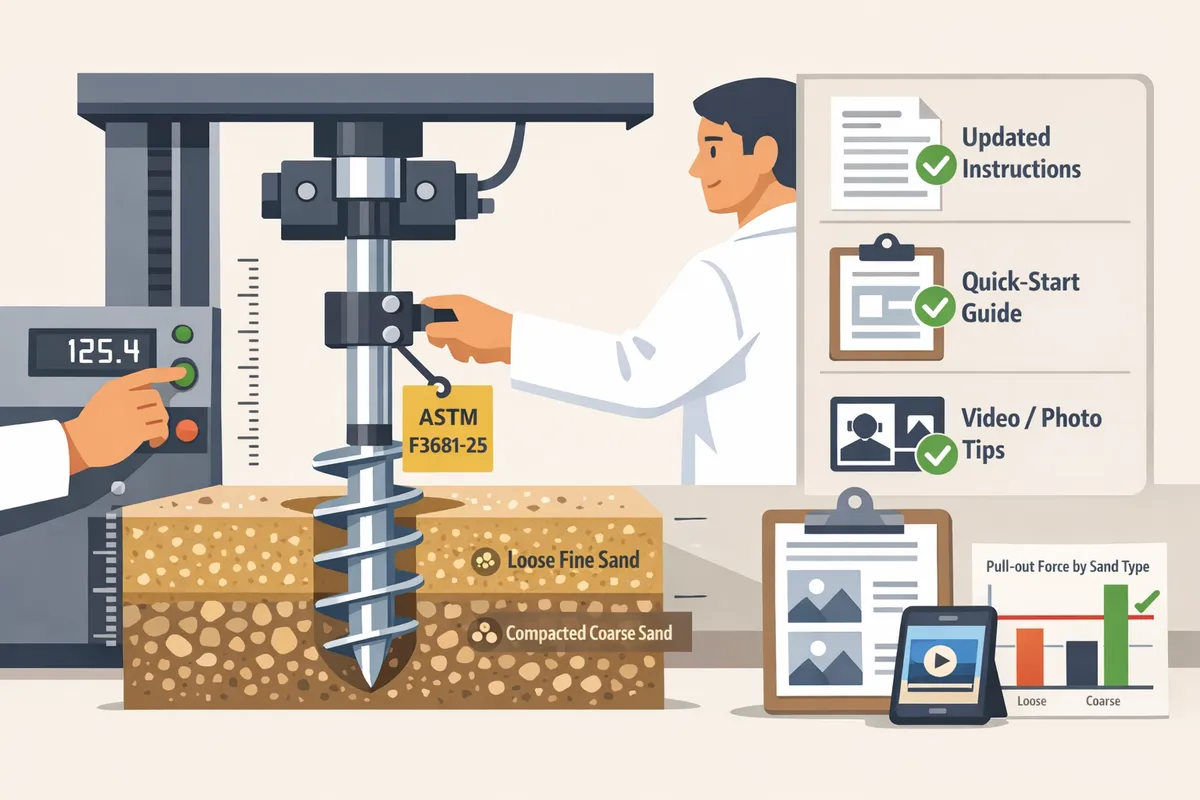
How should retailers and manufacturers change testing, labeling, and product copy to meet ASTM F3681-25?
Retailers and manufacturers must update testing, labels, and product copy to document compliance with ASTM F3681-25's tightened anchoring and wind-resistance requirements. ASTM F3681-25 is a safety standard that adds explicit tests for common anchoring methods and clarifies wind-performance thresholds. Prioritize anchoring and wind tests, revise on-label and online language to state tested conditions, and keep dated records to support CPSC inquiries or customer safety questions.
Which tests should you run first and why? 🔬
Prioritize anchoring performance and wind-resistance tests because ASTM F3681-25 raises minimums and adds explicit anchor-method tests. Start with an anchoring-method matrix that tests the SKU in its most realistic use state (for example, compact sand with a screw-augur-style anchor, loose sand with a fluke anchor, and packed sand with a stake). Next run a gust-simulation wind test on the same worst-case configuration, then a static pull/tilt test to verify retention under load.
For limited budgets run a worst-case SKU sample per construction family (canopy size, pole diameter, and anchor type). Use ISO/IEC 17025–accredited labs or consumer-products test houses experienced with ASTM standards. According to Better Canes Umbrellas, retesting top-selling commuter and beach models first reduces recall risk and protects customer trust. Keep a labeled test-report template to speed audits and supplier requests.
How to update labels, packaging, and online product copy to reflect ASTM F3681-25 🏷️
Labels and online copy must state the exact tested conditions, safe-use limits, and the standard edition (ASTM F3681-25) rather than broad marketing claims. Include a short, readable label block that lists: tested anchor method, tested surface type, tested wind-condition descriptor (e.g., gust profile), the test date, and a link or reference to the test-summary location.
Checklist for product pages and packaging:
- Required label elements: tested anchor method, tested surface, test date, "Tested to ASTM F3681-25."
- Recommended page copy: "Anchoring tested using screw-augur anchor in compact sand; see test summary."
- Editing rule: remove claims like "windproof" or "will not blow away."
| Example claim type | Weak wording (change this) | Compliant wording (use instead) |
|---|---|---|
| Marketing | "Windproof umbrella" | "Tested to ASTM F3681-25 for anchoring using screw-augur in compact sand" |
| Safety promise | "Safe to use in strong winds" | "Not for use in sustained gale conditions; see tested conditions" |
⚠️ Warning: Do not publish specific wind-speed guarantees on product pages unless the claim exactly matches an accredited test protocol and report. Misstated wind speeds trigger CPSC beach umbrella safety guidance and recalls more quickly.
According to Better Canes Umbrellas, product pages that state tested conditions and link to a downloadable test summary reduce customer returns and friction with regulators.
What documentation should retailers keep to reduce recall and liability risk? 🗂️
Keep dated test reports, supplier declarations of conformity, production lot IDs, and archived product-page snapshots to support due diligence and rapid response to safety complaints. Retain primary test reports and supplier declarations for at least five years after the last production run for a SKU; keep marketing and product-page snapshots for three years or until two years after discontinuation.
Minimum record set:
- Laboratory test reports (raw data and summary) — retain 5 years.
- Supplier declaration of conformity and purchase orders tied to lot numbers — retain 5 years.
- Label artwork, packaging proofs, and product-page HTML/text snapshots — retain until 2 years after SKU discontinuation.
- Customer-service logs for safety complaints and the corresponding test-report references — retain 3 years.
💡 Tip: Store scanned test reports in immutable storage and log who accesses them. That audit trail simplifies responses to CPSC beach umbrella safety guidance and recalls.
Better Canes Umbrellas centralizes test reports in a compliance folder and requires a production-lot tag on every shipment to match a report quickly.
How Better Canes Umbrellas approaches compliance and customer messaging 🏬
Better Canes Umbrellas treats ASTM F3681-25 compliance as a cross-team workflow that starts with testing and ends with customer-facing language. The retailer retests top SKUs, updates label templates, publishes a short test-summary on each product page, and trains customer service to answer safety questions using the tested conditions.
Practical steps Better Canes Umbrellas follows:
- Prioritize retesting for high-volume beach and commuter umbrellas.
- Update packaging art to include the tested-anchor block and test date.
- Edit product copy to replace generic safety claims with specific tested conditions and a short FAQ line: "Anchoring and wind limits are based on ASTM F3681-25 testing. See test summary."
- Train CSRs with scripted responses that cite the test type and direct customers to the test summary or warranty process.
According to Better Canes Umbrellas, this approach reduces uncertain claims, lowers return rates, and makes it faster to respond to retailer or regulator inquiries about anchoring performance.
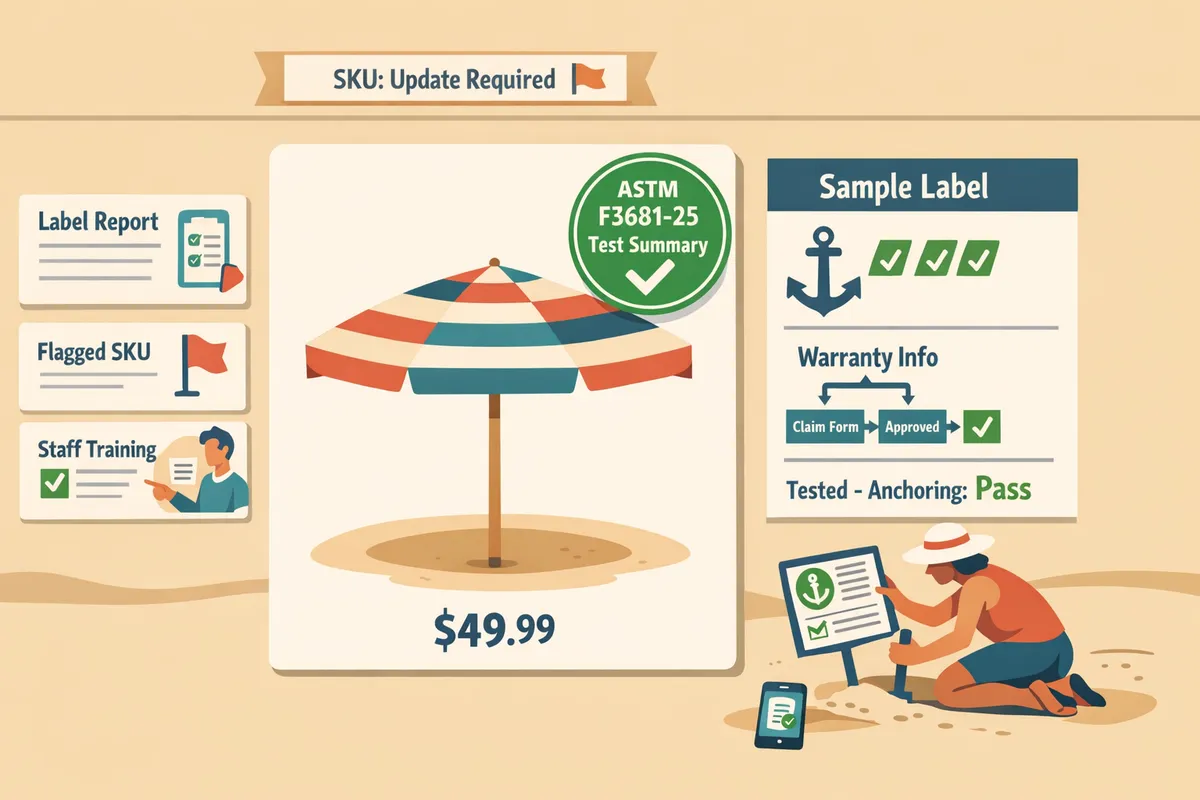
What practical safety and merchandising steps should retailers and beach‑goers take right now?
Retailers should verify compliance, update labels and staff training, and remove or flag any SKU lacking recent test reports. Beach-goers should use anchoring methods matched to sand conditions and close umbrellas when local wind advisories are posted. These steps reduce returns, decrease incident risk, and make it easier to show compliance with ASTM F3681-25 changes.
Retailer verification checklist: restocking, relabeling, and supplier checks ✅
Retailers must confirm each SKU's test reports, relabel affected stock, and train floor staff on CPSC beach umbrella safety guidance and recalls before selling models under the ASTM F3681-25 changes. Start with a prioritized audit to block sale of any umbrella without a dated lab report that lists tested anchoring methods and tested wind thresholds.
- Inventory audit (what). Identify SKUs with beach use claims or large canopies. (why) These pose the highest liability if untested. (how) Sort by supplier and model and mark items for immediate review.
- Required paperwork (what). Request the test report, lab name, date, and scope showing which anchoring methods were tested. (why) Retailers must be able to substantiate any ASTM F3681-25 claim. (how) Save PDFs in a central folder and note expiration or re-test dates.
- Sample compliance request language (what). Use a short template to request proof from suppliers. (why) Clear wording speeds responses. (how) Example: "Please provide the ASTM F3681-25 lab report that verifies anchoring method and wind-performance for model X, including test date and lab contact."
- Relabeling and product copy (what). Add tested anchoring method and tested wind threshold to shelf tags and product pages. (why) Customers make safer choices when facts are visible. (how) Append a small factual line: "Tested anchoring: spiral auger. Tested wind range: per lab report."
- Staff training (what). Brief staff on simple messaging and return-handling steps. (why) Consistent answers reduce disputes. (how) Provide a one-page cheat sheet and a 10-minute roleplay covering common customer questions.
⚠️ Warning: Do not claim full ASTM F3681-25 compliance for a SKU unless you hold the supplier's dated test report covering the specific model and anchoring method.
Consumer-use guide: anchoring tips by beach condition and umbrella type 🏖️
Beach-goers should match anchoring method and insertion depth to sand condition and umbrella size following ASTM F3681 beach umbrella anchoring methods test scenarios. Choosing the right anchor and installing it correctly reduces the chance the umbrella becomes airborne.
- Loose, dry sand (what). Use a spiral auger or screw-type anchor and insert deeply. (why) Loose sand provides poor lateral resistance. (how) Twist an auger at least 12 to 18 inches down, then tilt the pole into the wind by 10–20 degrees before tightening.
- Packed or wet sand (what). A straight-shaft anchor or sandbag can work effectively. (why) Packed sand offers better hold but may still fail under gusts. (how) Drive the shaft 8–12 inches and add a sandbag over the base for large canopies.
- Pebbly or rocky beaches (what). Use a weighted base or tether to a fixed heavy object. (why) Anchors do not bite well in stones. (how) Loop a strap through a concrete bench or secure to a vehicle wheel if local rules allow; never rely on a single stake.
- High-wind or changing conditions (what). Close and stow umbrellas when gusts exceed local advisories. (why) Even tested anchoring has limits. (how) Monitor posted wind advisories and have a simple plan to collapse and pack quickly.
Step-by-step install (sequence):
- Choose the right anchor for sand type. 2. Insert anchor per method above. 3. Mount pole, tilt slightly into wind, then secure tension on canopy ties. 4. Add ballast for large canopies.
💡 Tip: For compact commuter umbrellas with small canopies, use lower profile and extra anchoring when stationary on a crowded beach to reduce trip hazards and wind lift.
How to communicate safety and recall information without legal risk 📣
Use factual, tested statements and cite CPSC beach umbrella safety guidance and recalls rather than making absolute safety promises. Clear, restrained language reduces legal exposure and gives customers usable information.
- Product page copy (sample). "This model was tested for anchoring with a spiral auger; see supplier test report for full conditions and dates."
- Email template for older purchases (sample). "Our records show you purchased Model X before recent ASTM F3681-25 changes. We recommend reviewing the attached test report or returning the umbrella for inspection. Contact our support team for options."
- Recall-response steps (sequence):
- Verify supplier and lab documentation. 2. Notify customers with factual steps: stop use, how to return, refund or exchange options. 3. Retain a record of communications for regulatory review. 4. Keep a written log of communication with CPSC, suppliers, and customers for 3+ years as recommended in recall procedures. Following CPSC beach umbrella safety guidance and recalls step-by-step reduces regulatory scrutiny and speeds customer remediation. Better Canes Umbrellas maintains a recall-response playbook and will post instructions and affected-SKU lists prominently if a recall occurs.
⚠️ Warning: Do not advise customers to modify anchors or hardware in ways not covered by supplier test reports; modifications can void test assumptions and increase risk.
Where Better Canes Umbrellas can help: testing referrals and compliant product filters 🧭
Better Canes Umbrellas provides testing referral contacts and a compliance-ready product filter to reduce time spent vetting SKUs. Our resources let merchandising teams find items that list tested anchoring methods and documented performance without chasing ad hoc paperwork.
What we provide and how it helps:
- Testing referrals (what). Contacts for independent labs familiar with ASTM F3681-25 test methods. (why) Using known labs shortens turnaround and avoids rework. (how) Request a referral and share the supplier model number to accelerate quotes.
- Compliance-ready product filter (what). A storefront filter that flags SKUs with supplier test reports and labeled anchoring methods. (why) Filters cut vetting from a manual lookup to a quick sort. (how) Use the filter to create a compliance shelf or online collection and update merchandising copy quickly.
For retailers that sell both umbrellas and mobility products, Better Canes Umbrellas can also advise on cross-merchandising messages so safety copy does not conflict with style or gift positioning.
Frequently Asked Questions
This FAQ answers common retailer and consumer questions about ASTM F3681-25 changes, anchoring tests, and CPSC beach umbrella safety guidance and recalls. Read each Q&A for a direct answer followed by actionable verification or next steps tailored to retailers and shoppers.
How does ASTM F3681-25 change anchoring test requirements? 🛠️
ASTM F3681-25 tightens and clarifies anchoring test loads, measurement methods, and pass/fail criteria to reflect real consumer-use scenarios. ASTM F3681-25 is a safety standard that raises the bar on how anchors are tested (for example, testing lateral and uplift forces that mimic gusts), so suppliers must show test apparatus, load profiles, and results that match those clauses. Retailers should ask suppliers for reports that explicitly cite F3681-25 and describe the sand condition and fixture used. Better Canes Umbrellas will request updated lab reports from vendors and flag SKUs that still reference earlier editions.
Is compliance with ASTM F3681-25 mandatory or voluntary? ⚖️
ASTM standards are voluntary consensus standards, but following F3681-25 reduces liability risk and aligns with CPSC expectations. The CPSC often references ASTM performance criteria when evaluating product safety; ignoring the new clauses increases recall and legal exposure risk. Responsible retailers typically treat F3681-25 compliance as a de facto requirement because it demonstrates due diligence under CPSC beach umbrella safety guidance and recalls. Better Canes Umbrellas will adopt the updated requirements across merchandising and product copy to limit retailer and consumer risk.
How do I confirm a supplier’s test report matches F3681-25 requirements? 🔍
Confirm the report by checking five clear items: citation, apparatus and conditions, raw results, pass/fail mapping, and lab accreditation. 1) Report must explicitly cite "ASTM F3681-25." 2) It must describe test apparatus, sand type or simulant, insertion depth, and load vectors used. 3) Raw data or a load-displacement curve should be included so you can compare outcomes to the standard. 4) The report should state which clauses were tested and whether the sample met pass/fail criteria. 5) A certifying lab signature or accreditation block (ISO/IEC 17025 or equivalent) should appear on the report.
💡 Tip: Ask suppliers for a short summary page that maps each test clause to the specific page and figure in the lab report; that speeds review and reduces back-and-forth.
Better Canes Umbrellas will publish test-report summaries for eligible SKUs when suppliers provide them.
What are safe anchoring methods for consumers under the new guidance? 🏖️
Safe anchoring methods include using purpose-built screw anchors in loose sand, deeper shaft insertion in packed sand, and not using shade when winds exceed manufacturer-specified limits. For loose, dry sand use a long corkscrew-style anchor installed until the top collar sits flush and then apply a 10–20 degree rearward tilt to the pole; for packed or wet sand, insert the pole deeper (beyond the recommended collar) and consider staking the guy line. Always check the umbrella after installation by applying a firm lateral tug; if it shifts, re-seat or change anchor type. Avoid use in gusty conditions that exceed the umbrella's stated wind limits.
⚠️ Warning: Do not rely on small wood-handled anchors or partially inserted poles in gusty conditions; those failures account for most propulsive incidents on crowded beaches.
Better Canes Umbrellas recommends selling compatible anchors and listing recommended installation steps on the product page.
How should retailers respond if CPSC issues a recall related to umbrella stability? 📝
Retailers must stop sales, isolate affected SKUs, notify customers, and maintain records as soon as a recall notice arrives. 1) Pull the SKU from online and retail shelves immediately and tag inventory as recalled. 2) Use CPSC templates to notify customers who purchased affected units and offer the specified remedy (refund, repair, or replacement). 3) Coordinate logistics with suppliers to return or remediate product and preserve chain-of-custody records. 4) Keep a written log of communication with CPSC, suppliers, and customers for 3+ years as recommended in recall procedures. Following CPSC beach umbrella safety guidance and recalls step-by-step reduces regulatory scrutiny and speeds customer remediation. Better Canes Umbrellas maintains a recall-response playbook and will post instructions and affected-SKU lists prominently if a recall occurs.
Will Better Canes Umbrellas mark products that meet F3681-25 on the site? ✅
Yes. Better Canes Umbrellas will label eligible SKUs and provide test-report summaries or a compliance note on product pages so shoppers and staff can answer safety questions confidently. Labels will clarify which anchoring methods were tested, the sand conditions used in testing, and any manufacturer-stated wind limits. For SKUs without updated reports the product page will display the last tested edition and a note that an updated report is pending. Merchandisers will also receive quick-reference cards for floor staff to explain ASTM F3681 beach umbrella anchoring methods and correct installation to shoppers.
Practical next steps for manufacturers, retailers, and consumers
Prioritize updated anchoring, labeling, and retail handling to comply with ASTM F3681-25 changes. Retailers should update product pages with clear anchoring specs and train staff to verify labels at point of sale. Manufacturers must document test results and update assembly instructions to avoid liability and costly recalls. Consumers should inspect anchors and manufacturer labels before purchase and prefer products with explicit installation guidance.
💡 Tip: Inspect a sample anchor in wind or sand conditions similar to your market before listing a model.
Review ASTM F3681 beach umbrella anchoring methods when choosing models to stock or buy. Small changes to packaging and staff checklists typically prevent complaints and reduce return-related costs. For manufacturers and retailers, adopting one high-impact change now—such as standardized anchoring instructions on every SKU—yields faster compliance than waiting for full catalog revision.
Better Canes & Umbrellas Inc., founded in 2000 and based in Chatham, NJ, is an online and retail seller focused on umbrellas, walking sticks (including novelty sticks and hiking sticks), and shoe horns. Their assortment emphasizes variety for commuters, mobility users, and gift buyers and aims to build customer trust through reliable products and service.
Start by updating your top commuter umbrella listings with compliant anchoring specifications through Better Canes & Umbrellas. Subscribe to our newsletter for implementation tips and standard updates.