
Are Walking Canes Covered by Medicare Part B in 2026? Eligibility, HCPCS Codes, and How to Qualify
Are Walking Canes Covered by Medicare Part B in 2026? Eligibility, HCPCS Codes, and How to Qualify
A single denied Medicare claim for a walking cane can leave a beneficiary with several hundred dollars in unexpected costs. Are walking canes covered by Medicare Part B? Medicare Part B is the federal benefit that covers certain durable medical equipment, including standard walking canes when a physician documents medical necessity and assigns the appropriate HCPCS code. Our site, Better Canes & Umbrellas, has operated since 2000 from Chatham, NJ and sells walking sticks that span commuter-friendly supports, novelty and collectible canes, and practical aids. This FAQ-style article explains eligibility, the HCPCS codes that matter, how to qualify, and next steps to obtain a covered cane. Which HCPCS codes apply to your cane and how to get approval may be easier to pin down than you expect.
Medicare Part B covers certain walking canes when a physician documents medical necessity. Does Medicare Part B cover walking canes in 2026?
Yes. Medicare Part B in 2026 covers certain walking canes when a physician documents medical necessity, the cane is primarily for use in the home, and the device is provided by a Medicare-enrolled durable medical equipment (DME) supplier. The claim must include the correct HCPCS billing code and a signed physician order. Understanding the home-use rule, required documentation, and typical patient cost helps avoid surprise denials and out-of-pocket charges.
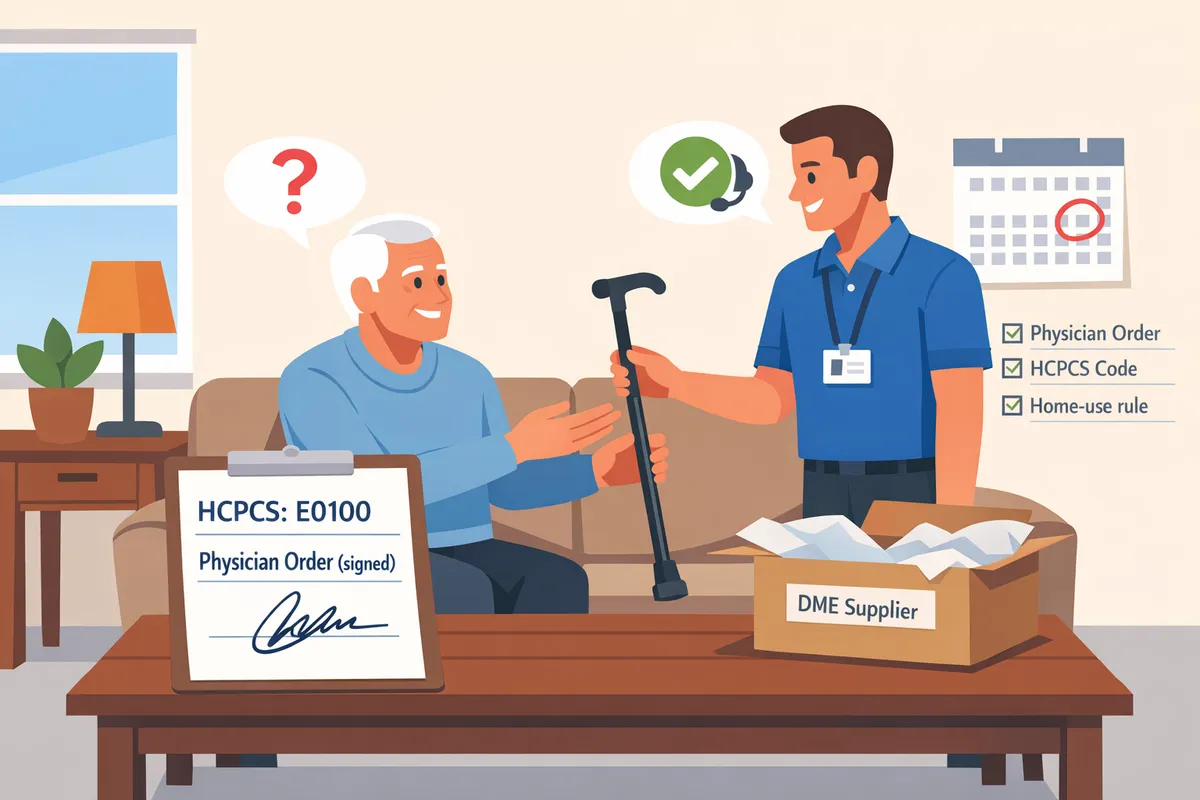
Who qualifies for coverage? 🩺
Patients qualify when a physician documents that a cane is medically necessary to improve safety or mobility for activities performed inside the home. Physicians commonly document necessity for conditions such as recent hip or knee surgery with gait instability, post-stroke hemiparesis causing one-sided weakness, progressive balance disorders (for example, advanced Parkinson's with frequent falls), or severe lower-extremity arthritis that limits safe walking indoors. Medicare requires a signed written order from a physician stating the medical necessity and that the cane will be used primarily in the home. HCPCS code is a billing code that Medicare uses to identify DME; suppliers must list the appropriate E01xx series code on the claim. Better Canes Umbrellas sells a range of walking sticks and supportive models, but buying from our retail catalog without working through a Medicare-enrolled DME will not satisfy the supplier enrollment requirement for Part B reimbursement.
What does coverage cost? 💸
Coverage typically requires meeting the Part B deductible, after which Medicare generally pays 80% and the beneficiary pays 20% coinsurance. If you have not met the Part B deductible for the year, you may be responsible for the full cost until the deductible is satisfied. Example: for a $50 cane, your typical share after meeting the deductible is $10 (20% coinsurance). Medigap (Medicare Supplement) policies often cover that 20% coinsurance, while Medicare Advantage plans may use different copay structures or prior authorization rules, so check plan details before buying. Confirm whether the supplier will bill Medicare directly or expects payment up front; if the supplier is not Medicare-enrolled you will pay out of pocket.
⚠️ Warning: Buying a cane from a retailer that cannot bill Medicare usually prevents any Part B reimbursement, even if you later obtain a prescription.
Which cane types are likely excluded? 🚫
Medicare excludes devices that are primarily cosmetic, novelty, or not intended for mobility support. Examples that are commonly excluded include decorative or collectible sticks, costume canes, umbrella canes sold primarily for weather protection, and many novelty walking sticks with nonfunctional designs. There is also a frequent exception around white canes used solely for vision navigation; coverage for those items varies and often falls outside Part B DME rules. If you prefer a fashion-forward or collectible model from Better Canes Umbrellas, understand that those items often do not meet Medicare's medical-necessity standard. To avoid surprise denials, confirm that the exact cane model you plan to acquire is listed under an appropriate HCPCS code on the supplier invoice and that the supplier is enrolled in Medicare before you purchase.
A physician order, a Medicare‑enrolled DME supplier, and complete documentation make claims approvable. How do you qualify and obtain a cane under Medicare Part B?
You qualify for Medicare Part B coverage of a walking cane by obtaining a signed physician order, purchasing from a Medicare‑enrolled DME supplier, and submitting complete supporting medical records. Follow a clear clinic-to-supplier workflow to reduce delays and denials and decide whether the supplier will bill Medicare directly or you will pay upfront and seek reimbursement.
What documentation should your doctor provide? 📄
A signed physician order that states medical necessity, intended home use, and the specific cane type is required. Include these essential elements in the order:
- Medical necessity statement (for example: "Patient requires a cane for balance due to left-sided weakness").
- Intended place of use (explicitly state "primarily for use in the home").
- Exact device description or model (single-point cane, quad cane, adjustable, or manufacturer/model if known).
- Physician name, signature, professional credentials, and date.
Bring supporting notes to the appointment: recent progress notes that document gait instability, fall history, functional limitations, and any physical therapy or OT evaluations. If you plan to buy a specific model from Better Canes Umbrellas, bring the product name and SKU to ensure the order matches the supplier's billed description.
Checklist to bring to the visit:
- Photo ID and Medicare card.
- A copy of any recent therapy or mobility assessments.
- The desired cane model name/SKU (if known).
How do you find and verify a Medicare-approved DME supplier? 📍
You confirm a Medicare-enrolled DME supplier by checking Medicare's supplier enrollment status before purchase and asking the supplier to confirm they accept assignment. Use Medicare's online supplier lookup or call Medicare to verify enrollment and billing practices. Our website, Better Canes Umbrellas, lists product model details and notes when a model matches typical supplier descriptions to help you avoid mismatches between the physician order and supplier billing.
When you contact a supplier, ask these specific questions:
- "Are you enrolled in Medicare and do you accept assignment for Part B DME?"
- "Will you bill Medicare directly for the cane, or do I pay and submit for reimbursement?"
- "Which HCPCS code will you use when billing for this model?"
If the supplier says they will bill Medicare, confirm they will submit the physician order and supporting documentation with the claim. If you prefer to buy immediately (for style or immediate need), understand that paying upfront shifts the reimbursement paperwork and risk to you.
How do you avoid denials and appeal if needed? ⚠️
You avoid denials by ensuring the physician order exists, the supplier uses the correct HCPCS code, and the cane type is one Medicare covers; if denied, you can appeal by submitting a physician appeal letter plus detailed records. Common denial reasons include missing or vague physician orders, incorrect HCPCS codes, and billing for non-covered cane types (for example, novelty or white canes billed for visual aid rather than mobility).
Appeals checklist:
- Request the Medicare Summary Notice or denial letter and note the denial reason.
- Obtain an appeal letter from the prescribing physician that restates medical necessity and links specific exam findings to cane use.
- Collect supporting therapy notes, fall history, and the supplier's billing details (HCPCS code and item description).
- File the first-level redetermination; typically you have 120 days from the date on the denial notice to request it. Medicare's appeals process lists successive levels if the redetermination is unfavorable.
⚠️ Warning: White canes used solely as visual aids are often excluded from Part B coverage; document mobility-related need clearly if your cane serves both purposes.

Coverage depends on the cane type and the HCPCS code billed to Medicare. Which cane types map to HCPCS codes and how does that affect coverage?
Coverage depends on the specific cane style and the HCPCS code submitted on the claim; single-point canes most often map to E0100 and quad canes to E0105, which changes approval odds. The billed HCPCS code tells Medicare which device the supplier provided, so a mismatch between the physician order, the supplied cane, and the code is a common reason for denials. Better Canes Umbrellas lists models that align with common HCPCS codes to help clinicians and suppliers match orders to the correct billed code.
What does HCPCS code E0100 cover? 🦯
E0100 is the HCPCS code for a standard single-point cane and typically qualifies when a physician documents medical necessity. E0100 covers canes with a single tip used primarily for improved balance or partial weight bearing. Typical clinical reasons include unilateral weakness after stroke, short-term postoperative mobility assistance, or mild balance impairment. Suppliers commonly document height adjustability, a single-point rubber tip, and a physician order stating home use. For example, Better Canes Umbrellas' Classic Single-Point and Folding Commuter models match E0100 when prescribed and billed correctly.
What does HCPCS code E0105 cover? 🦯
E0105 is the HCPCS code for quad canes with a four-point base and often meets Part B coverage for patients needing extra lateral stability. Quad canes provide a wider stance and more surface contact with the ground, so clinicians order them for bilateral weakness, significant balance deficits, or frequent near-falls. Billing implications include documenting the medical rationale for a quad base and showing the patient benefits from the extra stability in clinical notes. Better Canes Umbrellas' Stability Quad model is an example that aligns with E0105 when a clinician specifies the need for a quad base on the order.
Which cane type should I choose? 📊
Match the cane type to the physician order and the HCPCS code on the claim to minimize denials. Below is a comparison table that clarifies coverage likelihood and when each cane is appropriate.
| Cane type | Typical HCPCS code | Coverage likelihood | When to pick | Notes |
|---|---|---|---|---|
| Standard single-point (including folding) | E0100 | Covered when medically necessary | Mild balance issues, unilateral weakness, short-term use | Folding commuter canes qualify if ordered as a medical device; example: Better Canes Umbrellas Classic Single-Point |
| Quad cane (four-point base) | E0105 | Covered when documentation shows need for extra stability | Patients with bilateral weakness, high fall risk, poor lateral stability | Supplier notes should state why quad base is required; example: Better Canes Umbrellas Stability Quad |
| Adjustable specialty canes (height-adjustable medical models) | E0100 (typically) | Covered when medically necessary | Need for customized height for gait safety | Ensure order specifies adjustable medical model rather than novelty description |
| White cane (for vision) | Varies; often not covered by Part B | Conditional or Not covered | Primarily used for visual impairment orientation | Many white canes fall under blindness services not Part B DME; check state/local programs and document mobility-related medical need |
| Novelty/collectible canes | N/A | Not covered | Gift, costume, collectible use | Cosmetic or decorative sticks do not meet DME criteria; Better Canes Umbrellas sells novelty sticks for those use cases |
💡 Tip: Ask the prescribing clinician to write the HCPCS code or exact cane description on the order (for example, "E0105 quad cane for home use") and confirm the supplier will bill that code.
Do novelty, collectible, and white canes qualify under Part B? 🎭
Novelty and collectible canes generally do not qualify for Part B, while white canes for vision impairment usually fall outside Part B coverage. Medicare excludes items whose primary purpose is cosmetic or recreational, so ornate or collectible sticks do not meet DME medical necessity standards. White canes used for orientation by people with blindness commonly sit outside Part B and may be covered by other federal, state, or nonprofit programs instead. If a white cane is prescribed specifically to address a documented mobility deficit rather than purely as an orientation aid, document the mobility rationale clearly and use a Medicare-enrolled supplier to file the claim.
Frequently Asked Questions about Medicare Part B and walking canes
This FAQ gives direct answers to the short questions beneficiaries ask most about Part B cane coverage, HCPCS codes, and next steps to obtain or appeal a claim. Read the short answers first, then use the supporting details to prepare orders, supplier invoices, or an appeal.
How many canes does Medicare Part B cover per year? 🗓️
Medicare Part B does not set a fixed annual limit; approvals for new or replacement canes depend on documented medical necessity and the reason for replacement. Medicare reviewers expect a signed physician order plus clinical notes that explain why the cane is needed for gait or balance and why a replacement is required (for example, damage, change in medical condition, or wear that makes the device unsafe). Include the supplier invoice with the HCPCS code billed (common codes include E0100 for single-point canes and E0108 for quad canes) and dated evidence of previous supply when available. Better Canes Umbrellas can supply itemized receipts and product specifications that speed review when you request them.
Does Medicare Advantage cover canes differently than Original Medicare? 🧾
Medicare Advantage plans generally follow Part B coverage rules but often add plan-specific requirements such as prior authorization, network supplier restrictions, or different cost sharing. Medicare Advantage is a type of Medicare plan that replaces Original Medicare and often includes plan rules about who can supply DME, whether prior authorization is required, and which suppliers are in-network. Before you order, check the plan's Evidence of Coverage and confirm whether your supplier accepts the plan and will bill Medicare Advantage. If Better Canes Umbrellas does not bill your plan directly, ask whether the plan permits out-of-network reimbursement and what documentation it requires.
Are white canes for vision impairment covered by Medicare Part B? 🦯
White canes used only for vision navigation are typically not covered by Medicare Part B because coverage focuses on devices prescribed for ambulation or balance. If a white cane also serves a documented gait or balance impairment, include clinical notes that show how the cane addresses those mobility needs rather than only vision. For example, a beneficiary with low vision plus diagnosed vestibular dysfunction should have a physician note linking cane use to fall risk reduction. Better Canes Umbrellas carries both novelty and functional sticks; if you buy a white cane for combined vision and balance reasons, request a detailed product spec sheet to support your claim.
Can I purchase a cane upfront and get reimbursed by Medicare? 💳
Yes. You can buy a cane and submit a claim for reimbursement, but Medicare reimburses only when you have the required documentation and the supplier and HCPCS coding meet Medicare rules. Required documents usually include a signed physician order, clinical notes substantiating medical necessity, an itemized supplier invoice showing the HCPCS code, and proof of payment. Direct supplier billing to Medicare or to your Medicare Advantage plan reduces patient paperwork and speeds payment; beneficiaries who file for reimbursement face longer processing and may need more documentation.
💡 Tip: Ask your supplier to bill Medicare or your Medicare Advantage plan directly and to provide an itemized invoice with HCPCS codes to avoid lengthy beneficiary reimbursement claims.
Better Canes Umbrellas can provide itemized receipts and model numbers on request to support a reimbursement claim.
What documentation do I need to file an appeal for a denied cane claim? 📁
An effective appeal includes the original physician order, supporting clinical notes that document medical necessity, the supplier's itemized invoice with the HCPCS code, and any denial letters or CMS notices you received. Add photos if the denial concerns a damaged or unusable cane, supplier enrollment details (to prove the supplier was Medicare-enrolled), and dated proof of prior cane issuance if the denial questions replacement timing. You generally have 120 days from the date on the denial notice to request a redetermination; include a short cover letter that explains the medical rationale and cites the specific clinical entries that support use for ambulation or balance. Better Canes Umbrellas can supply model specifications and transaction records to strengthen an appeal.
Where can I find Medicare-approved DME suppliers near me? 📞
Use Medicare's supplier search or call your local Medicare office to confirm Medicare-enrolled DME suppliers and to verify that a supplier accepts assignment and bills for the HCPCS codes you need. When you call, ask for the supplier's Medicare billing number, whether they accept assignment, the HCPCS codes they bill (for example, E0100 or E0108), and whether they will submit claims directly to Medicare or to your Medicare Advantage plan. If you prefer to buy online from a retailer like Better Canes Umbrellas, verify whether they bill Medicare; if they do not, request an itemized invoice, proof of delivery, and product specifications so you can submit a reimbursement claim or support an appeal.
Medicare Part B covers certain walking canes in 2026 when a physician documents medical necessity and the supplier bills the correct HCPCS code.
Short answer to are walking canes covered by medicare part B: yes, but only when a doctor documents the need, the claim uses the appropriate medical justification, and the supplier bills with compliant paperwork. That combination lowers the risk of denials and unexpected out-of-pocket costs.
HCPCS codes for canes E0100 and E0105 identify common single-point canes and models with special features; our website recommends confirming the exact code with your supplier before submitting claims. For many patients, securing the physician note, the right code, and a compliant supplier is the fastest path to approval.
Better Canes & Umbrellas Inc., founded in 2000 and based in Chatham, NJ, is an online and retail seller of umbrellas, walking sticks (including novelty and hiking sticks), and shoe horns. The business expanded after 2005 and positions itself as a source for reliable, fashionable, and collectible items that serve daily mobility and gifting needs.
Browse Better Canes Umbrellas' mobility cane collection to match Medicare documentation and begin an order or request supplier guidance. Subscribe to our newsletter for ongoing tips on Medicare coverage and choosing the right cane.