
Adjustable Walking Canes: 2026 Buyer’s Guide to Height, Handles, Bases, and Foldable Options
Adjustable Walking Canes: 2026 Buyer’s Guide to Height, Handles, Bases, and Foldable Options
A misset cane height often shifts weight to the wrist and increases fall risk during daily walks. Adjustable walking canes are mobility aids that let users set shaft height to match posture, reducing wrist strain and improving balance. This beginner's guide helps you compare adjustable cane options and pick the best model for arthritis, balance, travel, and daily use. Our Better Canes & Umbrellas Inc. catalog, operating since 2000 in Chatham, NJ, groups commuter-friendly, arthritis-friendly, stability, and foldable choices so you can match function with personal style. If you feel overwhelmed, we start from zero and explain height, handles, base types, and foldable mechanisms in clear steps. Which design keeps comfort, safety, and style in balance?
Adjustable walking cane is a mobility aid that allows users to change height, swap grips, and choose base types to match balance and comfort needs.
This section defines the core parts and terms every buyer should know before comparing models. Clear definitions stop confusion between adjustable height walking cane types, folding options, and specialty sticks. Knowing grips, materials, and base choices lets you match a cane to arthritis, balance loss, commuting, or travel needs.
Cane types 🦯
Single-point, offset, quad, and folding are the main adjustable walking cane types and each suits different support and mobility scenarios.
- Single-point cane is a standard cane that uses one tip and works best for light support and faster walking. Example: a commuter who needs short-term balance on trains or sidewalks.
- Offset cane is a support cane that shifts the shaft behind the grip to put weight more directly through the wrist and forearm. Example: someone with weak wrists who needs better load distribution while walking slowly.
- Quad cane is a stability cane that has a four-legged base for maximum standing balance and slower, deliberate steps. Example: an older adult with significant balance loss at home.
- Folding adjustable cane is a portable cane that collapses for storage and travel without losing height adjustability. Example: a traveler who needs an adjustable height walking cane that fits in a suitcase.
Better Canes Umbrellas stocks examples from each type so you can compare feel and foldability before buying.
Grip styles ✋
Crook, derby, T-handle, orthopedic, and gel grips change how pressure and wrist alignment feel during use.
- Crook handle is a traditional curved handle that is light and lets you hang the cane on a chair or stroller; it favors style and quick stowage. Trade-off: less ergonomic support for arthritic hands.
- Derby handle is an ergonomic handle that provides a larger palm surface and improved wrist alignment. Best for users who need reduced wrist torque.
- T-handle is a straight, narrow grip that supports a neutral hand position and works well for walkers who prefer minimal bulk.
- Orthopedic grip is a molded support that redistributes pressure across the palm and reduces point pressure. Example: people with rheumatoid arthritis or localized hand pain who need longer walking sessions.
- Gel grip adds cushioning and vibration damping but can increase handle diameter.
💡 Tip: Try each grip while walking at least two minutes in-store or with a friend; orthopedic grips reduce pressure but may feel bulky for smaller hands. Better Canes Umbrellas offers models with sample grips so you can compare comfort.
Materials and weight ⚖️
Aluminum, steel, carbon fiber, and wood determine a cane's weight, durability, and price.
| Material | Typical feel | Durability | Best use | Notes |
|---|---|---|---|---|
| Aluminum | Light and affordable | Moderate | Everyday commuting and indoor use | Good balance of weight and cost for most users |
| Steel | Heavier and very durable | High | Heavy-duty support and higher weight capacity | Better for larger users or when maximum strength matters |
| Carbon fiber | Very light with a higher price | High | Travel and users who need minimal carry weight | Ideal for folding, portable adjustable height walking cane options |
| Wood | Solid, classic aesthetic | Moderate to high | Fashion, novelty, or collector canes | Heavier and less adjustable; often chosen for style |
Example: a daily commuter who carries a cane on and off public transit will value carbon fiber or aluminum for lighter carry. Better Canes Umbrellas lists material details on each product to help you compare portability and expected lifespan.
Bases and tips 🦶
Single-point, tripod, and quad bases and rubber tips change ground contact, stability, and terrain suitability.
- Single-point base is a narrow contact point suited for indoor maneuvering and tight spaces. Example: apartment living where the cane must pivot easily.
- Tripod base is a three-pronged base that increases lateral stability while remaining easier to swing than a quad. Example: users who walk outdoors on mixed terrain but still want a relatively compact base.
- Quad base is a four-point base that gives the most stationary stability and helps during transfers or standing. Example: someone who needs steady support while reaching or standing from a seat.
Tip materials matter: solid rubber with tread grips wet surfaces better than hard plastic. Replace tips when the tread wears flat or when slips increase; check tips monthly if you use the cane outdoors daily. Better Canes Umbrellas sells replacement rubber tips and wider bases so you can customize stability without buying a new shaft.
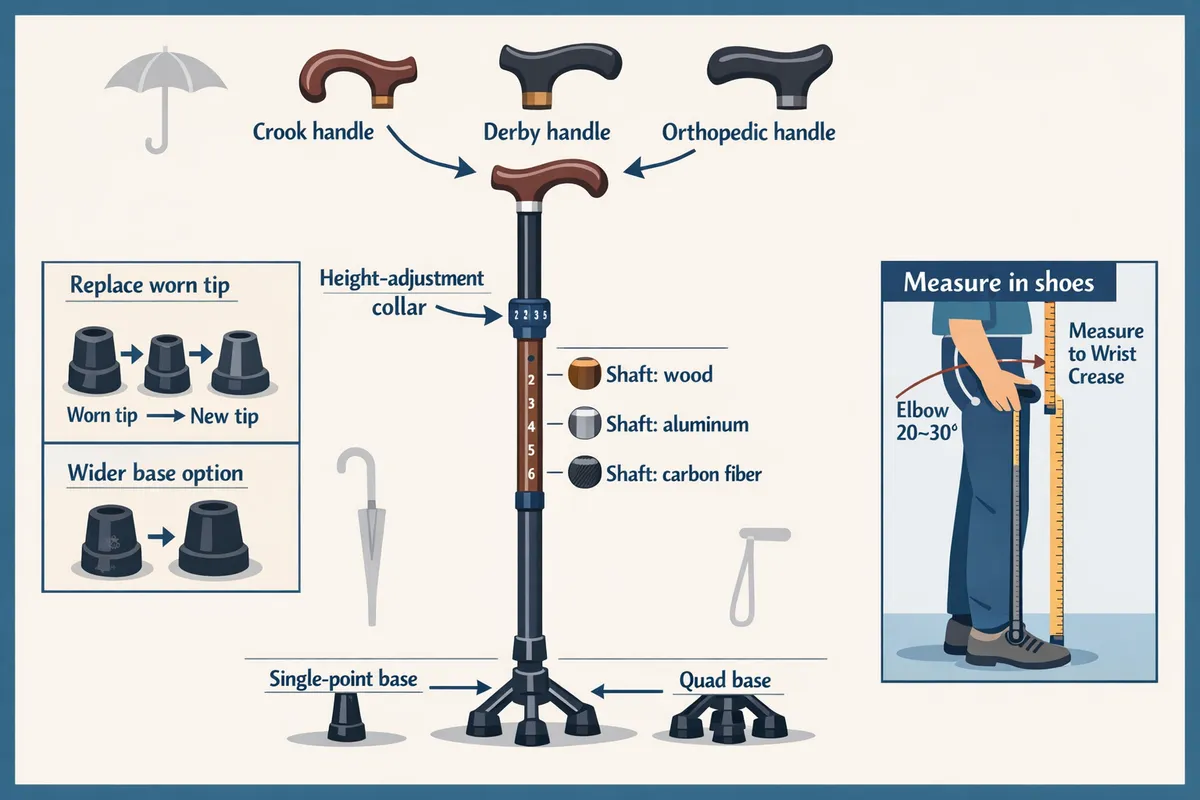
Measure cane height by standing in shoes and measuring floor to wrist crease so the elbow rests at a 20–30 degree bend.
Measure while standing in the shoes you normally wear so the cane setting matches everyday posture. This prevents an incorrect fit that shifts weight to the wrist or increases fall risk. Better Canes Umbrellas recommends rechecking height after any change in footwear or footwear style.
Step-by-step measuring checklist 🧭
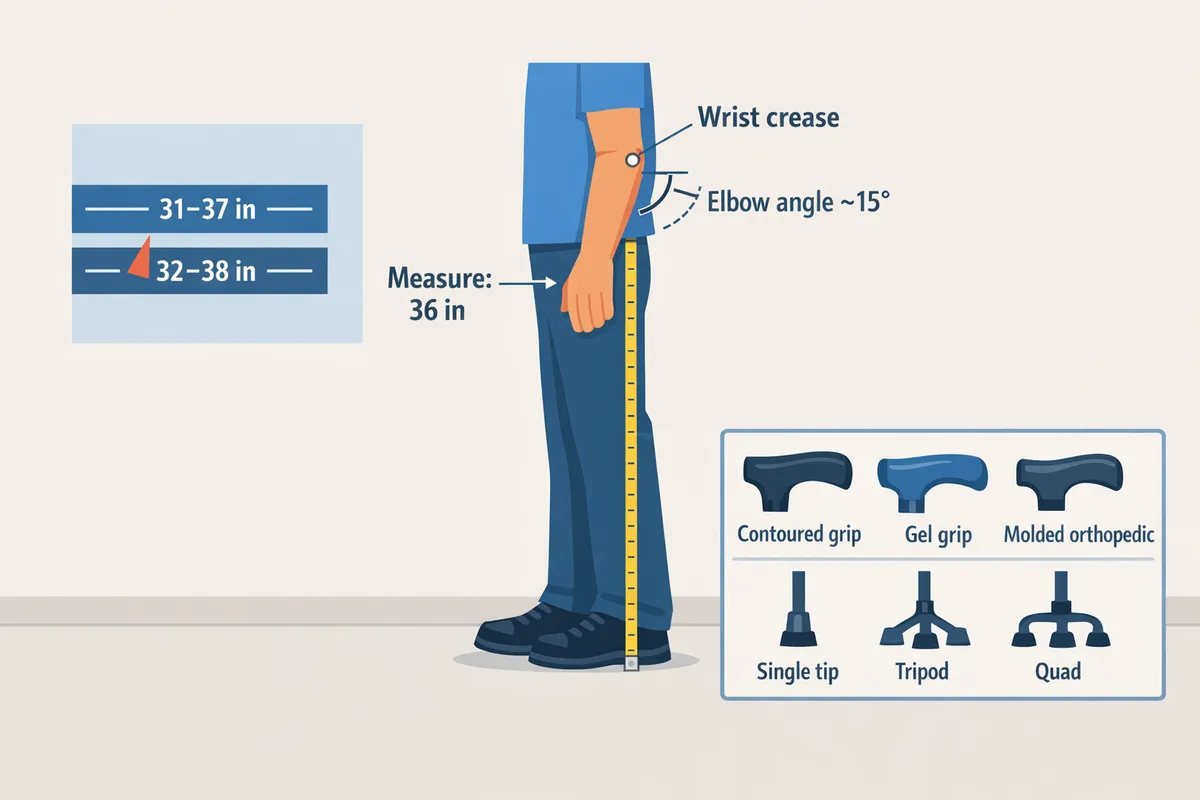
Stand in the shoes you wear for walking and measure from the floor to the crease where your wrist meets your hand. 1) Put on the shoes you will use with the cane. 2) Stand upright with weight evenly on both feet. 3) Let your arm hang relaxed at your side. 4) Measure from the floor to the wrist crease. 5) Adjust the cane so the elbow bends about 20–30 degrees when you hold the handle.
Quick examples for reading height charts. If your floor-to-wrist measure is 36 inches, choose an adjustable height walking cane whose range includes 36 inches. Many commuter folding canes list ranges like 31–37 inches, while heavy-duty models often cover 32–38 inches. Better Canes Umbrellas labels each product with a clear height-range chart so you match your measurement to the correct model.
Match grip and base to condition 🖐️
Arthritis benefits from softer, contoured grips and balance issues benefit from wider bases like tripod or quad. Gel, molded orthopedic, or anatomically contoured handles spread pressure over a larger area and reduce peak force on inflamed joints. For balance needs, tripod and quad bases increase contact area and stability on uneven sidewalks.
Scenario recommendations. For osteoarthritis of the thumb or wrist, choose an orthopedic gel grip with a T- or derby-style handle to keep the wrist straighter during use. For chronic balance problems or a history of falls, pick a cane with a quad base or tripod base and practice short indoor walks to confirm confidence. Better Canes Umbrellas carries gel-grip and quad-base options and labels which medical scenarios each model suits.
Pick weight capacity with a 25–30% safety margin ⚖️
Weight capacity is a specification that indicates the maximum safe load the cane supports, and you should add a 25–30% margin to your body weight. For example, a 160 lb person should choose a cane rated for roughly 200 lb or higher to allow for daily impact, leaning, and luggage carried while walking. Heavy users should favor steel or high-capacity aluminum models because they resist bending and wear over time.
Material notes and longevity. Aluminum offers light weight for commuters, while steel improves durability for higher-capacity needs. Better Canes Umbrellas lists the material and rated capacity for each cane so you can match the product to your safety margin and typical activities.
💡 Tip: After buying, test the cane with your typical shoes and a normal load such as a small bag to confirm the elbow angle and that the rubber tip contacts the ground fully.
Compare top adjustable canes 📋
This table compares commuter, arthritis-oriented, and heavy-duty adjustable canes by height range, weight limit, grip, material, foldability, and price range.
| Model | Height range (in) | Weight limit (lb) | Grip type | Material | Foldability | Price range |
|---|---|---|---|---|---|---|
| Better Canes Commuter Fold | 31–37 | 250 | Ergonomic foam | Aluminum | Yes (compact fold) | $40–$60 |
| Better Canes Orthopedic Comfort | 33–38 | 300 | Gel orthopedic | Aluminum/steel hybrid | No | $60–$90 |
| Better Canes Heavy-Duty Steel | 32–38 | 400 | Contoured T-handle | Steel | No | $70–$120 |
How to use the table. Match your floor-to-wrist measurement to the height range column, then confirm the weight limit provides at least a 25–30% safety margin. Next, choose grip and base that address pain points such as joint pressure or instability. Better Canes Umbrellas organizes these models so you can filter by height range, grip type, and foldability to find the right cane quickly.
Start by testing three cane styles at home or in-store, focusing on height, grip comfort, and base stability before buying.
Test three cane styles at home or in-store by comparing height, grip comfort, and base stability to find the best match. This quick comparison reduces buyer's remorse because small differences in grip or tip contact change how people walk and how much load their wrist bears. Use Better Canes Umbrellas product pages to pre-filter by adjustable height walking cane ranges and grip type, then verify the feel in person.
Quick five-minute fit test 🕒
A five-minute fit test confirms posture, elbow angle, grip feel, and tip contact before you commit. Start with the cane set so your wrist falls at your wrist crease while standing in the shoes you wear most. Walk 10 normal steps on level ground, note whether your elbow bends about 20–30 degrees, and watch the wrist: if it tilts up or down more than 10 degrees, the height needs adjusting.
Check turning and a single stair step to see if the tip stays planted and the grip stays comfortable under load. For people with arthritis, try both a contoured handle and a soft gel grip for at least 30 seconds each; pain points often show up within that time. Record one-line notes (height OK / wrist bent / tip slips) to compare later.
Store/home test script: 10 steps to compare models 📝
Use this compact script to run identical tests on three canes so you can compare notes objectively.
- Stand in your usual shoes and measure floor-to-wrist crease; set the cane to that mark.
- Confirm elbow rests at a 20–30 degree bend while holding the cane.
- Walk 10 normal steps; note wrist angle and any thumb or palm pressure.
- Turn 90 degrees and walk 5 steps to check tip contact during pivots.
- Climb and descend one step to simulate curbs.
- Apply a light downward press on the grip to test flex or wobble.
- If present, unfold and fold the cane 5 times to assess the mechanism.
- Inspect locking points for visible play or weak hardware.
- Score each cane on Comfort, Stability, and Portability (1–5).
- Photograph or note model number and score for comparison.
Bring a simple scorecard so you judge each cane against the same criteria. Use Better Canes Umbrellas to shortlist models that match your measured height and preferred handle type before testing.
Folding adjustable cane for seniors: benefits and trade-offs 🧳
A folding adjustable cane for seniors is a cane that folds into sections for compact storage but introduces extra joints to inspect. Folding models free up closet or travel space and work well for commuters who need a cane only at certain times. The trade-off is extra mechanical joints: inspect those joints for reinforced collars, secure locking hardware, and minimal play when the cane bears weight.
Test any folding model by repeatedly opening and closing it and by leaning your weight on the extended cane while it is locked. Check that replacement parts (tips and locking collars) are available and that the retailer’s return policy covers early wear issues. Better Canes Umbrellas lists folding models with visible specifications so you can prioritize reinforced joints and clear return terms.
⚠️ Warning: Test locking hardware under load before buying. A folding cane with loose locks increases fall risk.
Buying checklist: the must-check items before you buy ✅
Confirm height range, weight capacity, grip comfort, foldability, return policy, and warranty before you buy.
- Height range. Ensure the cane’s minimum and maximum settings include your measured floor-to-wrist crease plus shoe height.
- Weight capacity. Choose a cane rated above your body weight; ask the retailer if ratings include dynamic loads.
- Grip comfort. Try the handle for at least 30 seconds and score pain, numbness, and slippage. For arthritis, prefer contoured or soft gel grips.
- Base stability. Test single-point tips vs. quad bases; wider bases help balance but can catch on stairs.
- Foldability and hardware. If you need a folding adjustable cane for seniors, test the fold/unfold cycle and inspect locking collars.
- Replacement parts and accessories. Confirm replacement tips, wrist straps, and travel sleeves are available.
- Return policy and warranty. Verify at least a short trial window and what the warranty covers. Better Canes Umbrellas provides model details and purchase receipts that customers use for FSA or insurance claims.
Use your scorecard to eliminate any cane that scores below 3/5 in either Comfort or Stability. That prevents spending time on models that look good on paper but fail under small real-world stresses.
Consult a physical therapist for persistent balance problems, maintain canes with regular inspections, and consider upgrades like orthopedic grips and wider tips.
See a physical therapist for persistent balance problems because they identify the root cause and recommend the precise cane features, training, or exercises you need. Physical therapists measure posture and gait, confirm the correct cane height, and can rule out deficits that a cane alone will not fix. Bring your current cane to the appointment so the therapist can assess fit and show simple adjustments.
Care and maintenance 🔧
Inspect canes monthly for worn tips, loose collars, bent shafts, and damaged grips. Perform a quick monthly checklist: check the rubber tip for cracks or glazing; press each joint and the adjustment collar for play; and flex the shaft slightly to confirm there are no hairline bends. A worn rubber tip reduces traction; swap it for the correct diameter tip the same day you notice glazing.
Tighten collars and fasteners after heavy use and test locking pins before each outing. If your cane has a folding hinge, open and close it five times while listening for rattles. Better Canes Umbrellas sells replacement tips and adjustment collars that match most adjustable height walking cane models we carry, making maintenance a single-purchase task rather than a parts hunt.
⚠️ Warning: Replace glazed or split rubber tips immediately; they increase slip-and-fall risk.
Accessories that improve comfort and safety 🧰
Add accessories when a specific symptom or situation reduces comfort or raises risk. Orthopedic grips are handle replacements that reduce pressure points by contouring to the hand; add one for hand pain from arthritis or neuropathy. Wider rubber tips increase ground contact and stability on tile or wet surfaces; use these in kitchens or bathrooms.
Other useful add-ons: wrist straps to prevent dropped canes during stairs, gel or padded sleeves for pinch-prone hands, and carrying cases for a folding cane. Better Canes Umbrellas stocks gel grips and wider tips sized to fit common shafts, and product filters help you find a compatible folding adjustable cane for seniors or an adjustable height walking cane with the right shaft diameter.
When to replace your cane ⏳
Replace a cane when you notice metal fatigue, persistent wobble, loose joints that do not tighten, or cracked shafts. These faults indicate structural weakening that raises fall risk. Expect a busy daily-use cane to need replacement every few years; schedule an annual check if you use a cane daily.
Delaying replacement costs your business in lost mobility days and personal safety. For example, a cane that slips on entryways can cause a fall that leads to weeks of reduced work capacity. Better Canes Umbrellas recommends inspecting receipts and warranty paperwork at purchase so you can justify timely replacement to payers or for FSA documentation if needed.
Buying locally vs online and FSA tips 🛒
Buy locally when you need immediate fitting, hands-on testing, or rapid replacement; buy online for wider styles, narrower price ranges, and rare accessories. Local shops let you try grips and bases and will often fit the cane to your wrist crease on site. Online retailers typically provide clearer filter options for adjustable height walking cane ranges and folding models.
For FSA or insurance reimbursement keep the itemized receipt and any physician prescription or letter of medical necessity if required by your plan. Save a photo of the cane and its UPC or model number; Better Canes Umbrellas includes downloadable receipts and product details on order confirmations to simplify FSA claims.
Which cane for common scenarios (arthritis, recovery, travel) 🩺
Choose an arthritic-friendly cane that spreads handle pressure and uses a wider tip for traction. For example, select an orthopedic or gel grip and a quad or large-diameter tip to lower joint pain and improve stability on smooth floors. Better Canes Umbrellas lists grips and tip sizes in each product description so you can match a cane to hand size and floor conditions.
For short-term recovery pick a lightweight adjustable height walking cane with quick, tool-free height settings so family members can assist without special tools. For frequent travel the priority is a compact folding adjustable cane for seniors that folds into a carrying case, stores in overhead bins, and locks solidly when open. Test the folding mechanism at home to ensure it re-locks fully; Better Canes Umbrellas offers travel-friendly folding canes with matching carrying cases to simplify trips.
Frequently Asked Questions
These FAQs answer practical buying and safety questions to help you pick the right adjustable walking cane for daily use, travel, or recovery. Each answer gives a direct recommendation plus short, actionable next steps you can use when testing canes in-store or online.
How do I set the height on an adjustable walking cane? 🧍♂️
Set the handle so your wrist crease aligns with the top of the handle and your elbow bends about 20–30 degrees while standing in your usual shoes. The wrist crease is the fold where your hand meets the forearm; measuring to that point ensures the cane supports weight through your forearm, not your wrist. For an adjustable height walking cane, measure floor-to-wrist and match that to the cane's lowest and highest settings. Try the cane while taking three normal steps to confirm comfort and a natural stride. Better Canes Umbrellas lists shaft ranges on product pages to compare against your measurement before buying.
Are folding adjustable canes for seniors as stable as non-folding models? 🪑
Folding adjustable canes can be stable if they use reinforced joints and robust locking hardware, but non-folding shafts usually offer slightly greater long-term rigidity. Inspect each folding joint for play and listen for click-lock engagement when testing a folding adjustable cane for seniors. Ask the seller about the locking mechanism type and whether replacement tips and joint parts are available. Better Canes Umbrellas describes hinge and lock designs on folding models so you can compare wobble risk across options.
⚠️ Warning: Always test folding joints under weight in-store or request a short trial period when ordering online; small wobble under load indicates a higher fall risk.
What grip is best for arthritis? ✋
Orthopedic or gel grips that spread pressure across the palm reduce localized pain for many people with arthritis. Orthopedic grips are contoured to distribute load over a larger surface; gel grips add cushioning to lower peak pressure points. Try several grip shapes—T-handle, Derby, and palm-contour—on a short walk to see which minimizes soreness at the base of the thumb. Better Canes Umbrellas offers replacement orthopedic grips so you can upgrade a favorite shaft without buying a new cane.
Can I use an adjustable cane for hiking? 🥾
Use an adjustable cane designed for outdoor use with sturdy locking and an aggressive tip rather than a lightweight commuter model when hiking. Hiking-specific walking sticks have stronger locking collars, higher weight ratings, and carbide or rubber hiking tips for traction on mud, rock, and roots. Choose a model rated for outdoor surfaces and a higher weight capacity than your body weight to avoid sudden failures on uneven terrain. Better Canes Umbrellas carries hiking sticks with reinforced locks and trail-ready tips for steep or rocky routes.
Does my insurance or FSA cover adjustable canes? 💳
Some FSAs and private insurers reimburse medically prescribed mobility aids when you submit a receipt plus a doctor’s prescription or letter of medical necessity. Coverage rules vary: some plans require specific billing codes or preauthorization. Save your itemized receipt, the product SKU, and any supporting medical documentation before filing a claim. Better Canes Umbrellas can provide an itemized invoice on request to help with claims and FSA reimbursement paperwork.
How long do adjustable canes typically last? ⏳
Lifespan depends on material, usage frequency, and care: expect about 2–5 years for daily-use aluminum shafts and longer for well-maintained carbon fiber or hardwood models. Inspect for wobble, loose collars, thinning rubber tips, and worn or compressed grips; replace parts or the whole cane when any of these appear. Regularly check locking hardware and replace tips every 6–12 months with heavy use to maintain traction. Better Canes Umbrellas stocks replacement tips, grips, and collars to extend a cane's service life.
Choose the cane that matches your daily needs for stability, comfort, and portability.
You can compare handle shape, base size, height adjustability, and foldability to find the best fit for walking patterns, arthritis pain, or travel. Adjustable walking canes work well when you match the cane to your usual shoes and the surfaces you walk on. That decision cuts hours of trial and reduces return hassles.
For arthritis or balance concerns, focus on ergonomic grips and wider bases; for travel, prioritize a lightweight adjustable height walking cane that folds compactly. Consider the "Arthritis-friendly & Stability Canes" cluster if you need models with extra support or cushioning. Testing a few styles will show which handle and base feel most secure.
Better Canes & Umbrellas Inc., founded in 2000 and based in Chatham, NJ, is an online and retail seller focused on umbrellas, walking sticks (including novelty sticks and hiking sticks), and shoe horns; the company expanded its assortment in 2005 to include a wide range of walking and novelty sticks and later added shoe horns in unique styles and designs. Schedule a consultation with Better Canes & Umbrellas to get personalized sizing and fit recommendations and move from comparison to confidence.